Representative James Kaufman
House District 28
|
|
Volume 1, Issue 4, March 2021 |
|
Welcome back to our bi-weekly newsletter! Our committees are charging ahead on more bills and finance subcommittees are just closing out. This means we are deliberating on detailed changes from last year's budget for each department (I describe this in more detail later), discussing how the budget changes supplement or clash with organizational changes, analyzing and considering bills that come before our committees, and submitting possible amendments to these bills.
The last three newsletters have discussed the committee process, how I guide my decisions at a high-level, and how I consider bills. This newsletter will get into more detail on the state budgeting process, with a focus on the operating budget.
As always, I love hearing from my constituents and other Alaskans, so reach out by phone or email and tell me your thoughts, concerns, or anything else!
|
|
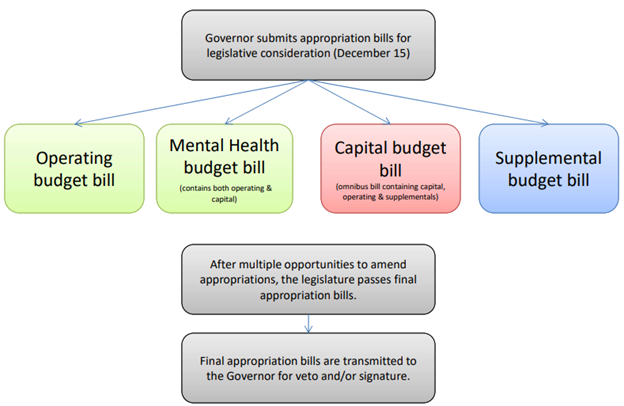
In previous newsletters, I've discussed the steps in the passage of a bill and mentioned a few of the finance subcommittees of which I am a member. In this newsletter I wanted to give a high-level overview of the budget process in the legislature. While the budget is still passed through "appropriation bills", the process is more intensive. At a very high level, the four bills that are used as the vehicles for the legislature to officially appropriate money are shown below. The text mostly focuses on the Operating Budget Bill since that is what we in the legislature are spending most of our time on to date.
|
|
The Legislature of the State of Alaska is given the power of appropriation by Article IX, Section 13 of the State Constitution. (A great guide to the Alaska Constitution is linked using the button below). |
|
This sounds good, but what does the "power of appropriation" mean? Appropriations are the building blocks of the budget. An appropriation is legal authorization to spend funds for a stated purpose. When talking about the state budget, an appropriation is funding directed towards the second level of a budget structure. This is the level at which the Legislature has the power to direct funds. The executive branch can move funding across allocations within the same appropriation. As an example, the Division of Motor Vehicles (DMV) is the second level of a budget (below the Department of Administration). This means that the Legislature can approve a level of funding to the DMV and then the executive branch can direct that funding within the DMV as it sees fit and within the rules dictating how DMV operates.
|
|
So now we know what an appropriation is, but how does the Legislature decide how much to appropriate to each division? Alaska uses an incremental budgeting system for the operating budget, meaning each year's budget is built based on changes to the previous year's budget. The Legislature is provided reports by the Office of Management and Budget (OMB) as well as Legislative Finance that break down, and provide explanations for, what changes were made to the budget since the last fiscal year. These changes are reviewed in-depth for each department's operating budget in finance subcommittees. The reviews cover amounts, funding sources, justifications, and more. |
|
Funding Sources
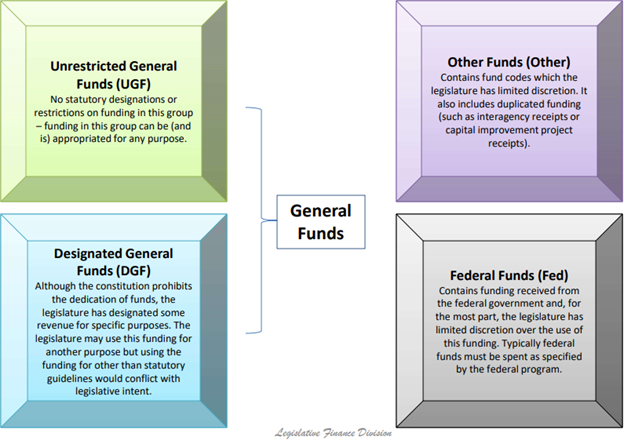
As a sidebar, there are four main groups of funding sources: UGF, DGF, Other, and Federal Funds. There is always an immense focus on UGF since this is often seen as "State Spending". While I don't 100% disagree with this, I also believe that the budget as a whole needs to be taken into account when making appropriating decisions. A fixation on UGF can be seen as 'only half of the picture'.
An example of this is the University of Alaska, who receives tuition and fees (DGF) and these pay for a portion of services. However, it is often publicized that state spending for the university system is less than some other departments (such as the Department of Corrections). When looking at UGF only, this is true although the two are close. However, when considering other fund sources, the budget for the university system is nearly twice that of the Department of Corrections. I just like to ensure that when framing decisions, all information is taken into account.
|
|
Subcommittee Closeout to the Floor Vote
After in-depth reviews of the operating budgets, each subcommittee will submit a report accepting, amending, rejecting, or adding budget changes to the main finance committee. The finance committee then takes all recommendations into account and implements either all, none, or some subcommittee recommendations for each department. After all these deliberations, discussions, and changes the Operating Budget will pass the finance committee and go to the floor of the House to be voted on. There are a few more steps in the process and this is slightly simplified, but hopefully, this can serve as an overview of the budgeting process and the role that the legislature plays. If any of this is confusing our office is always just a phone call away to answer any of your questions!
|
|
Boards, Commissions, and Task Forces |
|
Part of being a legislator is having the opportunity to serve on committees, boards, and taskforces. I have been appointed as a member to the Citizens’ Advisory Commission on Federal Management Areas in Alaska and the National Conference of State Legislators (NCSL) Standing Committee on Communications, Financial Services, and Interstate Commerce. I am also the State of Alaska's alternate for the Pacific NorthWest Economic Region (PNWER) Arctic Caucus. |
|
Citizens' Advisory Commission on Federal Management Areas in Alaska
The Citizens’ Advisory Commission on Federal Management Areas in Alaska is part of the Department of Natural Resources. They consider, research, and hold hearings on the consistency with federal law and congressional intent on management, operation, planning, development, and additions to federal management areas in the state. The commission reports annually to the Governor and the Legislature within the first 10 days of a regular legislative session.
|
|
NCSL - Communications, Financial Services, and Interstate Commerce Committee
The NCSL Standing Committee on Communications, Financial Services, and Interstate Commerce is composed of legislators and legislative staff and its purpose is to serve NCSL members in helping to shape policy, experiment with new laws and manage legislative institutions. While the committee explores issues that states have to deal with, they do not recommend policy to legislatures on issues that are internal to the states.
|
|
Pacific Northwest Economic Region - Arctic Caucus
The PNWER Arctic Caucus is a partnership between Alaska, the Yukon, and the Northwest Territories. It provides a forum to share information, discuss issues of mutual concern, identify areas for collaboration between the three jurisdictions and the rest of North America, and provide Arctic-relevant input to PNWER working groups and the region at-large.
|
|
HB 45: Workers' Comp and Contagious Diseases
Sponsor: Representative Andy Josephson
Committee: Labor and Commerce
Opinion: I do not support this bill and have serious concerns with program scope as there are too many unanswered questions. A future commissioner could add anyone they wanted to the list of covered individuals and this places the burden of (negative) proof on the employers.
Next Steps: Awaiting next hearing in the Labor and Commerce Committee
|
|
HB 55: Peace Officer/Firefighter Retirement Benefits
Sponsor: Representative Andy Josephson
Committee: State Affairs
Opinion: I have concerns with the creation of new benefits (public pensions) and feel that it would be a better option for a private-sector alternative of a deferred annuity be made an option in the retirement program.
Next Steps: Will hear this bill again on Saturday, 3/27, in State Affairs
|
|
HB 106: Missing Person Under 21
Sponsor: House Rules by Request of the Governor
Committee: State Affairs
Opinion: Likely to support this bill.
Next Steps: Held in committee and hearing again Thursday, 3/25.
|
|
HB 117: Extend Board of Direct-Entry Midwives
Sponsor: Representative Dan Ortiz
Committee: Labor and Commerce
Opinion: I support this bill which extends the Board for a minimum of two years as the board responds to Legislative Budget and Audit committee audit issues. When I asked if this two-year (short) extension caused a hardship, the chair of the board was not able to identify any areas that were a significant hindrance.
Next Steps: Held in committee. Will hear again Monday, 3/29.
|
|
HB 118: Expanding Prisoners' Access to Computers
Sponsor: Representative Jonathan Kreiss-Tomkins
Committee: State Affairs
Opinion: I have some concern with the control and security mechanisms which are not spelled out in this bill, and which are up to the rules and regulations of the Department of Corrections. I do think that carefully monitored and productive computer access could be helpful, but this will need to be implemented very carefully if it passes.
Next Steps: Held in committee. Awaiting next hearing.
|
|
HB 100: Extend Workforce Invest. Board Allocations
Sponsor: Representative Adam Wool
Committee: Labor and Commerce
Opinion: This extension leaves in place an allocation to apprenticeship and vocational training programs which I believe could be improved. Instead of carving up dollars as allocation percentages in a statute, I believe that we should be creating a virtual training clearinghouse in the Department of Labor where those seeking vocational training can find a matrix of opportunities that have been vetted and scored for performance/satisfaction, completion rates, cost efficiency, market need for skills, and other metrics that will create a stronger program.
Next Steps: Now under consideration of House Finance Committee.
|
|
HB 132: School Apprenticeship Progs; Tax Credits
Sponsor: Labor and Commerce Committee
Committee: Labor and Commerce
Opinion: As with HB 100, this bill creates some concerns in that it is the creation of a program that is funded by tax credits which hit the state's bottom line but do not show up as an "expense" in the current budgeting process. As a result, this can show up as a 'zero' fiscal note attached to the bill, but actually, there is a financial effect. There is also the issue of program efficiency, as mentioned in the opinion on HB 100.
Next Steps: Now under consideration of House Education Committee.
|
|
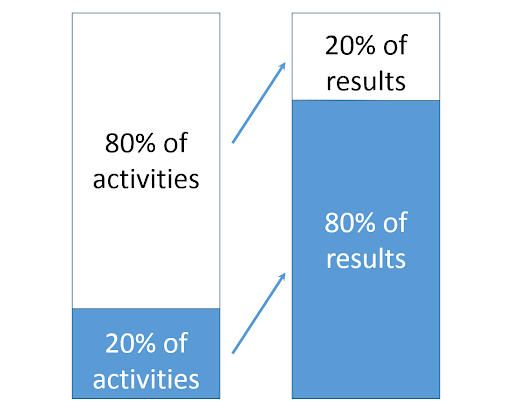
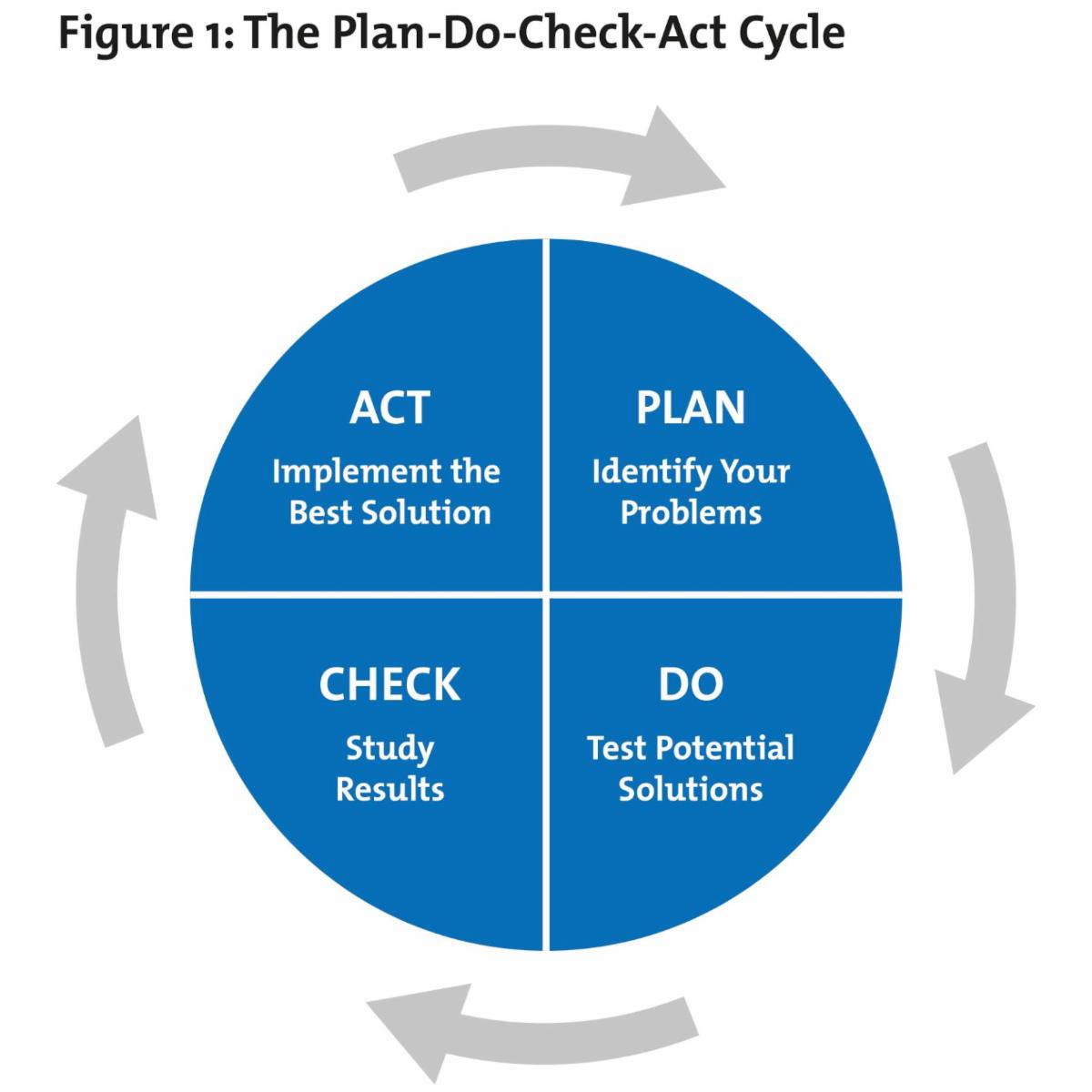
I want to share a tidbit from one of the thought leaders in quality management, W. Edwards Deming. From the 1930s to the early 1990s, Deming's career progressed as a statistician, physicist, educator, and business consultant. Early in his career after college, Deming became interested in ways that statistics could achieve better quality control (QC). Deming's QC methods were based on systematically tallying not just the number of product defects but also the identification and analysis of the root cause. Over time, enough data was collected so that a factory could gain a better understanding of what causes were resulting in the majority of defects. Once the major factors contributing to problems were identified and corrected, the factories would experience fewer defects. There are two important principles that helped Deming connect his analysis to business decision-making. One is the Pareto Principle, stating that 80% of consequences (problems) come from 20% of the causes (therefore effort could be focused on the major factors). The other is the Plan-Do-Check-Adapt (PDCA) Cycle, which is a framework for continually improving based on the above. |
|
|
|
Again, these are just two tools of many, but they are powerful tools which can be applied to problem-solving in many different areas. For example, is 80% of the spending in any one department only responsible for 20% of the value which they deliver? If so, how can continuous improvement methods such as the PDCA cycle help to fix that? |
|
Upcoming Community Council and other community meetings
Click below for links to council home pages:
- Hillside Community Council: Monday, April 15, 2021, at 7 pm via Zoom
- Girdwood Board of Supervisors: Monday, March 30, 2021, at 7 pm via Zoom.
- Huffman/O'Malley Community Council: Sunday, April 15, 2021, at 7 pm via Zoom.
- Turnagain Community Council: Thursday, April 1, 2021, at 7 pm via Zoom.
- Anchorage Home and Landowners Owners Association: Thursday, April 1, 2021, at 7 pm via Zoom
- Rabbit Creek Community Council: Thursday, April 8, 2021, at 7 pm via Zoom.
- Bear Valley Community Council: Wednesday, April 14, 2021, at 7 pm via Zoom.
- Turnagain Arm Community Council: Thursday, May 11, 2021, at 7 pm via Zoom.
- Alaska Chapter, Association of Mature American Citizens: Tuesday April 13, 2021, at 7 pm at Wellspring Ministries Campus
- AK Common Ground's Annual Meeting: Monday, April 5, 2021, at 6:30 pm via Zoom
- Glen Alps Community Council: Thursday, April 29, 2021 at 6 pm
|
|
Accelerate Arctic; is a gathering for entrepreneurs, investors, and change makers hosted at the Anchorage Museum in Alaska. Be at the forefront of the next northern economy. Click on the image above for more info!
|
|
Alaska Young Professionals Summit; is a two-day conference to develop Alaska’s workforce and prepare, motivate, and inspire attendees to be informed, productive leaders. Click on the image above for more info!
|
|
Staff to Rep. Kaufman:
Diane O'Loughlin
Please feel free to call our office, 907-465-4949, or email anytime.
If you are unable to reach our office and need local assistance, please contact the Anchorage LIO at 907-269-0111
|
|
Interim Contact:
Alaska State Legislature
1500 W. Benson Blvd.
Anchorage, AK 99503
907-269-0244
|
|
During Session:
Alaska State Legislature
Alaska State Capitol, Room 405
120 4th Street
Juneau, AK 99801
907-465-4949
|
|
|
|
|
|
|