Weekly update from the National Housing Conference | | News from Washington | By Erika Ramirez | | |
Brian Johnson nominated to lead CFPB
President Trump has nominated Brian Johnson to serve as Director of the Consumer Financial Protection Bureau (CFPB). Johnson previously served as Deputy Director under former CFPB Director Kathy Kraninger during Trump’s first administration, where he played a central role in shaping the Bureau’s priorities and enforcement approach.
Since leaving the CFPB in 2020, Johnson has held positions in the private sector, including at Patomak Global Partners, and most recently, as a senior executive at Capital One. If confirmed by the Senate, he would take over an agency that has seen limited operational activity in recent months under Acting Director Russell Vought, with efforts largely focused on rolling back prior initiatives.
The CFPB has long faced criticism from Republicans, who argue it holds too much centralized authority and lacks sufficient congressional oversight. Johnson himself has previously expressed concerns about the Bureau’s direction, particularly under the Biden administration, while also indicating that the agency can function effectively if restructured and properly managed.
Johnson’s nomination is expected to face scrutiny on Capitol Hill. Senate Banking Committee Ranking Member Elizabeth Warren (D-Mass.), a leading supporter of the CFPB, criticized the nomination and signaled continued concern about the agency’s direction under Trump’s leadership.
| | | |
We are grateful for the overwhelming support and look forward to celebrating with housing leaders from across the country.
If you would like to be added to the waitlist, click here.
| |
House committee examines local needs in disaster recovery
The House Financial Services Subcommittee on Housing and Insurance held a hearing titled “Examining Local Needs in Disaster Recovery,” focused on the federal government’s role in supporting long-term recovery efforts after natural disasters. Lawmakers examined the Community Development Block Grant-Disaster Recovery program (CDBG-DR), with discussion focusing on whether the current structure gives the U.S. Department of Housing and Urban Development (HUD) and local grantees the flexibility and speed needed to respond effectively.
Subcommittee Chairman Mike Flood (R-Neb.) raised concerns about the pace, complexity, and administration of the program, calling it “a nightmare for both its administrators at HUD and the local governments that need disaster funds.” He pointed to data from HUD’s Office of the Inspector General showing that only $64.7 billion of the $109.8 billion allocated through CDBG-DR has been spent since the program’s inception. Chairman Flood argued that the program’s reliance on a CDBG framework creates unnecessary hurdles for recovery efforts.
Witnesses offered mixed views on whether Congress should codify the program or replace it with something new. Joseph Jaroscak, Analyst in Economic Development Policy at the Congressional Research Service, described CDBG-DR as an ad hoc recovery tool that has drawn repeated calls for reform, while Patrick Cave, Senior Vice President of Policy at Enterprise Community Partners, emphasized resilience, housing preservation, and faster delivery of aid. Heather Lagrone, Senior Deputy Director at the Texas General Land Office, said the program needs more flexibility and less bureaucracy, and Stephanie McGarrah, Deputy Secretary of the North Carolina Department of Commerce, supported permanent authorization but urged faster funding, automatic data sharing, and streamlined reviews.
Members and witnesses also discussed whether disaster recovery assistance should continue to be administered through HUD or be reorganized under a different structure. Several witnesses said the current approach needs major changes, with some expressing support for a standalone disaster recovery program if it can better serve communities after major storms and other disasters.
| |
New episode released!
"Communicating Before, During, and
After a Natural Disaster"
On April 8, the National Housing Conference hosted its Solutions for Housing Communications convening at the National Press Club. The event brought together policymakers and affordable housing stakeholders to discuss tangible, impactful, and achievable actions to address the nation’s most critical housing policy challenges.
In this week's episode, we revisit the panel, “Communicating Before, During, and After a Natural Disaster,” featuring a discussion on how to communicate clearly and credibly before, during, and after a disaster. Panelists share practical messaging strategies, discuss common communication pitfalls, and offer guidance on reaching residents, policymakers, and the media at each stage of a disaster. Listen here.
| |
Director Pulte outlines new FHFA plans
Federal Housing Finance Agency (FHFA) Director Bill Pulte outlined new policy goals for the agency, including potential efforts to expand the role of the Federal Home Loan Banks, explore small pilot programs tied to construction loans, and help smaller builders compete more effectively.
Speaking at a homebuilders' conference, Director Pulte said FHFA is evaluating ways the Federal Home Loan Banks could play a larger role in supporting housing finance and indicated that additional announcements related to the system may be forthcoming.
Director Pulte also noted that Fannie Mae and Freddie Mac may explore “very, very small” pilot programs to support home construction, while making clear he does not expect them to take on a significant role in construction lending. He also said he is working with Commerce Secretary Howard Lutnick to help small- and midsize homebuilders compete with larger companies.
Addressing his dual roles, Pulte said his intelligence appointment is “just temporary” and added, “I love housing.” His remarks come as President Donald Trump nominated Jay Clayton to serve as the next Director of National Intelligence.
| | | |
HUD proposes changes to manufactured home rules
The U.S. Department of Housing and Urban Development (HUD) has proposed a rule that would eliminate the requirement that upper floors of manufactured homes be transported and constructed on a permanent chassis. The transportable sections of the ground floor, however, would still need to be built on a permanent chassis.
“The permanent chassis requirement on the upper floors of a multistory manufactured home provides no practical benefit to homeowners or manufacturers, increases production and installation costs, and stifles innovation that can create more widely available, affordable homes for the American people,” the proposed rule states. HUD estimated that eliminating the chassis requirement more broadly could save consumers roughly $4,800 to $6,700 per unit.
The proposal is part of a wider federal effort to reduce regulatory barriers to homebuilding and expand the supply of lower-cost housing. HUD pointed to a January 2025 presidential memo and a March 2026 executive order, both of which emphasize cutting costs and removing obstacles to construction. The move follows broader discussions in Congress and the White House about easing manufactured housing rules to help address the nation’s ongoing housing affordability challenges.
| |  | |
HUD announces $193 million for youth homelessness programs
The U.S. Department of Housing and Urban Development (HUD) announced the availability of $193 million in funding to communities nationwide to help prevent and address youth homelessness. The funding will support projects that strengthen local youth homelessness response systems and create transitional housing and supportive programs designed to help young people move toward stability and self-sufficiency.
HUD Secretary Scott Turner discussed the agency's broader agenda on homelessness, stating “For too long, homelessness has been treated as permanent rather than solvable. No one should be left on the streets.” HUD said it aims to partner with communities to provide stability, resources, and healing for young people in need.
The funding opportunity combined two existing youth homelessness initiatives into one notice, which HUD described as a more comprehensive strategy to reduce youth homelessness. Eligible applicants include state and local governments, federally recognized Native American tribal governments and tribal organizations, and nonprofit organizations. HUD also encourages faith-based organizations to apply. Applications are due Aug. 10, 2026.
| | | |
Heirs’ property remains an emerging issue in Latino communities
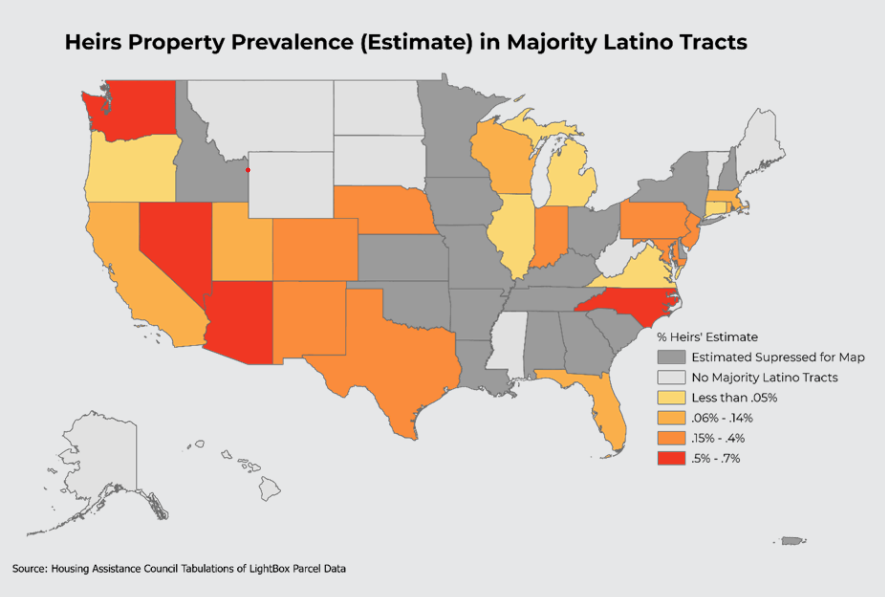
The Housing Assistance Council and UnidosUS published a report titled, “Heirs’ Property in Latino Communities.” Using tax-assessment data, the report estimates properties likely to be heirs’ property, as well as those at risk, across 9,472 census tracts where at least 51 percent of residents identified as Hispanic or Latino. The report finds that potential heirs’ property is unevenly distributed, with higher concentrations visible in parts of the Southwest, California, Florida, and selected areas in the South and Midwest, suggesting the issue is not confined to one region but instead follows areas where Latino households may be more exposed to informal inheritance practices and unresolved title issues. The analysis also shows that many tract-level estimates are unavailable or suppressed, highlighting the difficulty of measuring the problem at the parcel level. The findings suggest that heirs’ property may be a more significant issue in Latino communities than previously understood, with potential implications for homeownership preservation, wealth building, and access to housing finance.
| | |
The National Association of REALTORS® reports the U.S. Supreme Court has granted a petition challenging federal energy-efficiency rules for gas appliances. The filing gives the case new momentum after the Court vacated the lower court’s ruling that upheld the regulations and remanded the case for further review. The challenge centers on broader questions about the role of federal efficiency standards and their potential effects on shaping appliance choices and housing costs. The outcome of the case, along with the Department of Energy’s ongoing review of the standards, could influence future federal energy-efficiency regulations affecting the housing sector.
According to HousingWire, mortgage rates have remained elevated as strong employment data and persistent inflation continue to pressure the market. The 30-year conforming average stands at 6.78%, reflecting limited hopes for near-term borrowing relief as markets continue to monitor economic data and future Federal Reserve decisions. As a result, borrowing costs remain high, creating ongoing affordability challenges for homebuyers.
A New York Times story reports that a growing number of Gen Z and young millennial politicians are making housing affordability the center of their campaigns. The piece shows how candidates in places like Rhode Island, Massachusetts, Colorado, Montana, and Connecticut are tying soaring rents, zoning rules, and the lack of starter homes to a broader generational frustration about being priced out of the communities where they live. The story suggests that, for this cohort, housing is not just a policy issue but a defining part of how they see economic opportunity, community, and their place in politics.
| | The National Housing Conference is a diverse continuum of affordable housing stakeholders that convene and collaborate through dialogue, advocacy, research, and education, to develop equitable solutions that serve our common interest. | | Defending Our American Home since 1931 | | Copyright © 2024. All Rights Reserved. | | | | |