|
The Art of Living Together
Emily Witherspoon
“It takes a community,” most have heard that saying, a saying that opens into questions: How is community created? What does it mean to be a “good neighbor” And for some, “How does one go from living outside to living in?”
Going to Haywood Street Congregation for the first time in 2020 I knew I was experiencing something I was longing for. A place where I didn’t need to hide the chaos taking hold of my life at the time. Instead Haywood Street welcomed me just as I was. Haywood Street Church and the grounds that surround it became a respite, a safe space that I could sit long enough to dream while living outside. I longed for a home that I would not only feel safe inside but able to be part of a community in a neighborhood. I would often sit outside the garden gazing west over the mountains, thinking, dreaming, planning, praying for a home of my own. The dream came true in April 2026 when I moved into Lady Gloria Ridge.
Lady Gloria Ridge is the first affordable housing project from Haywood Street Community Development, who are striving to make low-income housing in Asheville housing people want to come home to. In many ways, my apartment at LGR is a dream come true.
At LGRC, there are 41 units, a mix of 1,2,3 bedrooms, for both families and individuals.
Thirty-six units are for those with “housing choice” voucher, a program in which participants pay about 30% of their income for rent and the housing authority covers the rest. Six units are income/rent restricted, and one of these is mine. Many residents have known at least one other resident for a long time. Some have old friends/neighbors from various housing authority placements. Some coming from shelters, hotels, the street, living with family, starting over. The apartment complex offers a shared community room, art programming, a garden, regular neighborhood potlucks, harm reduction meetings, and opportunities to serve on committees, allowing residents to participate in decision making.
For many of us at Lady Gloria uneven instability and becoming dependent on systemic boundaries began with no heads up. Fear, uncertainty, excitement, anticipation of the world exploding, or imploding, with nowhere to rest, get relief. Much like re-entry, going from the street or insecure, unstable housing to a home, is not an easy transition. It’s a whole lifestyle change to being able to walk in to a space and close the door, make something for dinner from your refrigerator and stove, sleep in quiet and private. The rates of suicide, suicidal ideation, and overdose among those who go from homeless to housed are high. Solving homelessness is about so much more than being able to close a door. It takes community.
At LGR, there’s a handbook all about community, which can also be stressful, but is designed to provide support and create a place of good neighbors. Perhaps community is walking out to leave, stopping at a picnic table, talking, laughing, hearing, listening, staying a little longer than planned or walking to the car and waving knowing friends will be there when you return. Neighbor allows a neighbor to live their life and create their home, while driving towards wellness, then it’s easy to allow our neighbors to live their lives. A good neighbor is there if needed yet allows their neighbors to be. Community is built on trust and understanding that neighbors may not agree on various things, but overall, wants neighbors to succeed. Community is created by getting to know your neighbor, by sharing resources, by checking in with each other and being there in times of need and struggle.
I circle my apartment gracefully, clumsily, setting altars for my friends, myself, community, love lost again and again, and found now, create the safety I would write about again and again while living outside. Create a place where self abuse finally ends. Here, at home, I’m finding, cultivating, believing that I finally found my heart.
And I’m not the only one.
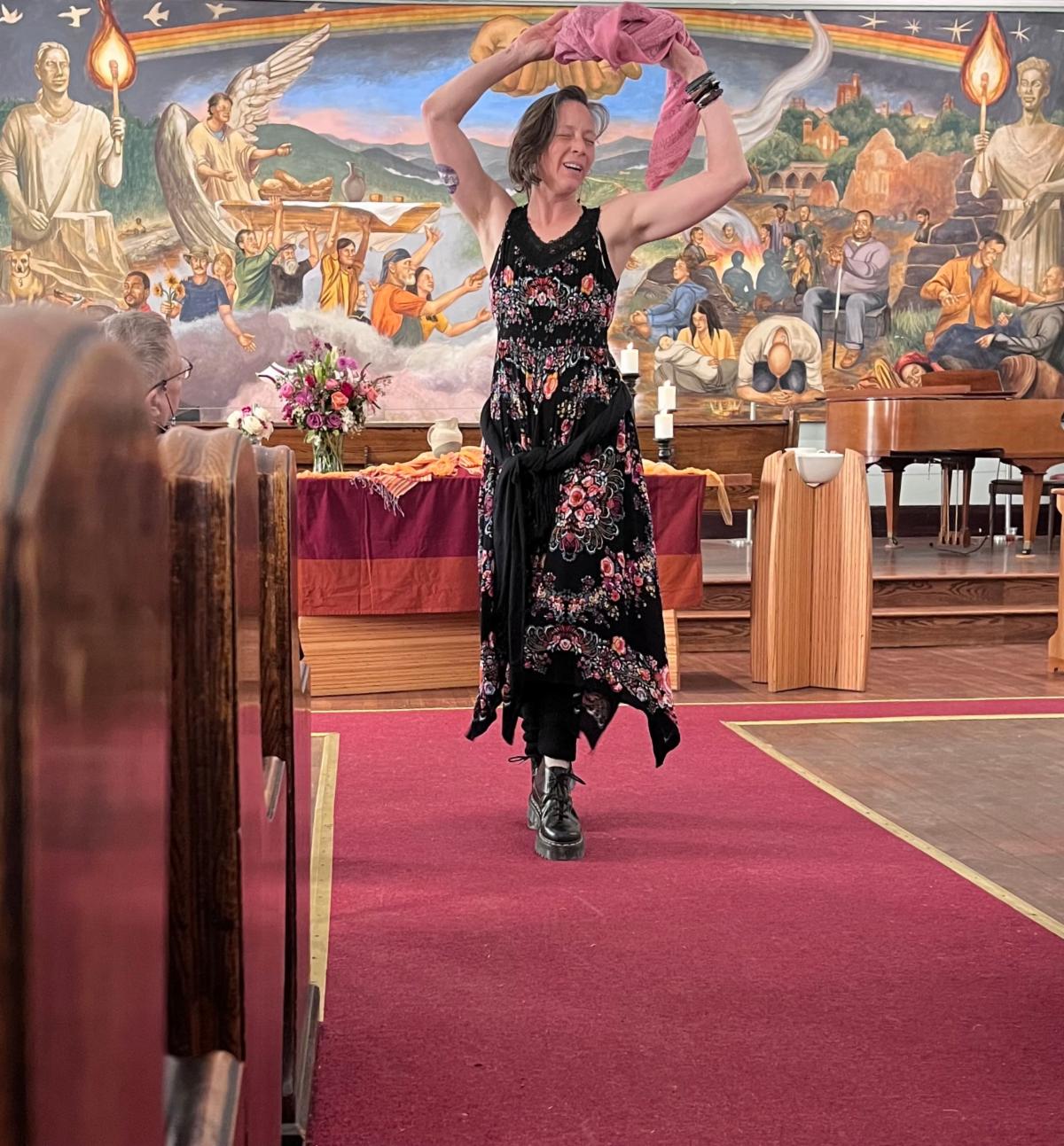
Image shown: Emily dancing during Haywood Street worship.
This article originally appeared in The Intersection, a print newspaper published and supported by Asheville Poverty Initiative.
|