Loudspeakers have always been the weak link in audio. While we speaker guys do our best to achieve high-fidelity reproduction, speaker audio quality often falls short due to the many physical constraints in design, size, and other transducer topology trade-offs. The speaker motor and the suspension are prone to nonlinearities not just from design constraints and build consistency, but also time varying. If we have real-time position monitoring of the diaphragm, and the motion profile is known, these limitation and compromises can be minimized through error feedback correction.
|
|
|
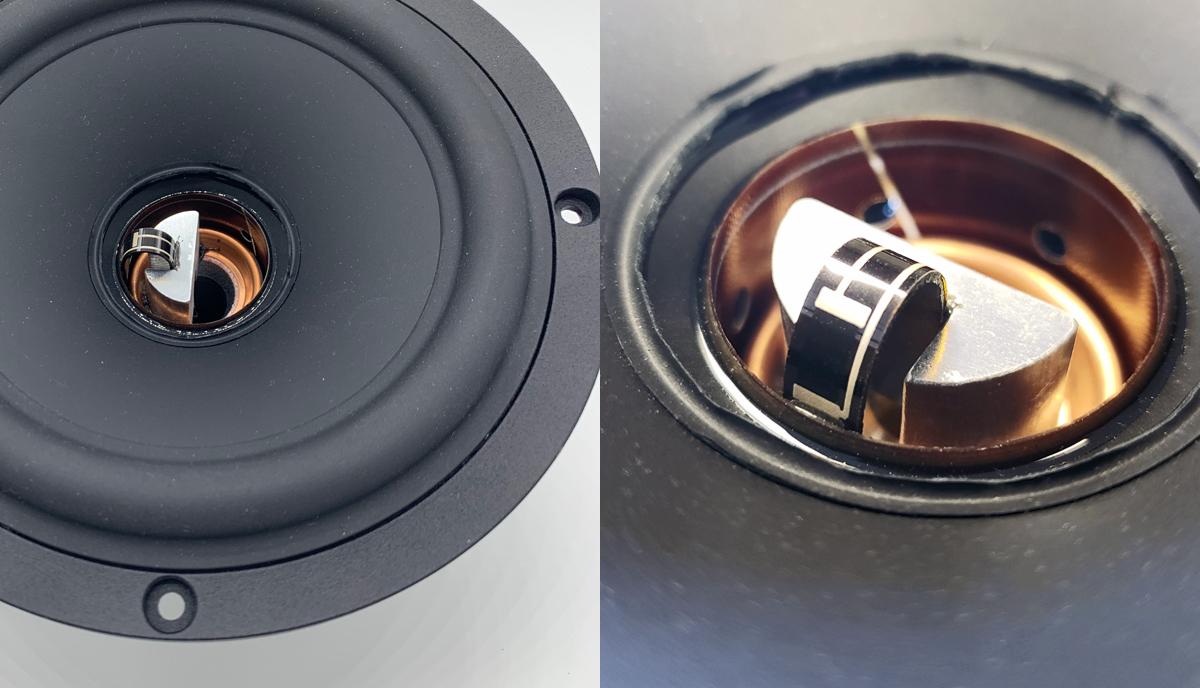
SubVo has developed a unique screen-printed sensor that changes in resistance when bent, enabling precision tracking of the diaphragm position (shown here mounted in the voice coil). It is durable, offers a long stable life, and is inexpensive and producible in mass quantities.
|
In my article last week, I briefly revisited many of the feedback correction schemes that have been developed over the last 50-plus years. From those experiences, we learned that two requirements must be in place before commercially viable servo-correction can reach commercialization in mainstream audio.
First, audio systems must integrate the amplifier and speaker into the same enclosure as feedback loops don't like long or varying wire runs. We have all seen the evolution and dominance of one box audio solutions. Subwoofers, soundbars, Bluetooth, and smart speakers all are self-contained. And even in pro-sound we have powered studio monitors and active sound reinforcement speakers.
Second, we need a low-cost, precise, and stable sensor that will not degrade or interfere with the physical operation of the speaker.
This requirement for a low-cost, precision sensor is just now reaching the audio industry with the launch of the patented bend-sensor - a unique screen-printed sensor that changes in resistance when bent. Recently adapted and optimized for speakers, founders Joe Harris and John Kelley first introduced the subVo technology at the 2020 CES, last January.
Let's start with the physical characteristics of the bend sensor.
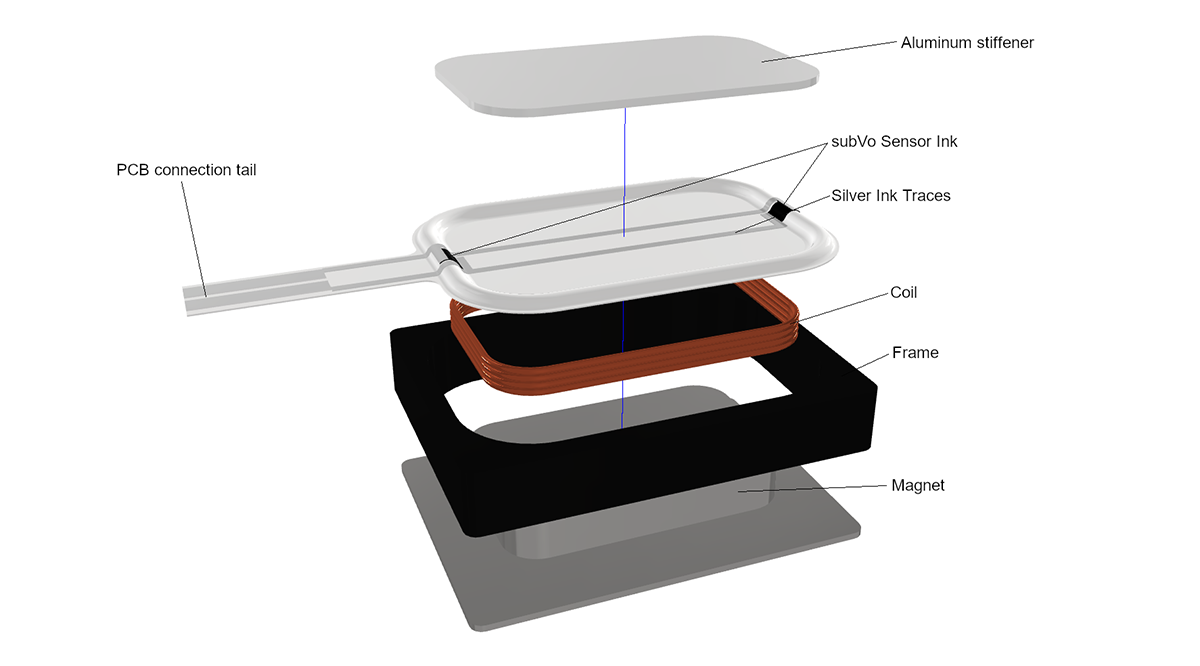
The sensor consists of a proprietary conductive coating that has "flex-points," which precisely change in electrical conductivity with the degree of bend angle. The single-layer thin-film substrate is typically polyimide (DuPont Kapton). It is very durable, resistive in nature, and free of reactive components, such as capacitance or inductance. Nor does it have the high Q resonances in the audio band inherent to alternative sensors. The bend-sensor also has a long life and is inexpensive to produce in mass quantities. For microspeakers, an application-specific bend-sensor can be integrated into the assembly with the conductive "tracks" directly deposited onto the diaphragm/surround.
The mounting position for the bend-sensor can be to the bobbin or the cone, with the other end fixed to a non-moving (stationary component), such as the frame or the magnetic structure. The surround may be used on some speaker designs, although edge resonances in the surround are a consideration.
|
|
|
klaraT, the sensor's proprietary feedback control loop algorithms completes the solution. The software can be ported to many audio subsystems, such as smart codecs and smart amps with integrated DSPs.
|
The Bend-Sensor and klaraT Processing
The sensor sends an output feedback voltage signal to the amplifier/DSP, directly proportional to the diaphragm position. Specifically, the resistance of the sensor is converted to voltage using a voltage divider, whose output is linear with displacement (tracking). The tracking precision of the movements is comparable to laser displacement instrumentation, with greater stability of external conditions (heat, time, magnetic fields, moisture, dirt, etc.). Over-laminates or over-molding may also be applied to the sensors for added environmental protection (e.g., in outdoor and marine applications).
SubVo
'
s klaraT is the speaker compensation algorithm that controls the feedback loop, enabling each speaker to self-calibrate. All speakers have slightly different specification characteristics as they roll off the production line and with self-calibration this disparity is eliminated, enabling higher production yield.
Beyond enabling more consistent quality without sorting and binning critical components, servo-correction tracks the cone's exact position at any given moment, enabling lower distortion and extending bass - all in smaller enclosures. Speakers can be driven to their limits without damage and with low distortion. Both short- and long-term performance is maintained with compensation for degradation of the loudspeaker (e.g., surround/spider wear and tear and magnet sensitivity loses) over time, temperature, humidity, and power compression.
Aside from these more obvious benefits, we can touch upon some interesting implications of feedback correction for specific product categories (e.g., soundbars and smart speakers).
|
|
|
With the combination of the bend-sensor and
and klaraT software with speaker protection algorithms, microspeakers can operate at their limits without introducing distortion or damage.
|
The subwoofer added to a soundbar represents half the cost - as there typically is a separate power supply, wireless link, bass amplifier, and speaker box - and the sub adds significant shipping costs. With sensing on perhaps just one speaker to cover all channels - and as the bass is already mono on soundbars - then an entry-level soundbar can achieve a meaningful improvement over TV sound.
As with soundbars, feedback sensing in conferencing and voice-enabled speaker systems will be game changing, well beyond extending the bass response. Two aspects are not obvious but significant - better Acoustic Echo Cancellation (AEC) and Barge-in.
For full-duplex operation, where second talkers can contribute without having to force their way into the call, there are various signal processing algorithms. But complicating life, these algorithms are surprisingly sensitive to speaker distortion. DSP guys look for distortion levels in even modest applications (e.g., speakerphones), and aiming for unrealistic distortion performance levels not easily found in real world speakers. With sensor feedback helping with distortion cancellation, AEC algorithms can do a better job, with more margin.
"
Barge-In" is a term that originated with half-duplex telephony where participants struggle to interrupt and engage with the incumbent talker. These days, "barge-in" additionally refers to the ability to summon (or trigger) a voice assistant in smart speakers or voice-enabled products, prompt the ability to respond quickly and accurately to voice commands while ignoring its own audio. That is easier said than done as the loudspeaker is closer to the mic than the person giving the voice commands. Existing barge-in algorithms use DSP to subtract or cancel out the music so only the voice is captured. This method works only if the music captured by the microphone perfectly matches the music delivered to the loudspeaker. In reality, the loudspeaker is off from the input signal. And because of this, the cancellation of the music is marginal. With the subVo sensor signal and klaraT processing in the feedback loop and the subtraction signal, we can more completely null the loudspeaker's output from the mic's pickup of the voice command.
|
|
|
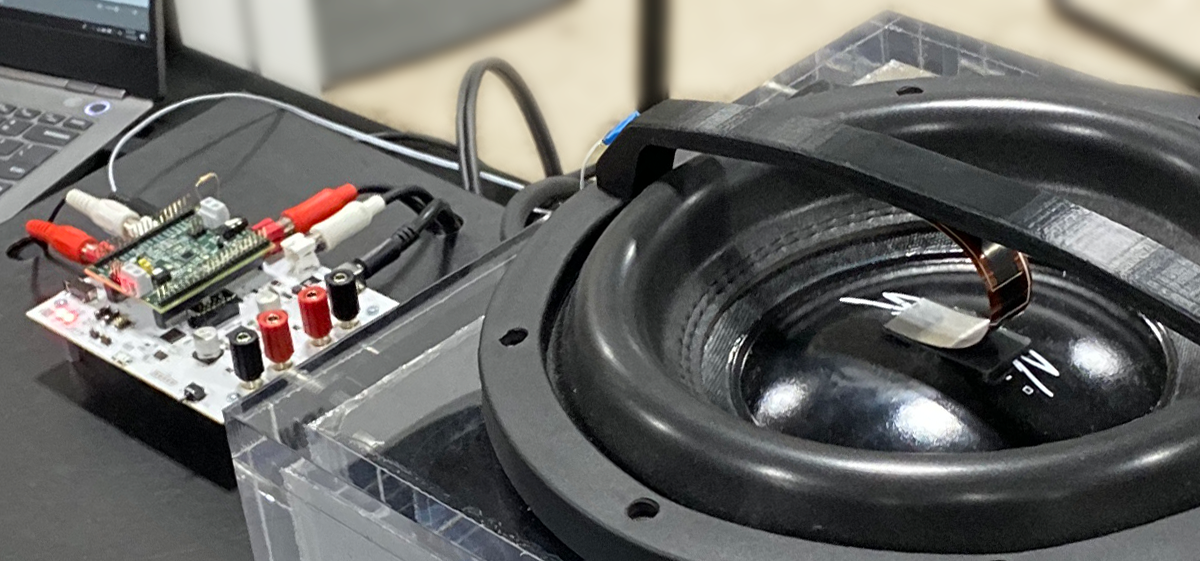
SubVo's evaluation kit was demonstrated at CES 2020 with speakers of different sizes and types.
|
SubVo's evaluation kit is a full reference design, which consists of a loudspeaker with the sensor integrated in a sealed box along with an evaluation board that runs the Klara-T algorithms and speaker protection. The kit can adapt to any size speaker as long as it has a subVo sensor attached. SubVo has a licensing program, which packages the sensor, technical support, and the klaraT algorithm intellectual property.