With most of the trade shows around the world effectively cancelled and converted into web conferencing meetings, China is pretending that it has controlled the virus and is again promoting trade shows like nothing happened - even if only local companies and visitors from China attended, defeating much of the purpose. Meanwhile, the audio industry is learning to deal with a new extended calendar, where products can effectively be announced and launched anytime. A trend that I signaled in
my editorial just two weeks ago.
This week, Europe is waking up to a dramatic reality of seeing new coronavirus cases and fatalities rising again, as a direct result of allowing people to travel for the Summer holidays and some countries pushing the tourism economy. While in Berlin, Germany, IFA 2020 is claiming to be holding "the first major global fair for consumer and home electronics that will physically take place since the pandemic." Well, not exactly, because American and Asian companies have not been able to travel to Berlin, in the same way as American and European visitors were not allowed to attend the recent trade shows in China. This, of course, converted the large annual consumer and home electronics show into a series of questionable hybrid press conferences and promotional meetings that certainly don't justify the risk of causing more people contracting the virus.
Nevertheless, this push to promote a trade show again, lead some major consumer electronics and appliances companies and brands to converge their announcements in the week from September 1-5, with showcases streamed to the world live from the Berlin exhibition grounds. This serves no practical purpose, and is exactly what the world doesn't need right now. Opposite to what IFA director Jens Heithecker states, the industry doesn't need this type of platform in order to present its innovations. Yes, virtual events lack the networking and emotional connections for the trade, but for consumers who have adjusted to digital behaviors during the pandemic, it makes no difference at all.
Maybe next year, if we get the vaccine, and the pandemic is under control, we can get back to that model in some way, but for now, companies are better by refocusing their marketing efforts digitally and reinforcing their messages working with media that reaches their markets. As for trade show promoters, they should focus on promoting "safe" online networking B2B opportunities exclusively. Yes, this year's IFA "non-virtual live events" promotes mainly B2B core functions. But the limited number of people who are able to attend defeat the purpose. So, better to move to totally digital platforms for now.
|
|
|
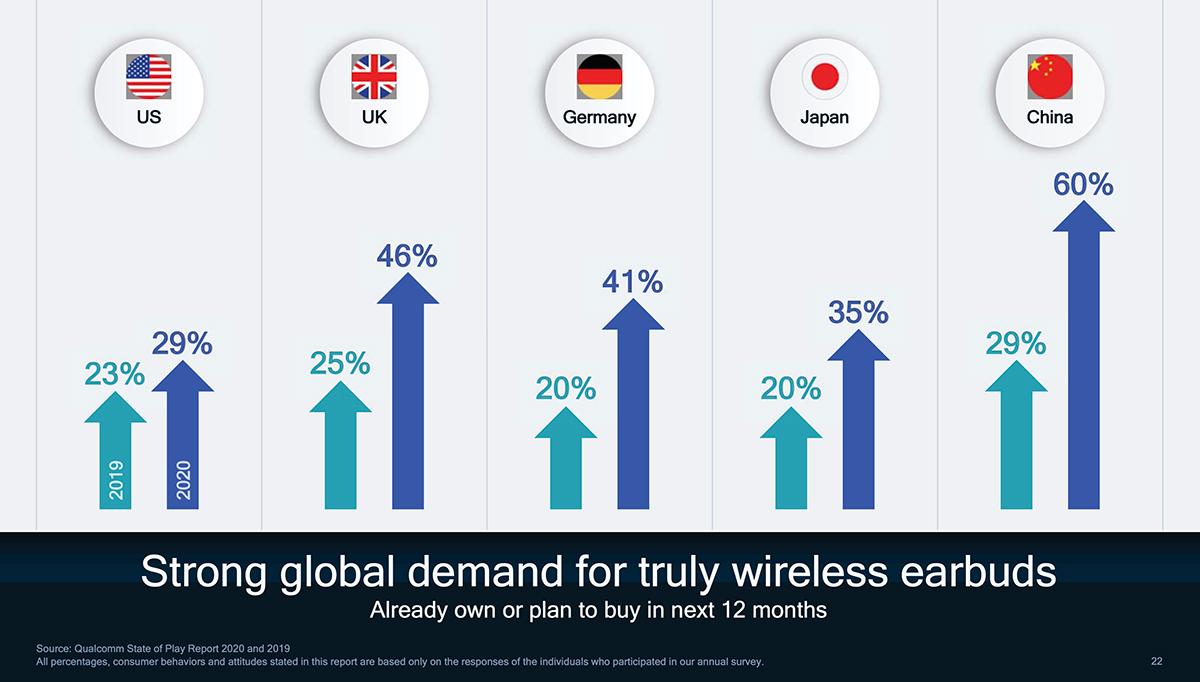
The Qualcomm 2020 "State of Play" is an excellent annual survey into consumers preferences of the latest wireless audio technologies.
|
Significant Technology
Anyway, as result of this effort, since September 1 there were a number of significant announcements that are relevant to the audio industry. And one of those events was promoted by Qualcomm, which used the opportunity to make important announcements on the technology front. Since there was no Mobile World Congress (MWC) this year (or any other important event), Qualcomm used the broadcast facilities of IFA to announce the company's latest 5G solutions, new Snapdragon 4-Series mobile platform solutions, and more Snapdragon processors to power the new generation of tablets and laptops, now evolving from smartphones to a whole new generation of Android-based devices. (It's a bit sad to see Microsoft being squashed and Windows made irrelevant, even if they behave as though adopting Android would be the best thing in the world for them.)
More important for
audioXpress readers, Qualcomm announced a new generation of system-on-chip (SoC) platforms for developers to implement even better active noise canceling true wireless designs. Called Qualcomm Adaptive Active Noise Canceling or Adaptive ANC, the new technology available in Qualcomm's latest premium tier
Bluetooth Audio SoC, QCC514x was designed to improve the user's experience with ANC TWS earbuds, provide a more consistent sound quality by adapting its performance to meet variations in how an earbud fits in a user's ear, and adapt in real-time to changes in fit as the earbuds are in use.
This, no doubt, is a very important evolution. Much in the same way as Qualcomm's latest Bluetooth SoCs have enabled dozens of much improved true wireless ANC designs (with very little differentiating in the most affordable cases, unfortunately), Adaptive ANC will sort the very real problem of dealing with different earbud form factors - in-ear with tight seal, loose-fit with non-sealing channeling, and totally loose-fit - all causing major variations in the way ANC becomes effective.
|
|
|
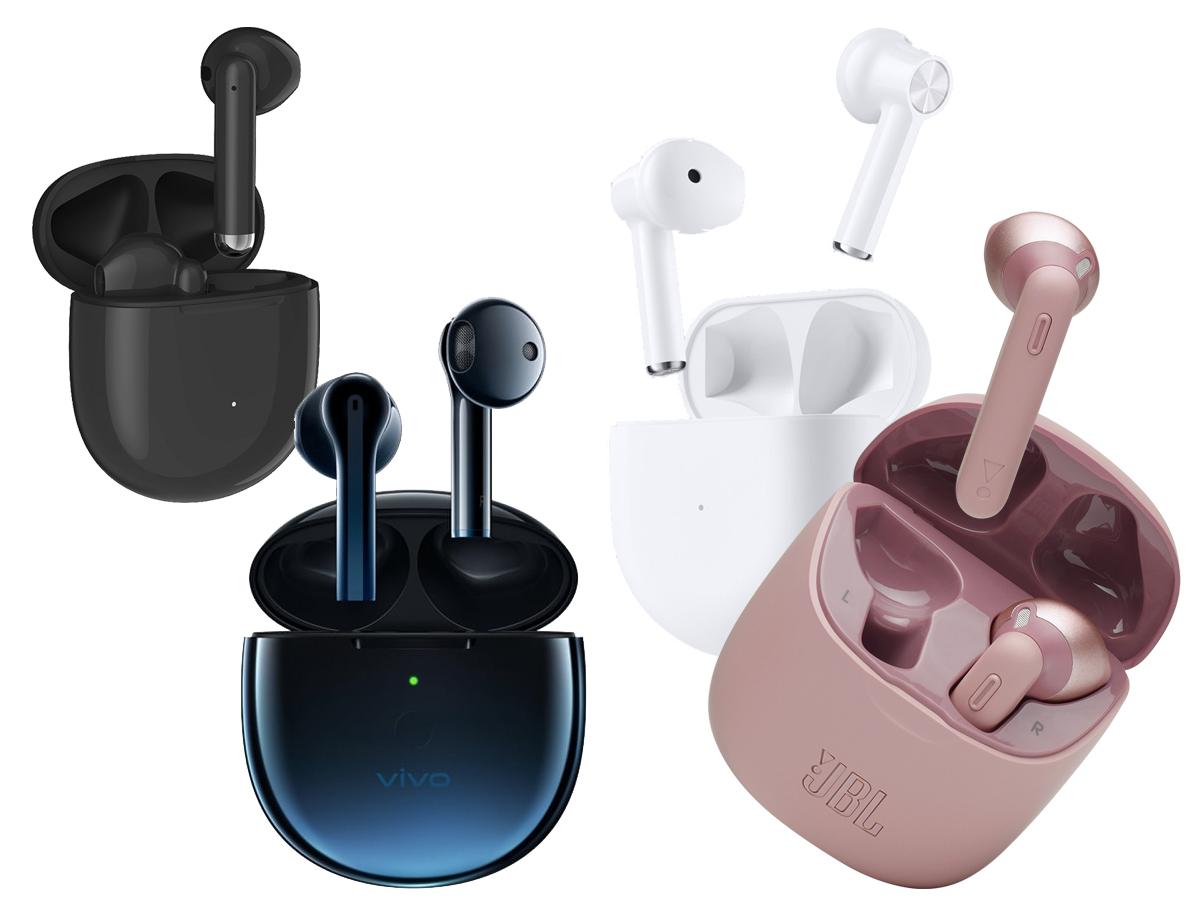
The image includes the latest JBL Tune 220TWS earbuds, side by side with the latest models from TCL, Vivo, and OnePlus. Discover the differences.
|
While Apple continues to have the leading TWS ANC product in terms of volume, value, and share with the AirPods Pro - establishing a golden reference for the whole industry - the truth is, implementing ANC on the previous loose-fit design of the original AirPods is not easy to do. Austrian company ams AG knows this too well (they are one of the leading vendors in the market) and they have been trying to improve ANC for loose-fit designs.
As the company's
own market research found out, around 45% of TWS users prefer "tight-fitting, in-ear earbuds because they are perceived to stay in place (67%) and feel more secure when exercising (51%). However, consumers noted tight-fitting earbuds are not comfortable for extended periods or they do not fit correctly (44% across all regions surveyed). Respondents also reported that tight-fitting earbuds can make them feel less aware of their surroundings (21%) and that they hear their own footfalls when wearing them - particularly during exercise (11%)." ams also notes that all those problems "are remedied with the loose-fit earbuds, which have ANC. In addition to being more comfortable than tight-fit earbuds (26%), the ability to hear what you want to hear with augmented hearing allows users to hear necessary surrounding noise and activity (20%)."
As in the previous years, Qualcomm also announced its own "State of Play" annual report, the fifth in a serious of consumer surveys into the ways consumers use their audio devices and what drives their purchases in the truly wireless age. According to this latest consumer audio research report, 43% of respondents either already own or plan on buying true wireless earbuds. And significantly, 71% of consumers surveyed said they're interested in active noise cancellation (ANC) as a feature for true wireless earbud purchases - and improved sound quality is the top reason they're seeking it.
Apparently, those consumers who have experienced it, are now aware that ANC can also make their experience more comfortable by minimizing the need to raise volume (to possibly unsafe levels) to drown out unwanted background noise, and enhance overall music enjoyment or productivity. As the report notes, as consumers are using their wireless devices throughout the day - at home, the office, or on the go - they are also learning that as ANC can help to filter unwanted background noise, it can also increase safety awareness by allowing key sound cues to pass-through. Interestingly, users discovered that ANC also enhances conversations in difficult environments, by filtering out all frequencies outside of the voice intelligibility range.
|
|
|
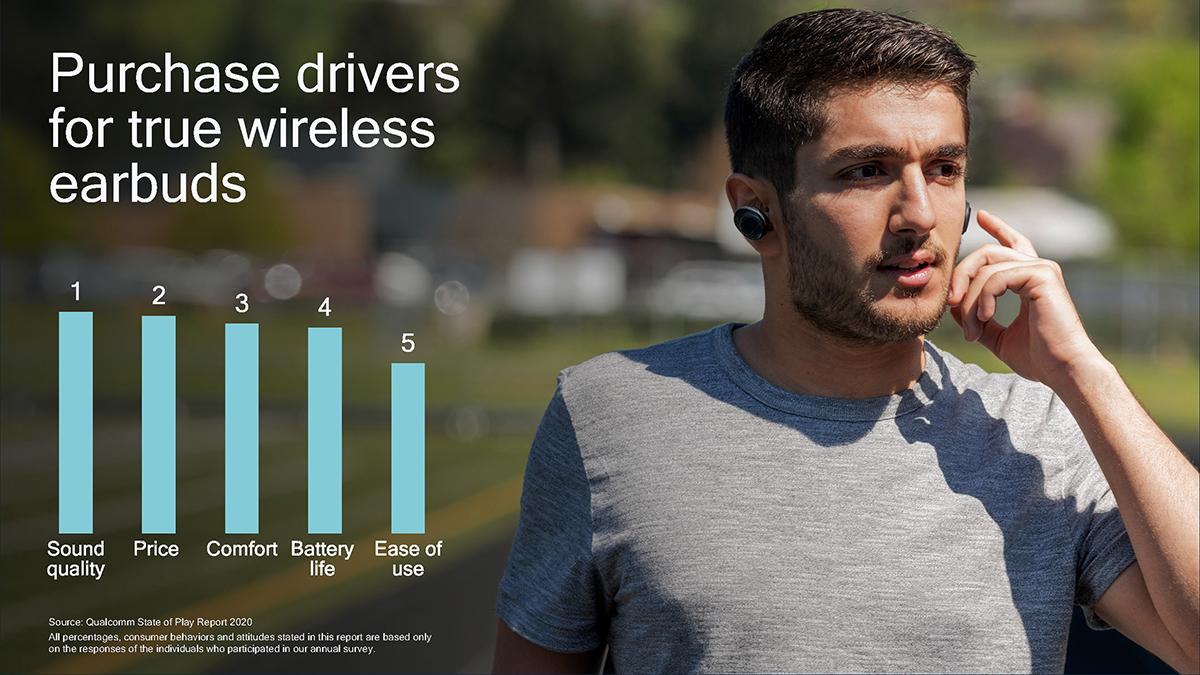
This Qualcomm 2020 "State of Play" graphic shows the main purchase drivers for true wireless earbuds.
|
And Qualcomm's new Adaptive ANC technology solves a very new problem, of ANC not working correctly when there is no tight seal, or the earbuds not being ideally placed. This could allow improved loose-fit designs like the original Apple AirPods, while still allowing ANC to be effective and solve a major consumer complaint that tight-fit, fully occluded designs cause discomfort when worn for long periods of time. The 2020 "State of Play Report" clearly indicates that 53% of consumers identified comfort as one of the top three purchase drivers for selecting true wireless earbuds.
With Adaptive ANC, users don't need to push or twist the earbuds into place, don't need to insert the earbuds in the same way every time, and the level of outside noise leak-through will not affect performance so much. And Adaptive ANC is designed to work well across all modes, and as users transition from one activity to another. For example, during a voice call, some leak-through is needed to allow the user to hear their own voice and Adaptive ANC will allow automatic leak-through of voice to support a natural call experience, while still actively reducing background noise.
This will mean that we can expect to see all manufacturers currently depending on Qualcomm's low power SoCs for effective true wireless designs with ANC, to finally experiment with new designs and not simply insisting on familiar well-tested form factors - many of which have already been rejected by large numbers of consumers, and are still present in many announcements from IFA 2020. Qualcomm's Adaptive ANC technology will at least offer greater flexibility and freedom to designers and manufacturers.
|
|
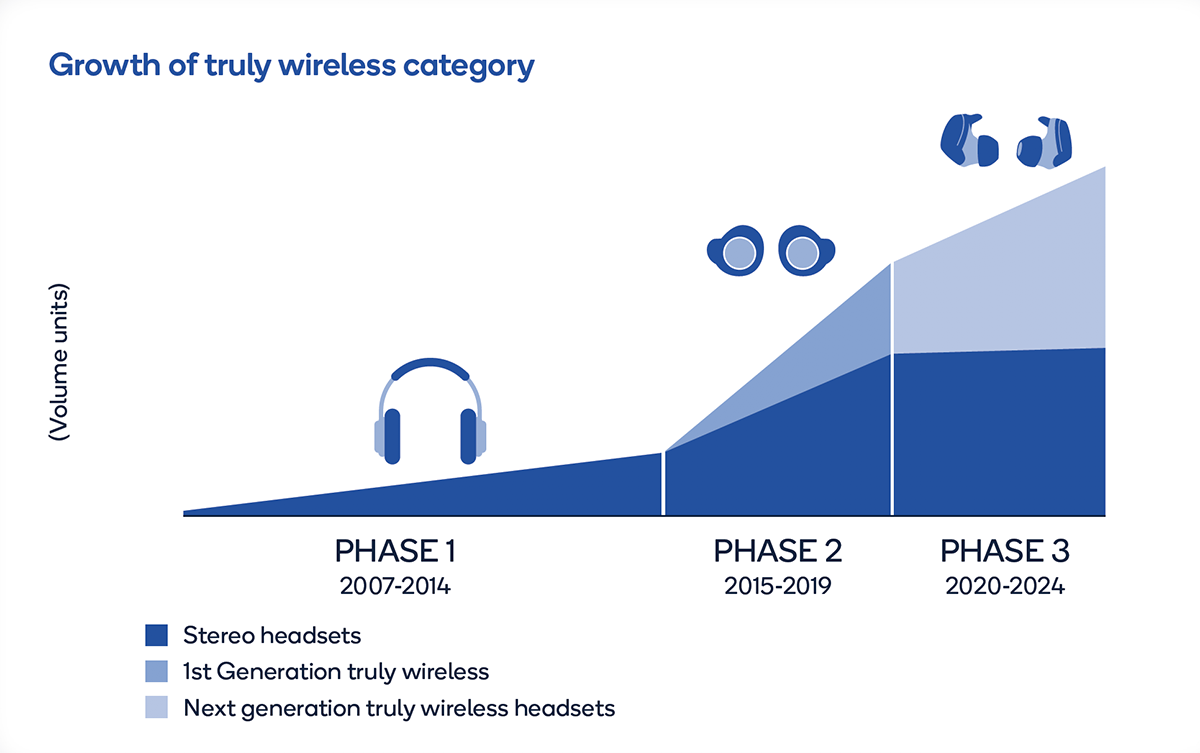
Growth of the truly wireless category. According to the Qualcomm 2020 "State of Play" survey, next-generation truly wireless headsets need to support a growing range of features and applications and continue to deliver customer satisfaction with seamless wireless connections.
|
What We Want
As Steve Jobs famously stated, "People don't know what they want until you show it to them." I would add in the very specific case of true wireless earbuds with ANC that, "People only know what they want when they need it." The product category is so new, that the large majority of consumers still haven't experienced different options. Even developers and product designers are still struggling to establish the basics in completely new form factors and what problems they need to solve. Praise justified to the efforts of pioneers like
Bragi and Nikolaj Hviid, who understood the challenges earlier on and are
still around to tell the story.
I really think that all the technical, design, and marketing discussions we are having regarding the booming category of true wireless audio and TWS specifically is still being veiled by the whole discussion of "what will consumers do with this?" Or "how will consumers react if..." And that, like designing solutions looking for a problem, is never the best way.
I believe that we will "know what we want" when we truly have access to actively smart true wireless earbuds that adapt to the moment and the activities. I do believe that like sophisticated active audio processing is truly essential now (ANC in reality is just an obvious first step into intelligent environmental hearing enhancement and awareness), so is the ability to combine biometric and health sensors, or having sophisticated edge processing, able to run complex AI algorithms and inference on devices. That will enable the differences between "hearables" and the current true wireless earbuds category to blur away and disappear, finding ways to truly enhance our hearing abilities in ways that consumers will want - and need.
Yes with that evolution - which I predict should take no more than 3 to 5 years - there will be health benefits for consumers with partial hearing problems, opening up a whole new category of over-the-counter opportunities for the hearing-aid industry. But just as important will be the convergence of those hearing enhancing technologies in the true wireless hearables consumer electronics category, expanding it even more toward active hearing enhancement.
That, and the fact that voice assistants will be an essential part of that convergence. Instead of being in the way, as happens in its current implementations, Voice will help to solve many current user interface dilemmas, and will gradually evolve to become a part of the personal device architecture. Currently, everyone is focusing on developing virtual assistants that are able to respond to our most sophisticated questions, which demand access to a vast repository of knowledge. But I don't think that asking "What was the first toy to be advertised on television?*" is a priority in a true wireless device - and that can be done with a two-second delay with a query to an online search engine anyway. The key for hearables will be in having our new earbuds talking to us, and telling us "Your mother-in-law seems to be home. I'll activate the high-pass filter now" or "Your heart rate seems to be increasing, want to hear the 'Totally Stress Free' playlist?"