|
All elections generate a ton of data–in fact, it’s probably one of the better documented activities we engage in. If you take the time to peek at what’s available, you’ll discover a bunch of election information that will help you and other members of the public conduct research and put our elections into historical context. For government officials and other elections stakeholders, election data provides the basis for political maps, resource allocation, decision thresholds, and evaluations, as well as being the historical record of elections.
Federal
When the Help America Vote Act (HAVA) was passed into law in 2002, there were a number of election data requirements that came with it. The states, for example, were all required to establish and maintain a statewide voter registration database–in California, that database is named VoteCal. Each statewide database must capture and maintain registration information from all available sources, most notably the Department of Motor Vehicles and other voter registration agencies as mandated by the National Voter Registration Act of 1993. Not only does voter registration data help us understand who’s registered, it also helps us understand who is not registered. From a practical perspective, registration data allows political parties and others to engage with voters directly. From a research and advocacy perspective, analyzing registration data allows community organizers and other interested persons know how to better encourage registration and voting for historically underrepresented communities and others who have a low propensity for voting. It also helps us understand at the agency level which methods of registration best meet voter needs and where some locations could improve.
HAVA also established the US Election Assistance Commission (EAC). One of the EAC’s important functions is to serve as a clearinghouse of election administration. For 20 years now, the EAC has surveyed all jurisdictions on various aspects of elections, from registration to methods of administering voting and much more. The EAC’s dataset of all elections data from across a large period of time is essential for researchers, advocates, and others to get a bird’s eye view of how elections function in the United States and, importantly, the policies that are behind those data.
State
At the state level, there’s also a treasure trove of election data that are available to anyone at any time.
One of the most frequently gathered data available are voter registration data. For every regularly scheduled election, the counties must provide a Report of Registration (ROR) at various points in time through the elections process. Every ROR will give you a snapshot in time of the number of registered voters in a given place. You might not know that registration changes on a daily basis, and some of our administrative processes rely on knowing the total number of registered voters at a predetermined deadline. The ROR gives elections officials a better idea of the amount of resources needed to administer processes, like how many state voter information guides to mail out or how many voting locations to establish. RORs are also required at least once in odd numbered years, and also are helpful to counties that administer elections every year.
Regularly scheduled elections in California generate a Statement of the Vote (SOV) and Supplement to the Statement of the Vote (SSOV). In short, the SOV and SSOV present election results for federal and statewide contests, as well as contests for state assembly and state senate. These data are broken down in different ways so that the public can know how the results affect them locally and so elections officials can make resource allocation and other kinds of determinations for future elections (e.g., thresholds for statewide recall elections).
If you wanted to look back even further, the state also provides historical registration information dating back to 1910 for primary and general elections. There’s also an online archive of statewide election results dating back to 1990, special election results since 1989, county, city, and school district elections since 1995, and historical statewide ballot measure data gathered in partnership with UC Law San Francisco.
Local
Locally, our office has a lot of election data that’s available for viewing, and in some cases for copy and/or purchase.
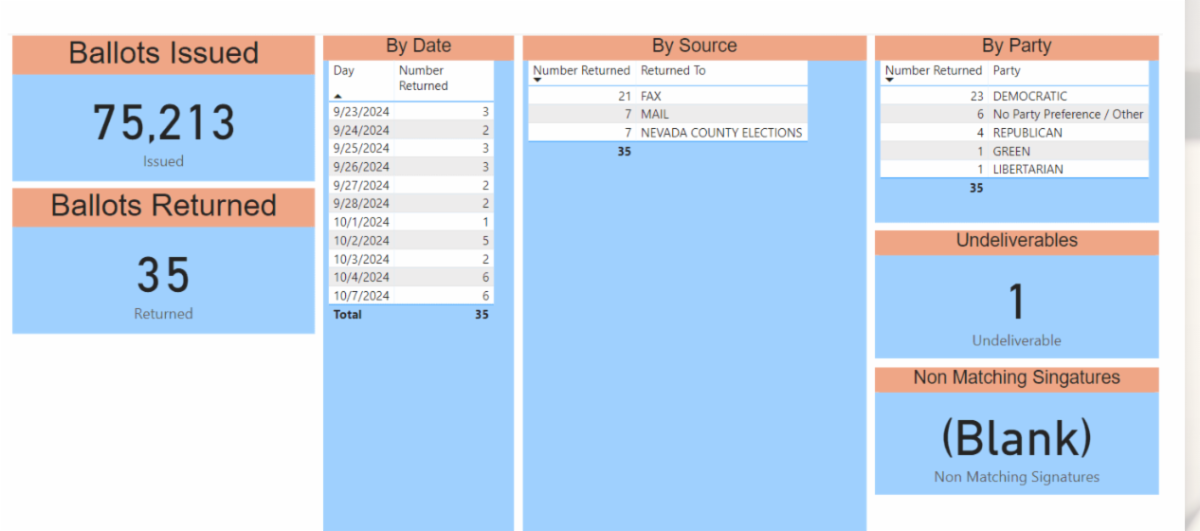
For this election, we’re proud to offer an elections dashboard that shows ballot return data. The dashboard offers a daily look into our vote by mail ballot returns. The dashboard shows how many ballots our office has issued and returns broken down by location, day, and political party. It will also offer aggregate information about undeliverable ballots and ballots that need to be cured due to a missing or mismatched signature. Our office believes that offering data in this way helps increase the transparency of our office and offers researchers and other members of the public a perspective on voter behavior.
Everyone is probably aware that we are required to report election returns, but might not know that we’ll have the data available visually as well as in reports. As we did in the last election, we are partnering with our Geographical Information System (GIS) team to provide candidates and the rest of the public with a map of results as well as printable documents showing unofficial and official results.
Voter registration data with voter history are available for a narrow set of purposes at a fee. The state legislature determined long ago that voter data is crucial for success in a political campaign, and so requesters may purchase voter rolls for that purpose. By law, these data may only be used for political, election, journalistic, scholarly, or governmental purposes and do not include certain personal identifying information. Requesters must complete an application and describe how they’ll use the rolls and how they’ll protect the data they receive. A voter roll may not be used for a prohibited purpose, such as a commercial use, or for the purpose of threatening, harassing, or intimidating anyone.
Finally, we offer Nevada County data for public use and viewing. We have visualized our resident data from the last Census, as well as a small but growing collection of year end reports that summarize election administration at the county level.
|