|
Every eligible United States citizen has the right to vote in local, state, and federal elections. Elections offices help ensure that voting is accessible to any registered voter, regardless of their personal, professional, or political background. As officials plan for an election, they must ensure that all voters have access to the information and materials they need to make informed choices–including voters who speak languages other than English, voters with disabilities, and military and overseas voters.
Language Accessibility
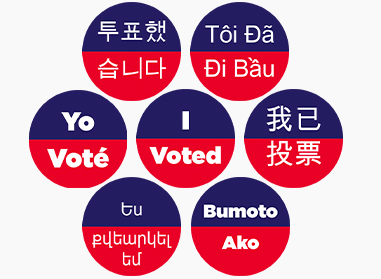
Naturalized citizens may experience barriers to accurate, reliable information about elections and voting in their preferred language. State and federal laws require elections officials to provide language access services to citizens whose primary language is not English, including translated ballots.
Section 203 of the Voting Rights Act requires covered states and jurisdictions to provide language assistance to voters. A covered locality has over 10,000 or over 5 percent of the total voting age citizens in a political subdivision who are members of a language minority group (e.g., Spanish, Chinese, etc.), have low literacy rates, and do not speak English very well. Determinations are based on data from the most recent Census. Elections officials must translate a wide array of materials, including ballots and educational literature, and provide bilingual language services for in person voters.
In addition to federal requirements, California adds language accessibility requirements for counties. In precincts where 3 percent or more of voting-age residents are members of a single language minority and lack sufficient English proficiency, Elections Code section 14201 requires that county elections officials provide facsimile ballots in languages covered by state law. Covered languages are based on Census data and determined by the Secretary of State.
Voters with Disabilities
Federal and state laws require elections officials to ensure that voters with disabilities have a full and equal opportunity to vote. Federal laws cover all aspects of voting, including registration, casting a ballot, and receiving assistance. The Americans with Disabilities Act (ADA) and the Help America Vote Act (HAVA) require accessible voting locations and voting systems that allow voters to vote privately and independently. Additionally, the Voting Rights Act allows voters with disabilities to bring someone of their choice to assist them, and the National Voter Registration Act helps them register through disability service agencies.
California has enacted several laws to ensure that voters with disabilities can fully participate in all elections.
Accessible Voting Locations Generally. All voting locations must have tools to assist voters with disabilities, such as magnifying glasses and pen grips, signs indicating accessible pathways and the availability of curbside voting, and methods for voters to contact precinct board members upon arrival for assistance.
Accessible Voting Equipment. All voting locations are equipped with accessible voting machines. These machines accommodate various needs, including those of voters with visual, hearing, or mobility impairments. In Nevada County, the Voter’s Choice Act requires a minimum of three accessible machines to help voters vote.
Assistance Marking Ballots. Under California Elections Code section 14282, voters who are unable to mark their ballots have the right to get assistance from up to two individuals of their choice, as long as those persons aren’t the voter's employer or representative of their union.
Curbside Voting. Voters with disabilities who cannot access a voting location have the option to vote curbside. Election officials will literally bring voting materials to the voter’s car, without requiring the voter to enter the voting location.
Remote Accessible Vote-by-Mail (RAVBM) Systems. California provides RAVBM, which allows voters with disabilities to receive their ballots electronically, mark them using their own assistive technology, and then print and return them by mail or in person.
Military and Overseas Voters
Citizens overseas experience unique barriers to voting due to the availability of information, mail services, and distance from home. Federal and state laws ensure that military and overseas voters can cast their ballots securely, timely, and with flexibility, even while stationed or living abroad.
The Uniformed and Overseas Citizens Absentee Voting Act (UOCAVA) provides federal protections for members of the military, their families, and U.S. citizens abroad to register and vote. Congress subsequently passed the Military and Overseas Voter Empowerment (MOVE) Act, which requires states to send absentee ballots no later than 45 days before a federal election and allows for electronic transmission of blank ballots (e.g., by email or online portal).
California’s Military and Overseas Voter Program extends UOCAVA and MOVE protections to state and local elections. Eligible voters can register as a military or overseas voter and receive ballots electronically, which they can return by mail or fax. They can register using a Federal Post Card Application (FPCA) or through California’s online voter registration and ballot delivery systems and vote using the Federal Write in Absentee Ballot (FWAB) if they do not receive an official ballot in time.
|