|
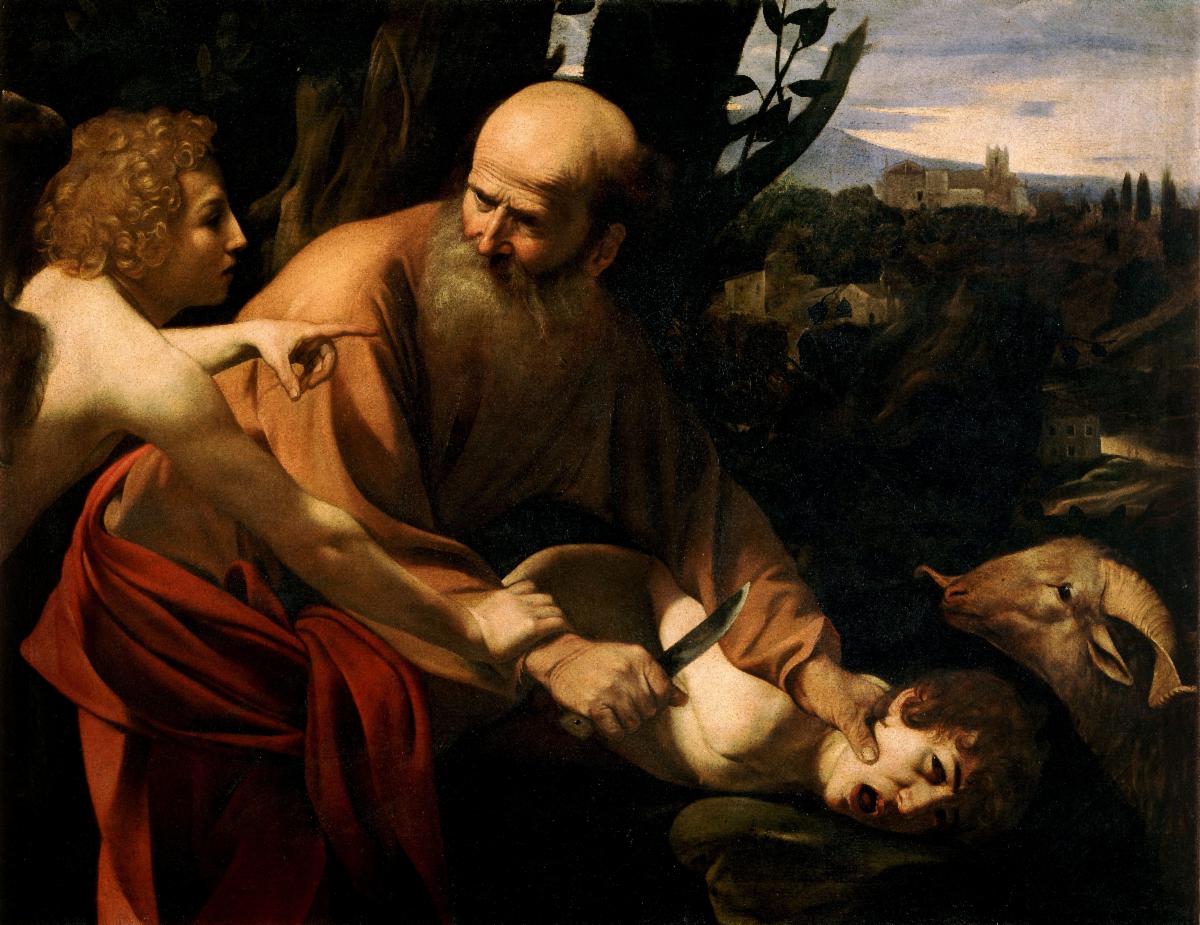
Caravaggio captures the moment the Angel of the Lord stops Abraham from sacrificing his son, Isaac, by providing the ram in the place of Isaac. While there are many avenues of exploration regarding this text, I thought it might be interesting to provide an overview of the Jewish, Christian, and Islamic understanding of this event given that Abraham is the Father of Faith for all three faiths and this story plays a central role in each faith tradition.
It should be noted that this overview is just that an overview and not a comprehensive analysis and it does not cover the variety of views and theologies that have developed over the centuries regarding this passage.
The Jewish tradition does not call this passage “the sacrifice” but “the binding” (Akedah). Naming it “the binding” is theologically significant. The act of “sacrifice” was interrupted before it reached the point of sacrifice. Abraham’s obedience to Yahweh is a paradigm. In the rabbinic tradition “the binding” is the culminating test in a series of trails Abraham successfully navigates.
Jewish tradition greatly expanded Isaac’s role beyond the passive child of the biblical text. In Jewish literature, Isaac is portrayed as the prototype of the voluntary and joyful martyr, willing to go bravely to his death. In fact, the first-century historian Josephus describes Isaac as a 25-year old who rushed to the altar, knowing he is to be martyred. This led to Jewish literature to develop the concept that Isaac’s willingness had atoning power.
Christians inherited the story from Judaism but read it through a radically different hermeneutical lens: the New Testament’s retrospective Christological interpretation. In early Christian writings, the sacrifice of Isaac was used as a type for the sacrifice of Jesus.
Isaac carrying the wood for the sacrifice prefigures Jesus who carries his own cross. And the entire text becomes a foretelling of Jesus’ sacrifice. The “unfinished” sacrifice of Isaac is completed in the sacrifice of Jesus upon the Cross.
The Islamic understanding of this story diverges from the Jewish and Christian in two vary distinct ways: the theological center shifts to submission (the very meaning of the word Islam), and the identity of the son.
Submission is the theological heart of this passage in the Quran. Judaism emphasizes covenant faithfulness and Christianity emphasizes both faithfulness and prefiguration of atonement. Islam, on the other hand, reads the story primarily as the supreme example of tawakkul (trust in Allah) and islam (submission). Therefore, the test was never about the son’s death; it was about the father’s heart. Abraham’s willingness to sacrifice was an exercise in extreme detachment—the ability to love the Creator more than the creation. The outcome, the preservation of the son, signals that the Creator values creation immensely.
In Islam, the son consents to his own sacrifice. The Quran includes the son’s own voice: Abraham tells his son what he has dreamed, and the son replies, “Do as you are commanded; you will find me, God willing, one of the steadfast.” We see in the Quran that both the father and son submit. This mutual submission is central.
The text in the Quran does not identify that son to be sacrificed. The majority of Muslims believe the son that was to be sacrificed was Ishmael. However, there are Muslims who believe the son that was to be sacrificed was Isaac.
There is a point of convergence among the three Abrahamic faith traditions: God does not, in the end, want the child’s death. A substitute is provided. Whether Isaac or Ishmael, the shared message is that God rejects human sacrifice. Abraham’s God shattered the cycle common in the ancient world—the divine will is expressed not in the killing of children but in obedience, mercy, and remembrance. The traditions diverge sharply on what that refusal means—but they all begin from the same moment of the ram in the thicket, which is exactly the moment Caravaggio captures in his extraordinary painting.
Peace,
Rev. Tim
|