|
Friends,
This coming Sunday, we begin our annual stewardship campaign. As part of the stewardship campaign, I will preach a four-part sermon series. What follows is an introduction to the sermon series.
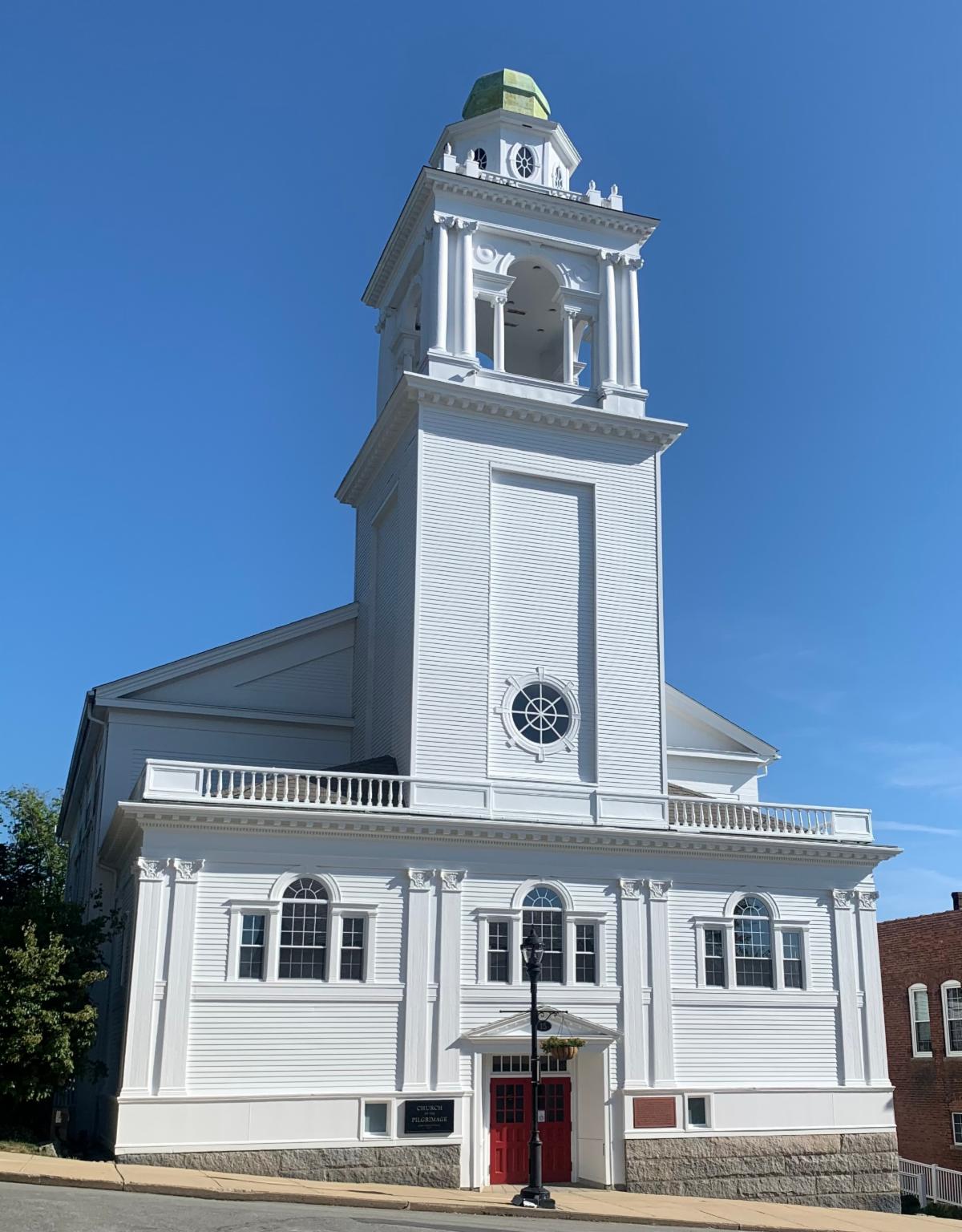
As most of you know, the Church of the Pilgrimage traces its life back to a congregation of Separatists, whom we call Pilgrims, who covenanted together in Scrooby, England in 1606, fled to Leyden, Holland in 1608 under the pastoral care of Rev. John Robinson. A small number of the Separatists left Europe on the Mayflower in 1620. Those persons first worshiped in the Common House, then on Burial Hill, then in a series of meetinghouses on Town Square. In 1801, a group withdrew to continue what they understood as more orthodox worship, forming the Third Congregational Church of Plymouth, which took the name Church of the Pilgrimage in 1870. Along the way this congregation lived through the Revolution, joined the UCC in 1957 and voted to be Open and Affirming in 2010.
The sermon series asks a single question in four movements: what does it mean to still be a pilgrim people—not people who were pilgrims once, four hundred years ago, but people who remain on the road? Each sermon pairs a chapter of this congregation’s history with scripture, and each ends by asking what that chapter asks of us now.
· Covenant People—the crossing, and what it means to bind yourself to others before you know where you’re going
· Liberty of Conscience—Plymouth in the Revolution, and the costly freedom to disagree
· Still Reforming—the splits, the votes, God is Still Speaking and the doors are wide open
· More Light Yet to Break Forth—pilgrimage in a pluralistic world
As I mentioned above the sermon series is tied to our stewardship campaign, “Moving Our Legacy Forward.” What does it mean for a legacy to move forward? A legacy is not something a congregation keeps in a drawer; it is something a congregation carries, and carrying is a very. Every chapter of this history we will walk through together—the covenant at Scrooby, the meetinghouses raised and rebuilt on this square, the congregations that split and re-formed, the doors this church chose to open—was moved forward by people who backed their convictions with their time, their labor, and their money. None of it was free, and none of it was owed to us. It was given, deliberately, by people who would not live to see everything their giving made possible.
For that reason each sermon ends in the same place: a short list of concrete, doable ways that members and friends of this church can move the legacy forward in the weeks ahead—through giving, through time, through welcome, and through the stories we tell.
Peace,
Rev. Tim
|