|
It’s May and GLP is immersed in administering and analyzing board and leader evaluations. We are also gearing up for end-of-year leadership retreats and board meetings—and all of these activities offer time for feedback, reflection, and planning for what lies ahead.
Effective assessment and feedback are vital to the work of governance and leadership—and to the partnership between the board and CEO. But it doesn’t always happen perfectly. Assessment can cause friction or build teamwork. It can make people feel meaningful or misunderstood. It can accelerate growth and progress, or stifle it. And the absence of effective assessment is even more risky—leaving individuals and organizations with a weak foundation for understanding what matters, what is actually happening, and for making sound decisions.
Assessment matters. Why you assess, what you assess, and how you assess matters.
In this Blueprint, we take a look at how you can use assessment and feedback to help your team and your organization learn, grow, and succeed. And we’ll approach it as we do in our practice, by thinking about assessment in three interrelated parts:
- Assessment of Organizational Performance
- Assessment of Governance Performance
- Assessment of Leadership Performance
Of course, assessment should happen everywhere in your organization, particularly to ensure you have the information you need to develop talent and refine strategy. In any case, for this Blueprint we will focus on the organization, the board, and leadership—knowing that these tips, tools, and insights apply or can be translated everywhere. Moreover, if you do assessment well in these three parts, chances are you’ll be able to spread and scale effective assessment throughout your organization!
We encourage you to bookmark and save this Blueprint for summer reading—it's long but it's chock-full of tips and resources.
–Stephanie
| | | Strategy:
Assessment of Institutional Performance | |
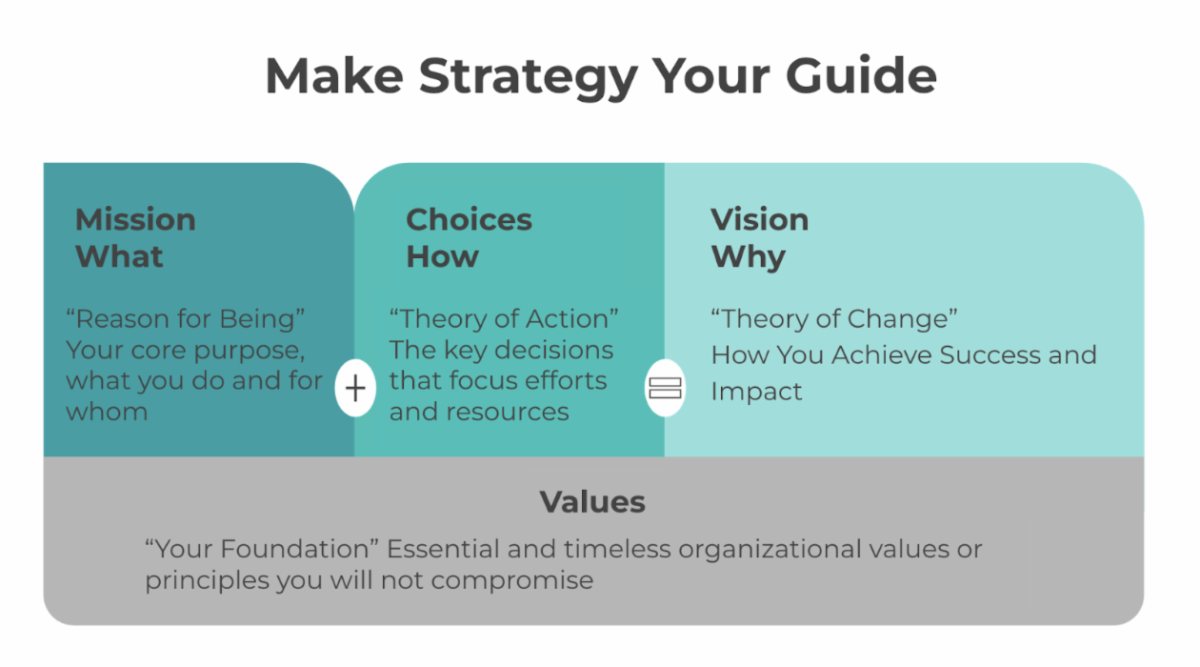
Start with where you are going: strategy is essential to assessment.
Assessment can be ineffective—and even harmful—if it is not grounded in a shared understanding of what you are trying to achieve and how you are trying to achieve it.
| | |
Make sure you have a clear sense of what success looks like (vision), how you will get there (strategy), and milestones you need to reach along the way (goals). When you define success, you also want to define how you will assess progress. Aligning what you will measure to the activities, experiences, and results you want is often the gap in an otherwise thoughtful approach to assessment.
In Creating Schools That Thrive, we reinforce this idea: “Your vision must include a description of success that is measurable and for which you can provide evidence.” Since writing that book, we have worked with numerous nonprofits and schools to facilitate board and leadership assessments that yield actionable data. We've learned that assessment needs to tie itself to measurable goals, and effective assessment gathers relevant examples and evidence of progress. But so often what gets assessed doesn't actually measure what matters most. The more clear you are about what matters, and the better able you are to measure effectively, the more you empower everyone in the organization to contribute to the results you want.
A shared understanding of vision and strategy (the why and how) creates conditions for people to succeed.
In this HBR podcast, Frances Frei, professor at Harvard Business School, offers a compelling recipe for results: high standards, trust, devotion to the success of the people you lead, and strategy.
Why does strategy matter so much for leadership and performance? Strategy, Frei notes, enables people to make good decisions even when their manager isn’t right there with them.
When everyone in the organization knows what is important, they can act autonomously and in unison at the same time.
| | “It’s a disaster if you have 100 people confronting the same situation and there’s a 100 different solutions. So when strategy is clear that takes a whole bunch of discretionary decisions off the table. It’s surprising how many organizations the strategy isn’t clear enough in the minds of everyone in the organization.” | | | |
In addition to yielding better results every day, a clear strategy that is well-understood throughout the organization is essential to establishing an approach to evaluation and feedback that fuels continuous improvement.
Show people they matter.
Assessment—which often fuels anxiety—can be approached as an opportunity to give people evidence that their efforts are valuable, and that learning matters.
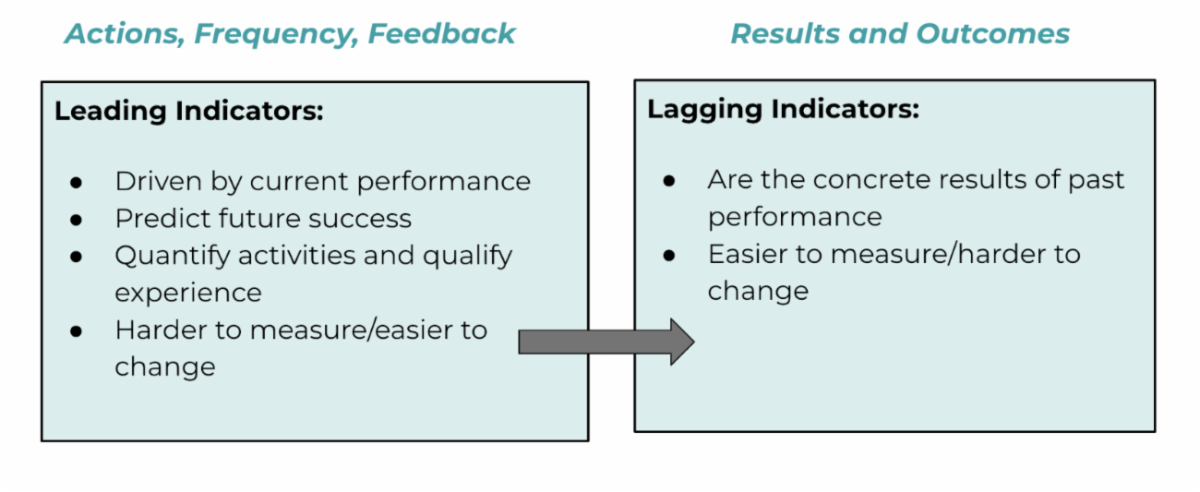
Let’s start with a conversation about lead and lag indicators in assessment. Assessment tends to default to lag indicators—results that reflect what happened in the past. Lead indicators are where the magic happens! And lead indicators drive the learning, behaviors, and focus you want in order to execute strategy.
| | This HBR article highlights an essential insight: one of the most important ways to motivate, inspire, and retain talented people is to show them that they matter—“to show them exactly how even their small tasks are crucial to a bigger goal or purpose.” | | “Mattering—a mainstay concept in the fields of psychology and sociology for more than 40 years—is the experience of feeling significant to those around us because we feel valued and know that we add value. It is a primal need. When people know that they matter at work, they thrive. Mattering enhances self-esteem (‘I’m worthy’) and self-efficacy (‘I’m capable’) and strengthens motivation, well-being, and performance. This is critical for organizations to recognize: Employees who believe they matter report greater satisfaction, are more likely to be promoted, and are less likely to leave.” | | | Mattering is not just about feeling like you belong. Mattering is about being significant, about contributing. | | “Research by the organizational psychologist Adam Grant shows that hearing just one real story of how our work benefits someone else can increase motivation by upwards of 400%.” | | | As you think about ways to evaluate, consider how incorporating lead indicators will focus you on the stories—with supporting evidence—that people are doing what needs to be done. Consider how a process for collecting stories of positive impact might add to—and refine over time—your existing approaches for measurement and evaluation. | |
When assessing performance, look beyond the surface of what appears to be a marketing or sales issue and ask, “Is this actually a strategy issue?”
If you are a school facing challenges with enrollment or a not-for-profit that needs to engage more clients, the most common response is to assume marketing is the problem and the solution. We appreciate this challenge from “Winning the Right Customer Isn’t Just a Sales Issue”:
| | “There are always opportunities for sellers to improve the way they interact with customers and prospects. But not winning enough of the right customers, selling what you’ve prioritized and invested most in, at the prices you need, is a leadership and strategy issue. Not only a sales issue.” | | | The authors highlight three steps to take if your organization faces this situation: | | |
“1. Identify the kinds of business you expect sales not to pursue.
Everyone knows you can’t be everything to everyone. Yet sales teams often pursue suboptimal opportunities.
2. Clarify your company’s competitive advantage.
For each of your prospect or client types, there are likely a handful of reasons why they will choose you over competing alternatives.
3. Emphasize how the sales experience is the customer experience.
It’s easy to forget that the sales experience is a critical part of your company’s customer experience.”
| | | Notice that the customer experience will be driven by certain actions and measured by “lead indicators.” Establishing an ongoing assessment process will help reveal if your organization lacks clarity around strategy, vision, and goals—or if these have been established but not communicated by the board and leadership team in a way that fully permeates throughout the entire organization. | | Governance and Leadership:
Performance Assessment | | |
Institutional performance is a function of both CEO and board performance. In GLP’s work with nonprofits and schools, we consistently see that the best results happen when the board and CEO share a consistent approach to assessment that strengthens their partnership and informs how each grows and develops.
What assessment drives learning so that the board and leadership feel supported and ultimately advance in their leadership and roles?
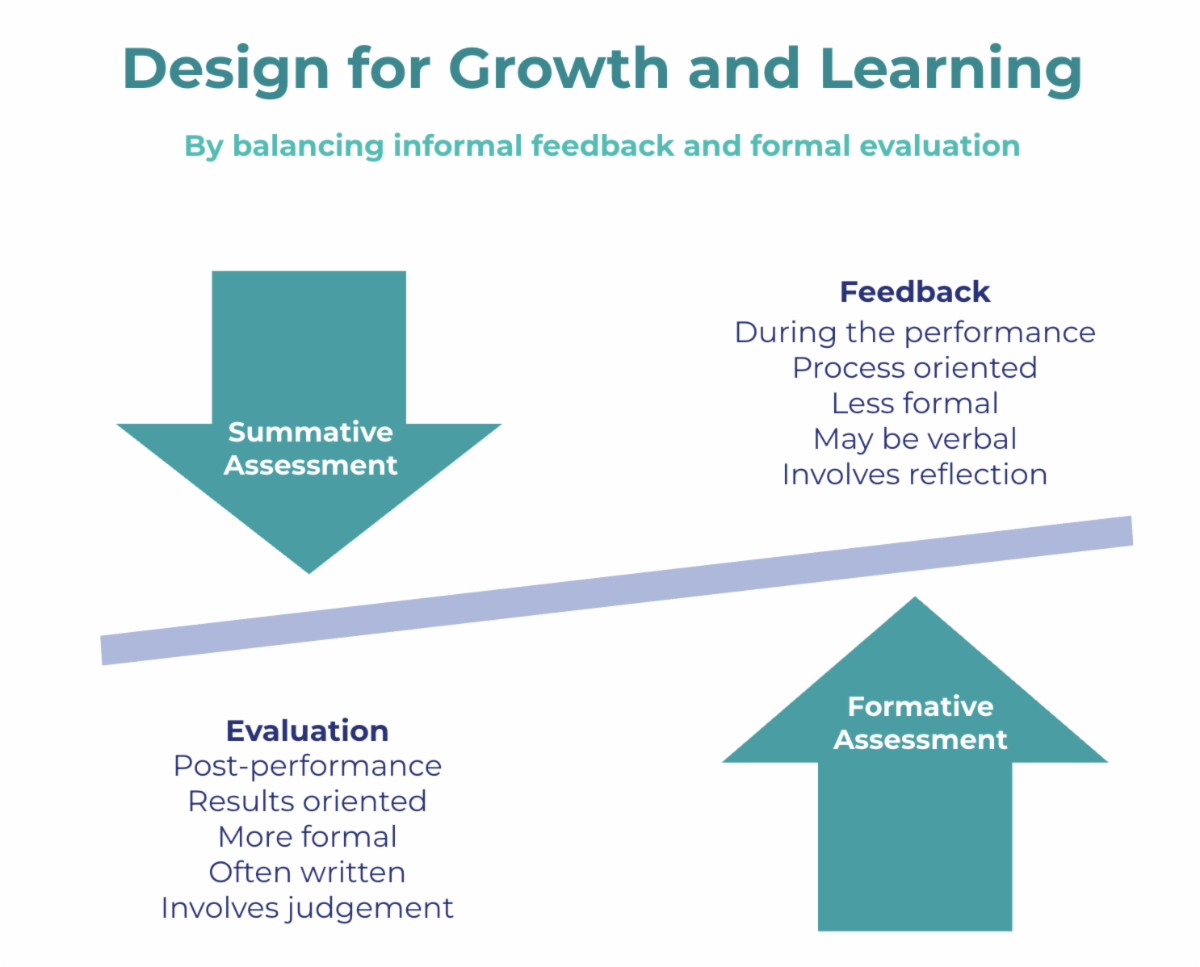
As you refine your evaluation practices, it is helpful to consider the benefits of formative assessments and summative assessments—and how both are crucial.
-
Summative Assessment—Evaluation that is post-performance, results oriented, more formal, often written, and involves judgement.
-
Formative Assessment—Feedback during the performance, process oriented, less formal, may be verbal, and involves reflection.
| |
How can you get better, more actionable feedback? Ask more specific questions.
Most likely you have experienced the frustration of vague feedback described in this HBR article:
| | “Maybe your manager has said that 'you need to be more strategic.' Or perhaps they’ve mentioned that they want to see you 'deepen your knowledge of the business' or that they wish your direct report was more of a 'team player.' … Without specifics or concrete examples, you’re left guessing what success looks like and at a loss for exactly what to change.” | | | The solution? Rather than asking, “Do you have any feedback?”—be more specific: | | “For example, ‘What’s one thing I could have done differently with how I shared the market analysis?’ or ‘How could I have addressed the CEO’s question about the budget more accurately?’ By narrowing down what you want to know, you encourage your manager to drill into the areas you care about the most.” | | | |
Though the article is addressing individuals who are seeing better feedback from their boss, it is a vital insight for leaders and board members as you offer one another feedback and develop leaders throughout the organization.
“The Power of Mattering at Work” (mentioned above) also offers helpful examples of questions that build stronger connections—and gather more useful information.
| | |
Clear questions have an object and a time frame.
For example, instead of saying, “How are you?” you might ask, “What has your attention today?”
Open questions give people the opportunity to share their experiences.
Instead of asking, “Did the meeting go well?” you might ask, “What was the most important insight you heard in the meeting?”
Exploratory questions seek to understand, not evaluate.
Instead of “What did you get done today?” you might ask, “Which parts of today’s projects were most challenging for you and why?”
| | |
Board Assessment
Great boards create value. How? They actively elevate the capabilities and impact of their organizations—and that starts with their own work. And they assess—in real time (e.g., feedback surveys after every board meeting) and formally (e.g., annual board evaluation).
In our September Blueprint, we asked, “Does your board raise the bar for organizational talent and performance?” In addition to fulfilling core responsibilities and technical fiduciary work, Adaptive Boards engage in proactive succession planning, a rigorous process for board composition and education, and future-focused innovation and vision building.
As the pressures and challenges faced by nonprofits and schools increase, boards have a growing responsibility to improve their own capabilities.
Where to begin? Knowing where you are today as a board is the first step to improvement—and an essential requirement for fulfilling key responsibilities such as succession planning and effective support and guidance for the CEO and executive leadership team.
| | |
When preparing for a board assessment, this article from Harvard Law School Forum on Corporate Governance reminds us to ask: What is the purpose of the assessment?
The article highlights some of the most common areas of focus, including:
- Evaluating board composition
- Setting and monitoring board culture
- Improving board practices
- Planning for board succession
| | |
We find it is important to also assess:
- Board performance in relation to established goals
- Board-CEO partnership
- Individual board member performance (engagement, knowledge of organization/mission/vision, etc.)
To expand the conversation, we offer a few framing questions:
- How would you describe your current board? Its talents and strengths? Its culture and climate?
- How would you describe the collaboration between board members and leadership?
- What behaviors are advancing board and organizational performance? What behaviors get in the way?
- How would you describe the current needs of the board, in context of both the technical and adaptive challenges facing your organization?
- How is the board positioned to help or support leadership in facing these challenges?
- What would you need to make your board engagement more valuable and rewarding?
In the best cases, the board defines—from the very top of the organization—the culture and standards for performance that cascade throughout the organization. What standards do you want to set for your organization? Is your board modeling the way for disciplined strategic work, excellent teamwork, and rigorous development and assessment of people and performance?
Although there is no single “best practice” for assessment that works for all boards, we offer a few key tips:
- Assess the key criteria for board members, and assess the collective needs of the board
- Assess culture, composition, structures, and function with questions that are clearly stated
- Ask senior administrators to assess the board and compare results
- Use a well-designed tool to provide evidence of year-over-year progress
As you think about what baseline criteria to assess, we have found that there are five mindset shifts that are essential for every board member. Take a look at our blog post for some inspiration!
| |
Leadership Assessment
We encourage boards and leaders to design an approach to leadership assessment that facilitates talent development, advances strategy, and fosters a healthy board-organization partnership.
Tips for effective assessment:
- Balance formal and informal evaluation
- Enable ongoing and open communication and feedback that flow both ways
- Measure the essential leadership criteria you need to see and develop year over year and assess the accomplishments relative to annual goals—consider how these two domains are related!
- Inform results with relevant qualitative data—measure progress by gathering specific perspectives, examples, and information about leadership that can then be quantified.
What mindsets, abilities, behaviors, knowledge, and skills are important for leaders today? Not-for-profit and school leaders face tremendous—and every growing—complexity. When deciding on criteria that matter for assessment, "Strategic Leadership: The Essential Skills" offers six essential skills to consider and specific ways to improve each. We highlight three here:
| | |
Anticipate - Most organizations and leaders are poor at detecting ambiguous threats and opportunities on the periphery of their business. To improve your ability to anticipate:
- Use scenario planning to imagine various futures and prepare for the unexpected.
- List customers you have lost recently and try to figure out why.
Interpret - Leaders who challenge in the right way invariably elicit complex and conflicting information. That’s why the best ones are also able to interpret. To improve your ability to interpret:
- When analyzing ambiguous data, list at least three possible explanations for what you’re observing and invite perspectives from diverse stakeholders.
- Actively look for missing information and evidence that disconfirms your hypothesis.
Learn - Strategic leaders are the focal point for organizational learning. They promote a culture of inquiry, and they search for the lessons in both successful and unsuccessful outcomes. To improve your ability to learn:
- Institute after-action reviews, document lessons learned from major decisions or milestones (including the termination of a failing project), and broadly communicate the resulting insights.
- Reward managers who try something laudable but fail in terms of outcomes.
- Conduct annual learning audits to see where decisions and team interactions may have fallen short.
| | | |
Again—evidence matters. Use a tool to collect feedback and specific evidence from all board members and direct reports. Don't rely on downloadable templates, you need to make your tool work for you and design it accordingly.
A few things to avoid in formal evaluation processes:
- Don't do formal evaluation via an interview process that’s not structured. A well-designed tool will help here. And don't have board members interview staff.
- Don't make feedback anonymous (you want to encourage a culture of honest and constructive feedback) but do ensure confidentiality.
- Don't base assessment only on how people feel. Make sure you have examples and evidence for the criteria or goals on which to assess.
Though the CEO and the board will be the primary focus of your governance and leadership assessments, we encourage you to continually look beyond the board-CEO partnership and strive to cultivate leadership development throughout the organization—including throughout the board. Distributed leadership and a strong leadership pipeline are vital to organizational performance—and the insights and practices you develop for CEO/board assessment can inform how you help leaders grow at every level of the organization. By affirming a commitment to rigorous assessment and on-going learning, you model the way.
GLP can help you assess or design your approach to evaluation. We welcome your questions!
| | Please feel free to forward the Blueprint to friends and colleagues who may find it helpful. And if you're not already on our mailing list and you'd like to receive future editions of the Blueprint, click the button below to subscribe! | | | | |