August 11, 2026

Getting America's Businesses Back to Business.

Dear Friends and Partners,


August often brings a quieter rhythm to Washington as Congress recesses. Yet at 1792 Exchange, our work continues at full pace. Helping American companies get back to business does not pause with the legislative calendar.


Recent insights underscore both progress and the need for continued vigilance. Many companies are quietly rebranding “DEI” as “Inclusion,” “Belonging,” or “Culture.” While some terminology shifts may signal genuine course correction, others appear largely cosmetic, leaving shareholders uncertain whether underlying policies have truly changed. Clarity and transparency serves everyone better than merely rebranding.


We are also tracking encouraging corporate responses to the Southern Poverty Law Center’s discredited influence. A growing number of companies have publicly removed SPLC-based filters from charitable giving platforms, confirmed they do not use politicized screens, or otherwise distanced themselves—steps that protect viewpoint neutrality, restore fairness in corporate philanthropy, and open the door for charitable gifts to formerly excluded religious and conservative groups.


Finally, we continue to document that ideological capture often begins long before the boardroom. Our recent comment supporting the Department of Education’s proposed rescission of Equity Assistance Center regulations highlights a simple truth: what is taught in the classroom shapes the culture of the companies those students later lead. Returning education to genuine equal opportunity strengthens the pipeline of talent that American enterprise needs.


True American companies put America and Americans first by prioritizing merit, free expression, and long-term value over imposed ideologies. At 1792 Exchange, we remain committed to providing the research, ratings, and roadmaps that help leaders make the right choice with confidence.


Thank you for standing with us. The work of restoring neutral, mission-focused business continues—August and beyond.


Best regards,

Doug Napier

Executive Chairman & CEO

1792 Making Headlines

Doug Napier on Christian Business Leader

New From 1792 Insights

As You Sow Misleads Readers about Anti-DEI Proposals


Earlier this summer, as the 2025-2026 proxy season came to a close, leading progressive shareholder group As You Sow intentionally misled readers about the success of anti-DEI proposals. As You Sow
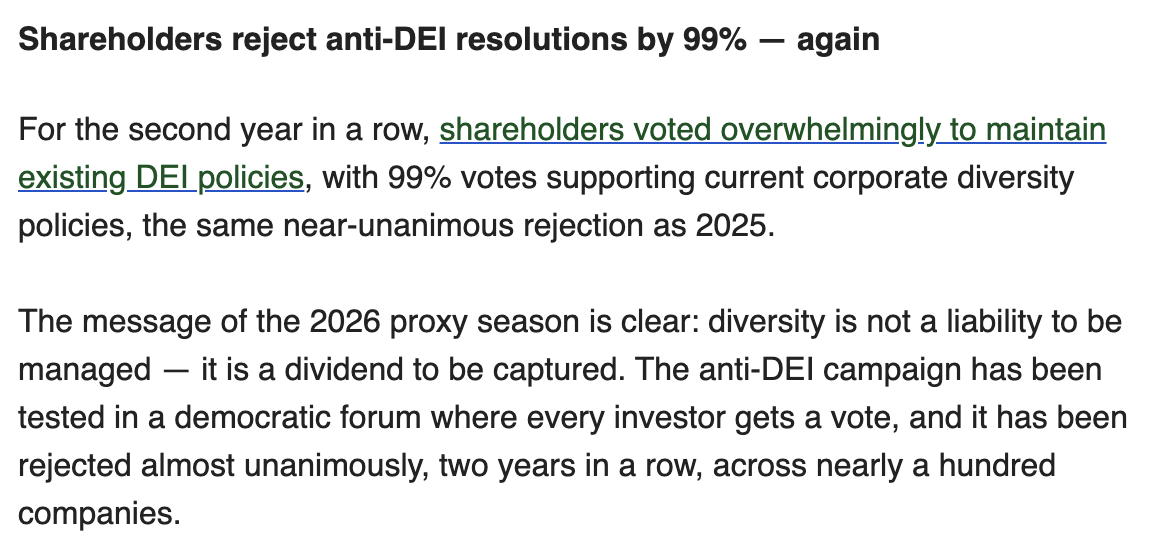
suggested that voting results on anti-DEI shareholder proposals at 43 companies this season, including Disney, Costco, Visa, and Apple, proved that 99% of investors are opposed to anti-DEI measures. 


As You Sow claimed that the universal failure of these proposals sends an “unmistakable message” to corporate boards that DEI is a “financial asset” that directors need to prioritize for the needs of the company, labelling anti-DEI efforts as a “political threat.”

A 0-43 record for anti-DEI proposals does appear striking at first. However, no ESG proposals won majority support in the 2025-2026 proxy season, which includes pro-DEI proposals at 0-10 with an average support around 13%. 


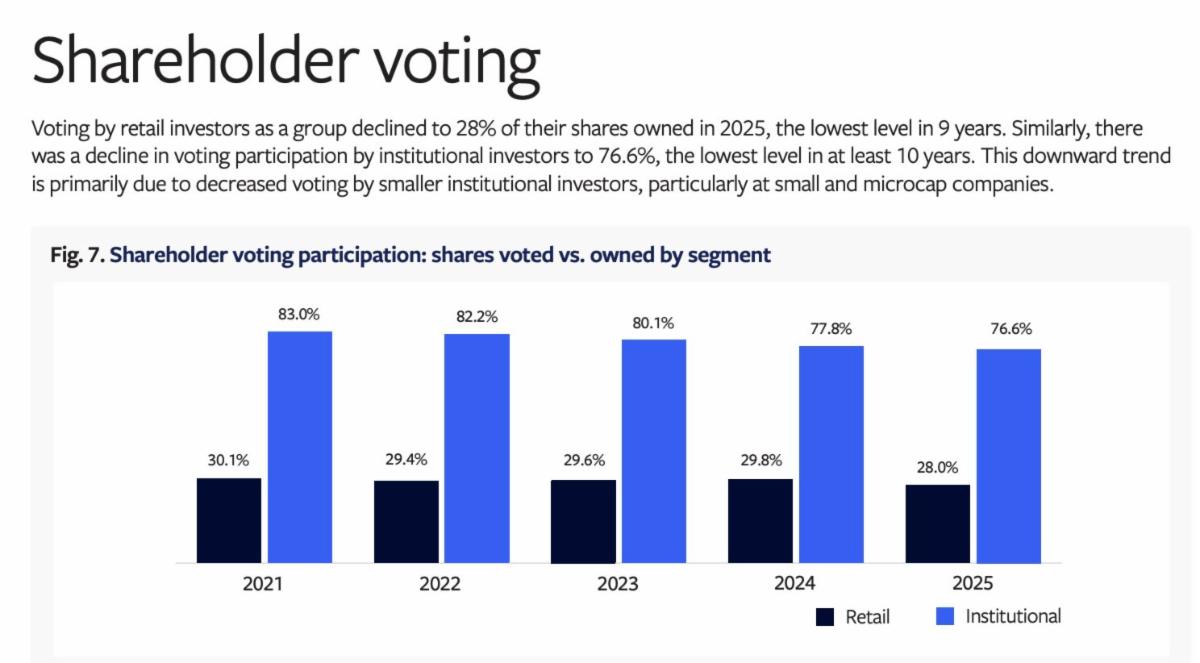
According to Broadridge’s 2025 ProxyPulse report, voting by retail investors “declined to 28% of their shares owned in 2025,” which is the lowest level of participation in 9 years. Low retail investor participation is the historical norm, as proxy votes are disproportionately cast by large institutions on their behalf, not by individual investors. As You Sow knows this.

Furthermore, for As You Sow to suggest that “[d]iversity is not a liability to be managed, it is a dividend to be captured” when companies like IBM and Nike have recently faced intense scrutiny for their DEI practices is absurd. 


To learn more about the Myth of Shareholder Democracy, consider reading Stefan Padfield’s piece titled: Proxy Voting and the Myth About Shareholder Democracy. 


Read More 1792 Insights:


In response to legal, political, consumer, or shareholder pressures, companies are increasingly replacing “DEI” terminology with broader terms such as “Inclusion,” “Culture,” or “Belonging,” while providing little explanation as to whether the changes are substantive or primarily cosmetic. 

For example,
CVS Health renamed its public-facing DEI page to "Inclusion & Belonging” without issuing a public statement explaining the change. The company also stopped referencing a diversity pay metric for leadership in their annual 10-K filing. Similarly, Home Depot quietly removed its DEI webpage and replaced it with a "Living Our Values" section. While these changes alter the public branding, they do not necessarily clarify whether the companies’ underlying policies or priorities have materially changed. 


From a shareholder perspective, this lack of transparency can create uncertainty about a company’s strategic direction and how it intends to approach politically and socially contentious issues going forward. 

(continued)


On July 23,
1792 Exchange filed a comment urging the Department of Education to finalize its proposed rule rescinding the Equity Assistance Center Program regulations. Congress created the program in the Civil Rights Act of 1964 for one purpose: helping school districts desegregate, which it defined as assigning students without regard to race. By 2016 the Department had renamed the Desegregation Assistance Centers as “Equity” Assistance Centers and read gender identity into a statute about sex, a reading a federal court struck down in 2025. Desegregation was a fixed command to stop sorting children by race. “Equity” became a blank check, and in February 2025 the Department cut $33 million in grants funding DEI, Critical Race Theory, and gender-identity training for school boards. (continued)

New: How Companies Have Responded to the SPLC

Growing scrutiny of the Southern Poverty Law Center has sparked a broader conversation about how its “hate group” list is being used to blacklist mainstream Christian and conservative nonprofits from corporate charitable giving programs, most notably through Benevity, one of the largest employee-match platforms, used by hundreds of the Fortune 500.


1792 Exchange is tracking how companies are responding to the public call to distance themselves from the SPLC and to stop using its designations to discriminate in corporate giving.

Join the Conversation

LinkedIn  X  YouTube

For timely news, insights, and commentary on important headlines and developments impacting business, as well as updates on our efforts to help get businesses back to business, we invite you to join the conversation.


X  LinkedIn  YouTube

Privacy Policy   Legal Notices   Terms and Conditions

View as Webpage

1792 Exchange | 4218 Bridgetown Rd | Cincinnati, OH 45211 US