November 3, 2026

Getting America's Businesses Back to Business.

Dear Friends and Partners,


On Election Day, we remember that we have the privilege and responsibility of voting as an act of stewardship for the constitutional order that has made American enterprise the envy of the world—stable law, secure property, equal treatment, and protection from arbitrary power. That same order is what calls the companies that employ our neighbors, serve our communities, and grow our economy to something higher: to act American.


An American Company is not defined by the place of incorporation or by hanging a flag in the lobby. It is earned by treating employees as free citizens, protecting lawful speech and religious liberty, and refusing to conscript corporate power into activist’s ideological campaign. We have already begun receiving nominations of businesses that meet this standard, and this month we look forward to highlighting the first of these. Help us to recognize those companies worthy of the name by reading the charter and nominating a company today.


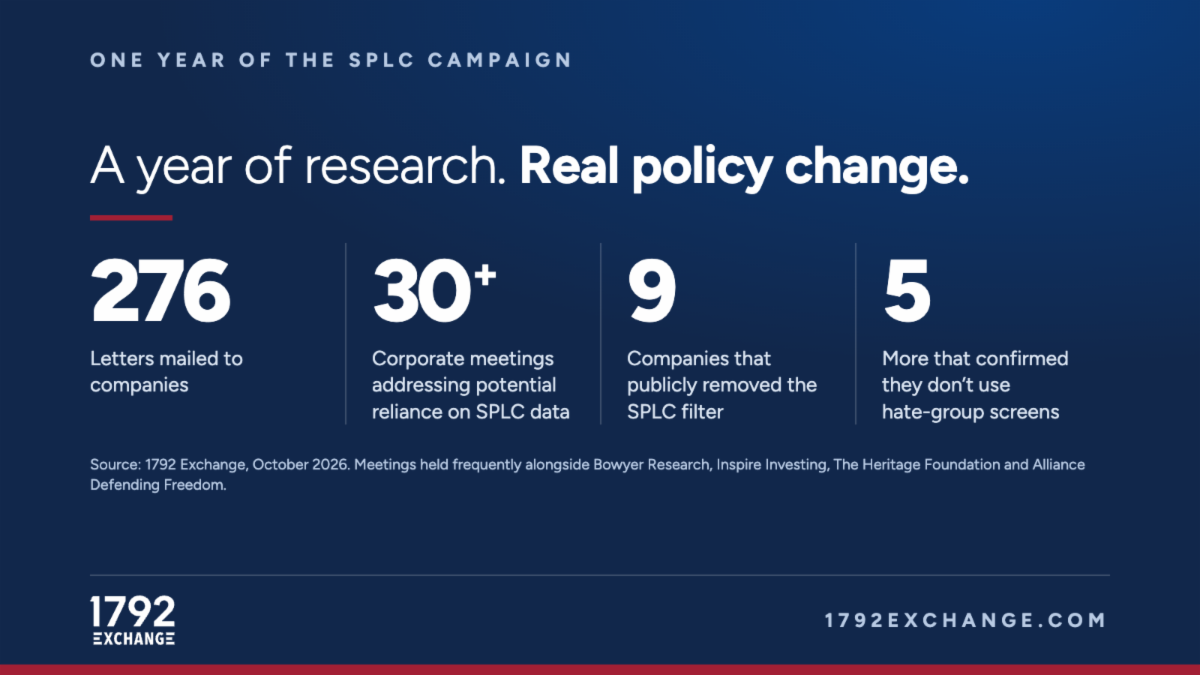
That same standard of consistency is at the heart of the work we marked last month: one year of our campaign to end corporate reliance on the Southern Poverty Law Center’s “hate” list in workplace giving. Through research, engagement, and a growing coalition of partners working together, nine major corporations so far—including BlackRock, Microsoft, NVIDIA, American Express, and others—have publicly removed the SPLC filter. Five more have confirmed they do not use politicized screening. We have sent 276 letters and held more than 30 corporate meetings. The tide is shifting. Corporate giving processors have begun to change. The work is not finished, but the progress is real.


Our mission remains the same: help American businesses get back to business—faithful to the Constitution, accountable to shareholders, and worthy of the public trust.


Onward with hope and resolve,

Doug Napier

Executive Chairman & CEO

1792 Making Headlines

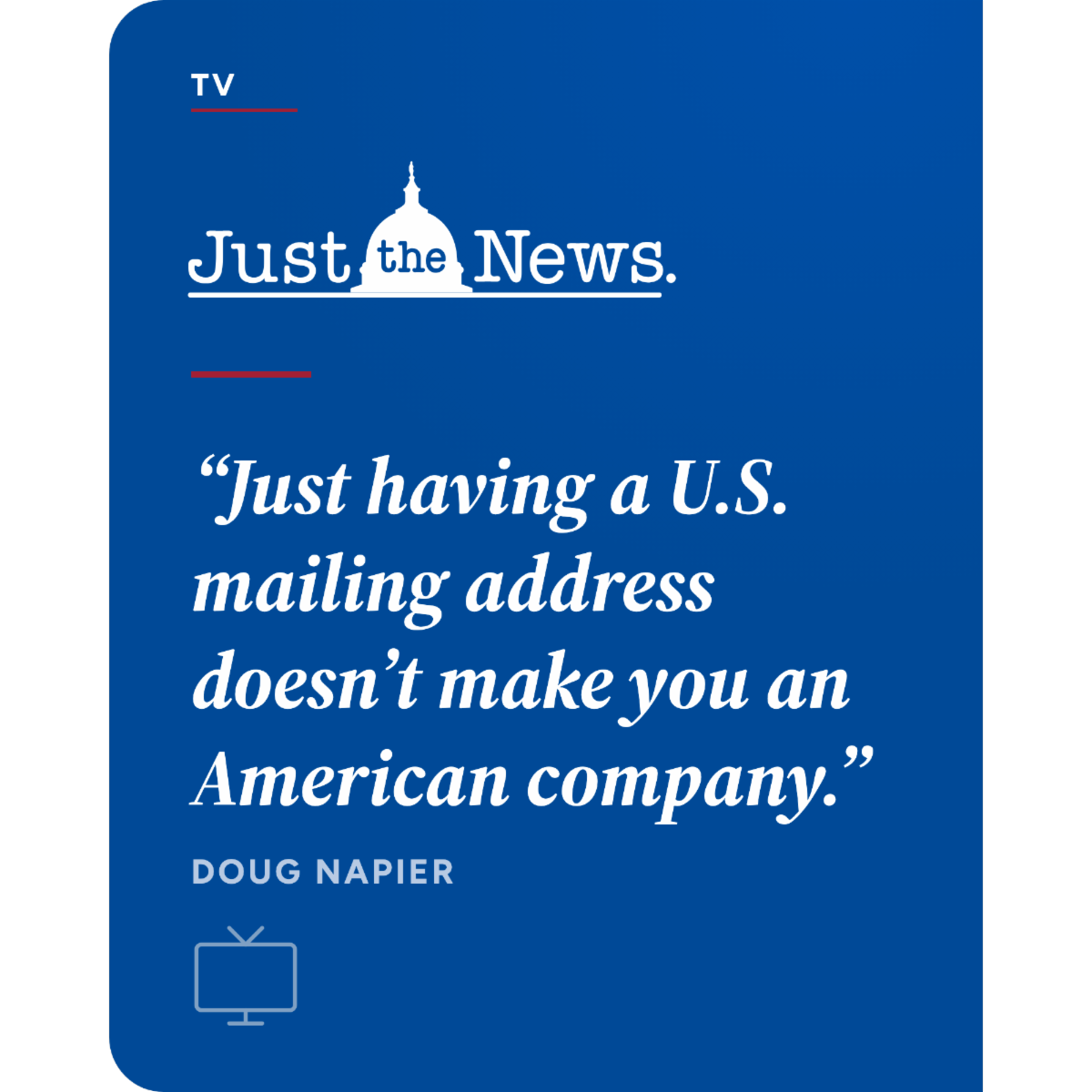
Doug Napier, Executive Chairman and CEO of 1792 Exchange, joined John Solomon on Just the News, No Noise to discuss the American Company, the new national call for companies to earn the name American. He explained the standard a company must meet, how the Corporate Bias Ratings help companies hold themselves to it, and why Europe is a warning for America.


New 1792 Insights


  • Corporate America’s Gender Ideology Ally Has A 99% Democratic Endorsement Record
    
    As Americans prepare to vote in November’s midterm elections, one of the Democratic Party’s most reliable political allies is mobilizing millions of voters and spending millions of dollars to influence the results.
    
    That organization is the Human Rights Campaign (HRC), which also happens to maintain close ties with some of America’s largest corporations, many of which publicly affiliate with and sponsor the organization.
    
    HRC bills itself as "the nation’s largest LGBTQ+ civil rights organization." But a
    new analysis by 1792 Exchange reveals just how overwhelmingly partisan its political activities have become.
    
    After examining HRC’s online archive of
    press releases, 1792 Exchange documented 1,408 political endorsements covering 970 unique candidates between 2010 and October 2026. 
    
    Of those 970 candidates, 964 were Democrats, two were Republicans, three were nonpartisan candidates and one was an independent.
    
    In other words, more than 99% of the unique candidates identified in HRC’s archived endorsements were Democrats.
    
    This record raises questions for companies that
    financially support HRC or affiliate with its infamous Corporate Equality Index under the banner of supporting nondiscrimination policies, particularly when they do not extend comparable affiliation with or support of conservative organizations. (continued)
    
  • New Heritage Report Highlights Risks of Corporate Alignment With the Human Rights Campaign
    
    
    Last week, The Heritage Foundation released a
    very important report detailing the risks companies face from affiliating with the Human Rights Campaign (HRC) and its Corporate Equality Index (CEI).
    
    The report provides valuable insight into the scope of HRC’s influence on corporate America and the organizations pushing back against it.
    
    Any institution concerned about the growing influence of modern gender ideology should familiarize itself with these findings.
    
    In short, the CEI pressures companies to incorporate gender ideology into
    nearly every aspect of corporate governance, including employee healthcare benefits, charitable giving, and marketing.
    
    Its influence likely contributed to the controversial Bud Light and Target marketing decisions in 2023.
    
    Fortune 500 CEI participation
    dropped 65% this year, a catastrophic decline.
    
    However, according to Inspire Investing and the 1792 Exchange, there are still
    242 publicly traded companies with a Verified 100 on the 2026 CEI, indicating coverage of transgender medical interventions for minors.(continued)
    
  • DEI Starbucks: A Breakpoint Between Better Business and Business Ends


    Starbucks’ recent resolution of the lawsuit brought by the Florida Attorney General only scratches the surface of the business risks created by subordinating core operations to ideological priorities. Florida employees and applicants reported “feeling excluded or humiliated because they were White,” alleging that the company had effectively converted hiring and recruiting into a process that favored preferred demographic groups. The settlement, under which Starbucks agreed to forgo race- and sex-based goals, quotas, and preferences companywide, underscores that such practices carry both legal exposure and internal costs, even when the company does not admit liability.
    
    The deeper question is why these commitments became central in the first place. In Greenfield, Massachusetts, Last Ditch Bar and Arts Venue supplies a clear, small-scale illustration of the consequences. Last Ditch built its model around ideological priorities,
    one notable being an expansive open-door policy intended to accommodate a particular activist customer base. When financial pressures led the owners to make a limited operational adjustment- a one night a week deal to help the business make more money.
    
    Like a late Starbucks open-door policy. The bar advocated and accommodated everyone. What happened? The “advocate community,” the business’ main customer base, only tore the business apart.
     (continued)

1792 Exchange Marks One Year of Success in Campaign to End Corporate Reliance on SPLC’s “Hate List”

Following a year of research, corporate engagement, coalition building, and public accountability, major corporations have started to abandon SPLC-based charitable gift matching restrictions, charitable-giving processors have changed their practices, and hundreds of companies have faced calls for reform. 


October 17 marked one year of 1792 Exchange’s campaign to end corporate reliance on the Southern Poverty Law Center’s (SPLC) defamatory “Hate List” to determine which nonprofit organizations are eligible for employee charitable giving and corporate matching programs. 


1792 Exchange and our coalition partners together have helped secure meaningful policy changes at major American corporations, raised national awareness of discriminatory charitable-giving practices, and pressed major charitable giving processors and hundreds of companies to review their reliance on the SPLC’s “Hate List” data. 


The campaign began with original research by 1792 Exchange into Benevity, a Canadian company that is one of the largest corporate charitable-giving platforms, which processes billions of dollars in donations annually. The research helped uncover how Benevity uses SPLC designations to exclude mainstream conservative, Christian, pro-family, and other advocacy organizations from corporate charitable gift matching programs, often without employees or corporate leadership understanding the criteria behind those restrictions. 


1792 Exchange identified more than 200 Fortune 1000 companies with verified Benevity giving portals, highlighting the scale of the potential problem and creating a foundation for shareholder engagement, direct corporate outreach, coalition advocacy, and investigative reporting. 

X  LinkedIn  YouTube

Privacy Policy   Legal Notices   Terms and Conditions

View as Webpage

1792 Exchange | 4218 Bridgetown Rd | Cincinnati, OH 45211 US