|
|
Sharing the latest CTCRE news, publications, fellow and faculty highlights, and important events
| |
Welcome!
It is my honor to introduce the inaugural newsletter from the Center for Tobacco Control Research and Education. For over 26 years, CTCRE has been at the center of tobacco control research, education, and public service activities by training postdoctoral fellows, publishing cutting-edge research, and working with policymakers to—slowly but surely—move us towards a tobacco-free world.
I’m so proud of everything CTCRE has achieved and the brilliant minds that have passed through these doors. I hope this newsletter can shine a light on the stellar work our fellows and faculty produce, and help you stay up to date with center-related news and events.
| |
- Pam Ling, MD, MPH
CTCRE Director
| What is the Center for Tobacco Control Research and Education? | The Center for Tobacco Control Research and Education serves as a focal point for a broad range of research, education, and public service activities for over 60 faculty in 15 departments and all four schools at UCSF. We have an NIH-funded postdoctoral fellowship research training program, which includes all aspects of tobacco science including basic physiology, biomarkers of exposure, behavioral science, history, anthropology, psychology, public health, economics, law, epidemiology, environmental health and policy science. We conduct leading edge science addressing important questions related to tobacco and related substances and health, and actively translate our work to inform public health policy and practice. |
-
The priority application period for 2026 fellowship applications has closed, but applicants may still submit an application for consideration. Late applications will be reviewed on a rolling basis if space is available after primary application review.
-
In January we submitted three public comments to the FDA ahead of the Tobacco Products Scientific Advisory Committee Meeting (TPSAC). These public comments opposed marketing ZYN with the modified risk claim that “using ZYN instead of cigarettes puts you at a lower risk of mouth cancer, heart disease, lung cancer, stroke, emphysema, and chronic bronchitis.” A list of public comments we submitted to the FDA, including the ones mentioned above, can be found on the CTCRE website here.
-
CTCRE had a strong presence during the 2026 SRNT Annual Meeting, March 4–7, in Baltimore, MD. Faculty and fellows participated in pre-conference workshops, delivered both plenary and oral presentations, and presented several posters.
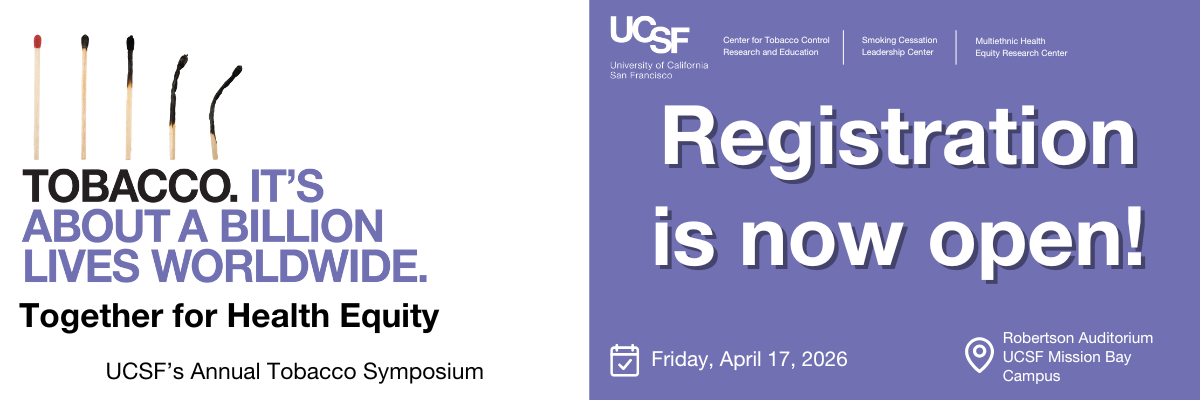
| Join the Center for Tobacco Control Research and Education, the Multiethnic Health Equity Research Center, and the Smoking Cessation Leadership Center on Friday, April 17, 2026, at UCSF Robertson Auditorium for the 2026 It’s About a Billion Lives Symposium. This year’s symposium will center on the theme “Together for Health Equity.” |
-
CTCRE fellow Deanna Halliday, PhD, is the lead author of a paper describing patterns of nicotine and cannabis co-use using smartphone daily diaries. She found that sad mood was associated with nicotine vaping, and cannabis craving was associated with co-vaping nicotine and cannabis together.
-
CTCRE fellow Divine Darlington Logo, PhD, is the lead author of one of the first papers describing tobacco use among adolescents in Ghana. He found more than one in five students currently used tobacco products, and that use was associated with religious affiliation, parental occupation, and knowledge about tobacco’s health risks.
-
2025 CTCRE Fulbright Visiting Scholar Kate Frazer, PhD, and CTCRE Fellowship Co-Director Maya Vijayaraghavan, MD, MAS, are co-authors on a paper examining how policy and environmental contexts influence smoking behaviors among women experiencing homelessness using a social ecological model framework.
-
In a recent publication, CTCRE faculty Nhung Nguyen, PhD, conducted interviews with young adults to better understand what influences their efforts to quit vaping nicotine and cannabis, providing insights into potential targets for future interventions to help this population quit.
-
Maya Vijayaraghavan, MD, MAS, Pam Ling, MD, MPH, and former CTCRE Fellows Karla Llanes, PhD, and Arturo Durazo, PhD, are co-authors on a paper that found predominantly Latino adults from the San Joaquin Valley were interested in digital tobacco cessation support, but current tools need to better address privacy concerns and improve on cultural relevance, accessibility, usability.
-
In a recent publication, CTCRE 2025 Visiting Scholar Prakash Kodali, PhD, MPhil, MPH, conducted a secondary analysis of the 2018–2019 Tobacco Control Policy India Wave 3 survey data and found that while one in five current users attempted to quit, only one in ten lifetime tobacco users successfully quit.
-
Kate Frazer, PhD, 2025 CTCRE Fulbright Visiting Scholar, is the lead author on a new editorial that outlines the role of nurses in a historical context and issues a five-point call to action to mobilize the profession and regulators towards the tobacco endgame.
-
CTCRE 2024-2025 Fellow Narges Neyazi, PhD, is the lead author on a new paper that looks at attitudes toward tobacco-free and cannabis-free policies among residents in permanent supportive housing.
|
| | | |