July 30, 2026 | BWE Arizona | Putting clients first. Trusted to be part of their future. | | | Agency
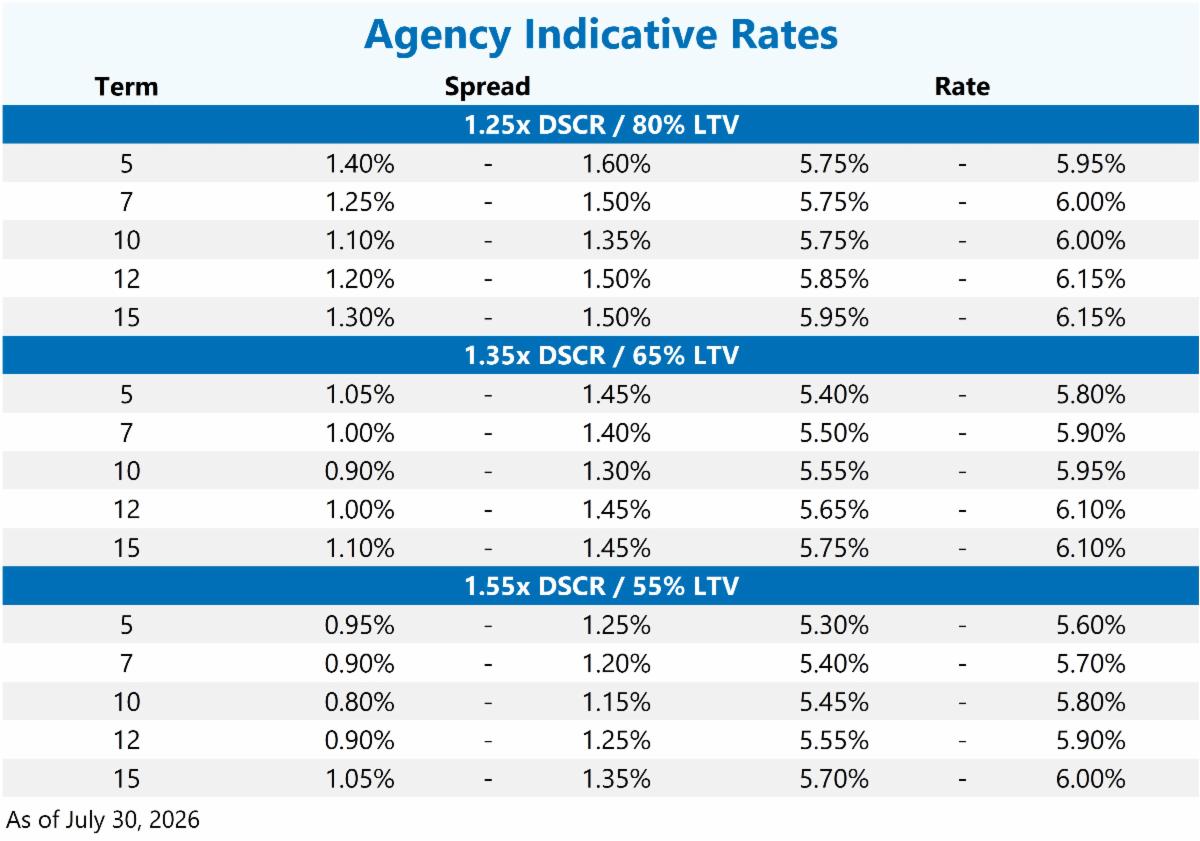
5.45%
0.80% + 10yr UST
Low leverage multifamily refinance | Life Company
5.85%
1.20% + 10yr UST
Low leverage multifamily refinance | | | |
Key takeaways
- The Federal Reserve voted 9-3 yesterday to hold the Federal Funds Rate at 3.50%-3.75%, with Dallas Fed President Lorie Logan, Cleveland Fed President Beth Hammack, and Minneapolis Fed President Neel Kashkari dissenting in favor of a quarter-point rate increase. Fed Chair Kevin Warsh's press conference noted that nominal and real yields are materially higher and reaffirmed the Fed's 2% inflation target with no "soft" target option. Swap markets now price greater than 60% probability of a September hike, down from over 90% earlier in the week.
- Middle East tensions escalated following the FOMC press conference, with U.S. and Iran exchanging airstrikes. Front-month Brent Crude Oil futures are hovering near $90/barrel today, while Treasury yields have steepened, particularly on the long end—the 30-year Treasury yield reached a 19-year high yesterday and peaked at 5.24% this morning as bondholders demand higher yields to compensate for inflation risks.
- Economic data released this morning showed slowing growth and modestly slower inflation: Q2 GDP arrived at +1.5% (vs. +2.0% expected), Core PCE at +0.1% monthly and +3.3% annually (vs. +0.2% expected), and personal income and spending slightly below forecasts. Rate lock volume in Fannie Mae DUS/MBS has recovered somewhat to approximately $425+ million week-to-date through Wednesday's close, with spreads holding fairly flat to ±1 basis point.
The Federal Reserve's decision to hold rates steady at yesterday's FOMC meeting was widely anticipated, but three dissents—the most since the current rate cycle began—underscore the Committee's growing hawkish sentiment regarding above-target inflation. Fed Chair Kevin Warsh's press conference emphasized that nominal and real yields are materially higher and reiterated the Fed's commitment to restoring the 2% inflation target, noting there is no "soft" target option.
While the statement was nearly identical to the prior meeting, the shift in market expectations is notable: swap markets have recalibrated a September hike to greater than 60% probability (down from over 90% at the start of the week), reflecting Warsh's reduced forward guidance and the incoming economic data showing slowing growth and moderating inflation pressures. The Fed Chair also confirmed that press conferences will continue following FOMC meetings for at least the remainder of 2026.
Following the FOMC press conference yesterday afternoon, U.S. and Iran exchanged airstrikes, reigniting geopolitical tensions. Front-month Brent Crude Oil futures are hovering near $90/barrel today, reflecting the ongoing uncertainty regarding potential broader Middle East conflict. On the fixed income front, Treasury yields have steepened dramatically, particularly along the long end of the curve, as bond investors demand higher yields to compensate for inflation risks in the face of the Fed's cautious stance.
The 30-year Treasury yield reached a 19-year high yesterday and peaked at 5.24% this morning. The Committee's focus on inflation and delayed easing has market participants reassessing the trajectory of longer-dated yields, even as near-term rate expectations have moderated slightly. Market commentary from fixed income strategists reflects divided views on the Fed's path forward: some believe the Fed's restraint and reduced guidance allows markets to price, while others caution that being hawkish without acting risks losing credibility if inflation re-accelerates.
Yesterday's FOMC hold with three dissents and the release of cooler-than-expected economic data this morning—including Q2 GDP at +1.5% and Core PCE at +0.1% monthly—have modestly reduced the probability of a September rate hike from over 90% at the start of the week to greater than 60% today. However, the steepening in Treasury yields, particularly along the long end (30-year yields reaching 5.24%), reflects bond investors' concerns about the Fed's cautious stance and the persistence of inflation risks despite the recent moderation.
Going forward, this week's remaining economic data—Weekly Jobless Claims, remaining PCE/GDP components, and next week's Employment Cost Index—could influence market expectations heading into September. Combined with ongoing U.S.-Iran tensions and potential Middle East disruptions, volatility is likely to remain elevated across Treasuries and agency lending spreads. The disconnect between moderating growth, moderating inflation, and still-elevated long-duration yields creates opportunity for investors to reassess positioning in fixed income markets.
| | |
Trading in new issuance Agency CMBS was light again due to the heightened Treasury yield environment, though there have been pockets of strength in spread activity given the higher “all-in” rates and yields for Agency CMBS buyers.
New issuance Fannie Mae DUS/MBS rate lock volumes finished the week at only ~$440 million, and Freddie Mac Multifamily Participation Certificate (PCs) volumes totaled around $960 million last week, slightly below the previous week.
Freddie Mac priced its $1.1 billion Conventional 10-year Fixed-Rate K-181 loan this week inside of expectations, which also helped modestly tighten investor spreads in the Fannie Mae DUS/MBS sector last week. Investor demand remains healthy as the heightened yield environment has attracted activity across all major tenors.
The tightest investor spreads continue to favor block-sized, full-term interest-only loans and transactions with interest-rate buydowns. Ginnie Mae PL and CL generic spreads held flat week-over-week in light new issue trading. Corporate credit spreads in the Markit CDX Investment-Grade 5-year Index and Bloomberg Single-A Industrials 10-year Index were both 1-2 basis points wider last week. Last week, corporate issuance fell to its lowest level in months and well below dealer forecasts as elevated funding costs weighed on borrower appetite.
Quick hits
- Overall, spreads decreased 1 bp during the trading session and since last month remain in a 3-bps window, a very positive sign for Agency markets.
- Half of the overall volume last week rate locked on Monday, so expect a more regular trading week in Agency volume. Also, many Agency loans continue to be 5-year terms.
Fannie Mae
- BWE has seen the second highest YoY increase in volume of lenders within the top 10 of Fannie Mae originators.
- One of the great benefits of the Fannie Mae program is the delegation that allows BWE to make many of its credit decisions in house. As a result, often BWE can get to a slightly higher underwritten net cash flow with Fannie over Freddie.
- Fannie has proven to be a great fit for loans coming out of stabilization on either a Near Stabilized or a “T1” option with a need to underwrite to budgeted expenses supported by appraisal and comps.
- In the current environment, Fannie is reluctant at times to give pricing breaks needed on lower leveraged loans compared to Freddie Mac. While this is a constantly moving target, it has been the case for the past two weeks.
Freddie Mac
- The Agency is getting more competitive as of late and winning several high-quality transactions.
- Freddie posted $6.2 billion for the month of June compared to Fannie’s $4.5 billion in loan volume.
- BWE saw 3 of 4 new applications sign up with Freddie last week with several $50 million plus type opportunities where the business is leaning toward Freddie Mac.
- Freddie loves large transactions and acquisitions with fresh capital being invested. The Agency’s net cash flow underwriting can be the most competitive on loans with stabilized operating histories and a clear track record on expenses.
- Here are some specifics as it relates to Freddie Mac
- Index lock program continues to be a great tool in the current environment.
- Spreads are held for 60 days and able to be extended for 1 basis point per week, enabling clients to manage existing maturities while taking some rate risk off the table.
- Fixed-rate, flexible prepayment options, e.g. 7-year loan with 5 years YM verses 6.5 years defeasance, costs 17-18 bps compared to 20-23 bps with Fannie Mae.
- For clients who own 2,500 units are more, Freddie is willing to go to a 70% LTV on a refinance with a 35-year amortization (Fannie is limited to 65%).
- For clients owning 5,000 units, Freddie has combined 35-year amortization and FTIO on multiple transactions.
- Despite Fannie making several recent improvements to their SARM, Freddie continues to be the lender of choice with respect to floating rate debt.
Loan highlights
Fannie Mae refinance of construction loan
- $29 million
- 70% LTV / 113 bps spread
- 10-yr term / 7 yrs IO
- 35-yr amort
Fannie Mae refinance for strong, repeat client
- $13.2 million
- 65% LTV / 110 bps spread
- 10-yr term / FTIO
- Waived 1% prepay
| | |
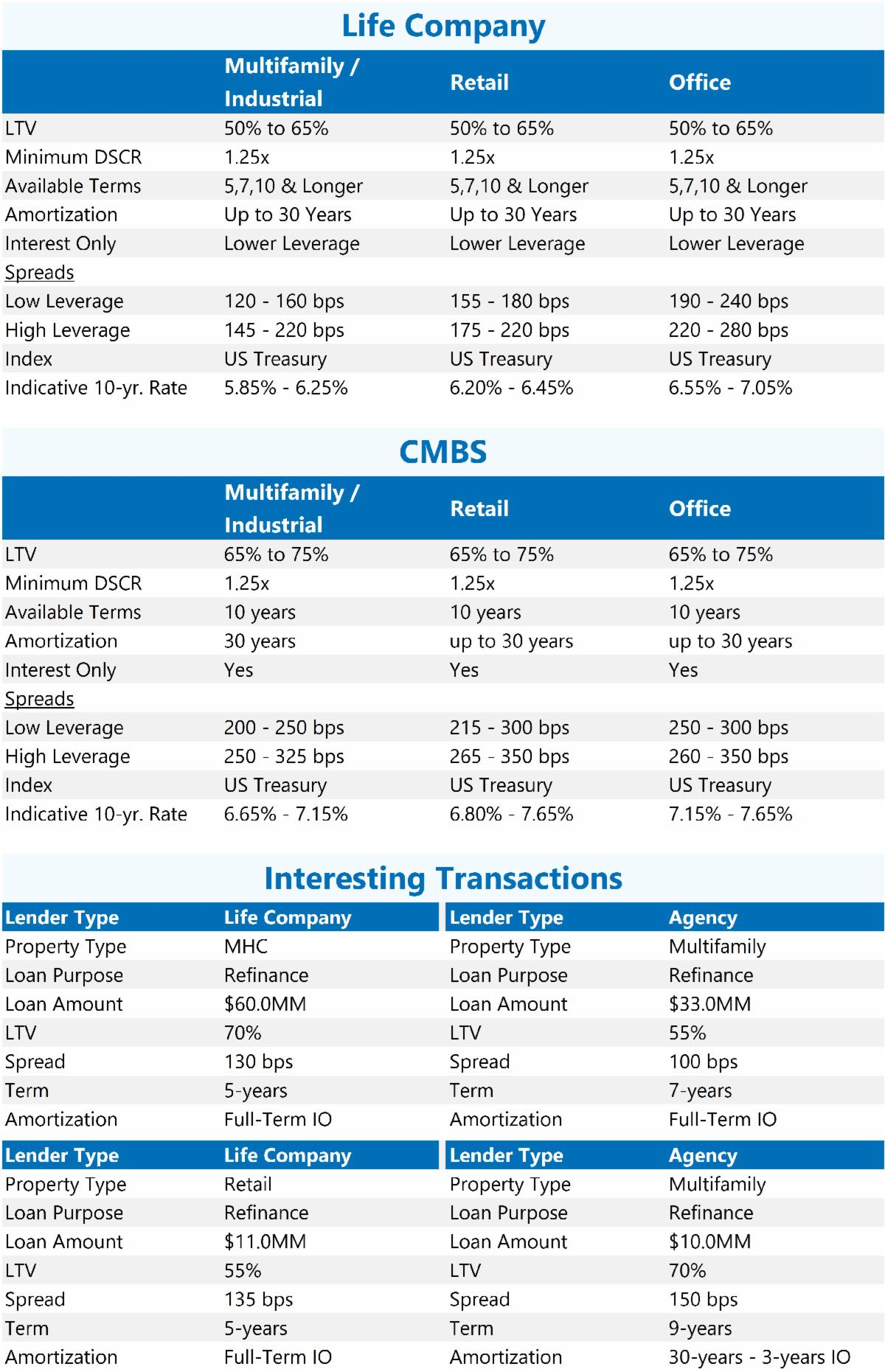
Life Company lenders reported strong loan volumes despite volatility from the U.S. Treasuries. Deal flow is down by ~10% compared to a year ago, however, there is optimism that volume will increase as tensions ease in the Middle East.
Lenders are responsive to loan requests and continue to show a willingness to get more competitive by improving metrics to win good loan opportunities. Early into the second half of the year, many lenders still have substantial capital to deploy.
Indicative spreads have remained consistent generally within the range of 130-180 basis points for well-located, good-quality assets. Lenders have quoted lower spreads by as much as 10-20 bps on very low leveraged requests on high-quality assets with strong borrowers.
| | |
U.S. CMBS issuance remained steady in recent weeks and now totals approximately $67.1 billion year‑to‑date, ahead of the $59.3 billion level at this point last year. Conduit spreads have been largely range-bound, with 10‑year AAA spreads currently at 73 basis points over Treasuries—consistent with the trailing 12‑month average of approximately 76 basis points.
Borrower spreads, likewise, have remained range‑bound over the past several months. Ten‑year CMBS loans are generally pricing at 200–225 basis points over Treasuries, while five‑year CMBS loans are pricing in the low‑to‑mid 200 basis point range. For high‑quality, low‑leverage transactions, pricing can be as low as 150 basis points over Treasuries.
Multifamily assets continue to attract strong lender demand, with CMBS lenders maintaining a willingness to offer full‑term, interest‑only structures. These loans allow borrowers to maximize proceeds, with underwriting typically supporting a 1.25x DSCR on an interest‑only basis. In addition, several CMBS lenders have secured dedicated B‑buyers for multifamily‑only securitizations, enabling the introduction of “stretch senior” executions. These loans are generally priced at 180–225 basis points over Treasuries and can be sized down to a 1.20x DSCR on an interest‑only basis.
Other property types, including office, have also benefited from the availability of full‑term, interest‑only financing. However, these transactions are subject to more conservative leverage constraints, higher debt yield requirements, and tighter overall underwriting standards compared to multifamily loans.
| | |
About BWE
Bellwether Enterprise (BWE) is one of the nation's largest privately-owned real estate financing companies. Its trusted advisors combine innovation, extensive experience and strong lender relationships to optimize a loan's capital stack for commercial and multifamily investors, developers and property owners. For more information, visit BWE.com.
| | |
Opinions, estimates, forecasts and all other information contained in this document are those of Bellwether Enterprise Real Estate Capital, LLC (“Bellwether”) and should not be construed as indicating Bellwether’s business prospects or expected results. Although Bellwether attempts to provide reliable, useful information, it does not guarantee that the information or other content in this document is accurate, current, or suitable for any particular purpose. All content is provided on an “as is” basis, with no warranties of any kind whatsoever and is subject to change at any time without notice. Information in this document may not be used without permission from Bellwether. This document is not intended to be an offer to buy or sell or a solicitation of an offer to buy or sell securities, if any, referred to herein.
Bellwether Enterprise Real Estate Capital, LLC (BWE) conducts business through Bellwether Enterprise Mortgage Investments, LLC – Mortgage Banker license #BK-1007784 – the Department of Financial Institutions State of AZ (Fannie Mae transactions), as well as Bellwether Enterprise Real Estate Capital, LLC – Mortgage Banker License #BK-1007825 – the Department of Financial Institutions State of AZ (all other transactions).
| | | | |