September 17, 2026 | BWE Arizona | Putting clients first. Trusted to be part of their future. | | | Agency
5.75%
0.80% + 10yr UST
Low leverage multifamily refinance | Life Company
6.15%
1.20% + 10yr UST
Low leverage multifamily refinance | | |
- The Summary of Economic Projections from monetary policymakers' forecasts Core Personal Consumption Expenditures (PCE) rising to 3.4%, headline PCE to 3.7%, unemployment cut to 4.1%, and GDP lifted to 2.3%.
- The CME FedWatch Tool put October near a coin flip at roughly 51% for another quarter-point move, with almost a 37% chance of a third rate hike at the December meeting.
- Brent Crude Oil pushed toward roughly $108 midweek on geopolitics before settling near $104 at this writing, keeping upward pressure on the inflation outlook.
- The Bureau of Economic Analysis annual revision to the historical core PCE series, due September 30, could lower measured core PCE by roughly 0.2% to 0.3%, softening the case for an October move.
- August retail sales rose 1.2% against a 0.8% survey, and August import and export prices ran hotter than expected, reinforcing the inflation side of the Fed’s framing.
- Weekly labor data today showed continued strength. Initial jobless claims fell below 200K to 196K, and continuing claims dropped to their lowest since January 2024, reinforcing Warsh’s full-employment framing.
Key takeaways from this week’s FOMC Meeting
- Removing accommodation: The Federal Reserve voted unanimously to raise the target range for the Federal Funds Rate by a quarter point to 3.75-4.00%. It was the first rate increase since July 2023 with the statement framing the move as support for a "timelier" return to the 2% inflation goal.
- Dots skew hawkish: The Dot Plot showed 16 of 18 policymakers penciled in at least one more rate hike for 2026. While the median projection doesn't demonstrate any movement in 2027, the distribution skewed higher and removed the cut previously projected for next year. The longer-run neutral rate moved to its highest level in a decade to 3.25%.
- The brief: Fed Chair Warsh once again ran a tight press conference, consistent with his pared-back communication style, with it being notably shorter than prior engagements as he limited reporters to one question apiece. However, he did offer more insight in the reaction function that stoked the hike, crediting a strengthening economy, inflation trends that were not passing the test, and a shifting geopolitical backdrop. He attributed higher long-term yields to economic strength, competition for capital, and geopolitics.
- Seller's remorse?: Warsh described the hike three times at the press conference following the FOMC rate decision as having "removed a dose of accommodation,” signaling further tightening ahead with the hike being the first blush of potentially unwinding last year's 75 bps of cuts to support a then slowing labor market.
- Bear flattener: The policy sensitive 2-year jumped above 4.70% into the decision, its highest level since 2024, driven by the higher expected policy path ahead. The 10-year had its second consecutive close above 5% - the first such occurrence since 2007 - before retreating today to nearly 4.95%. This caused the yield curve to flatten (bear flatten – when short end yields rise faster than the longer end yields) the 2-to-10-yield to roughly 27 basis points, to its narrowest since April 2025.
| | |
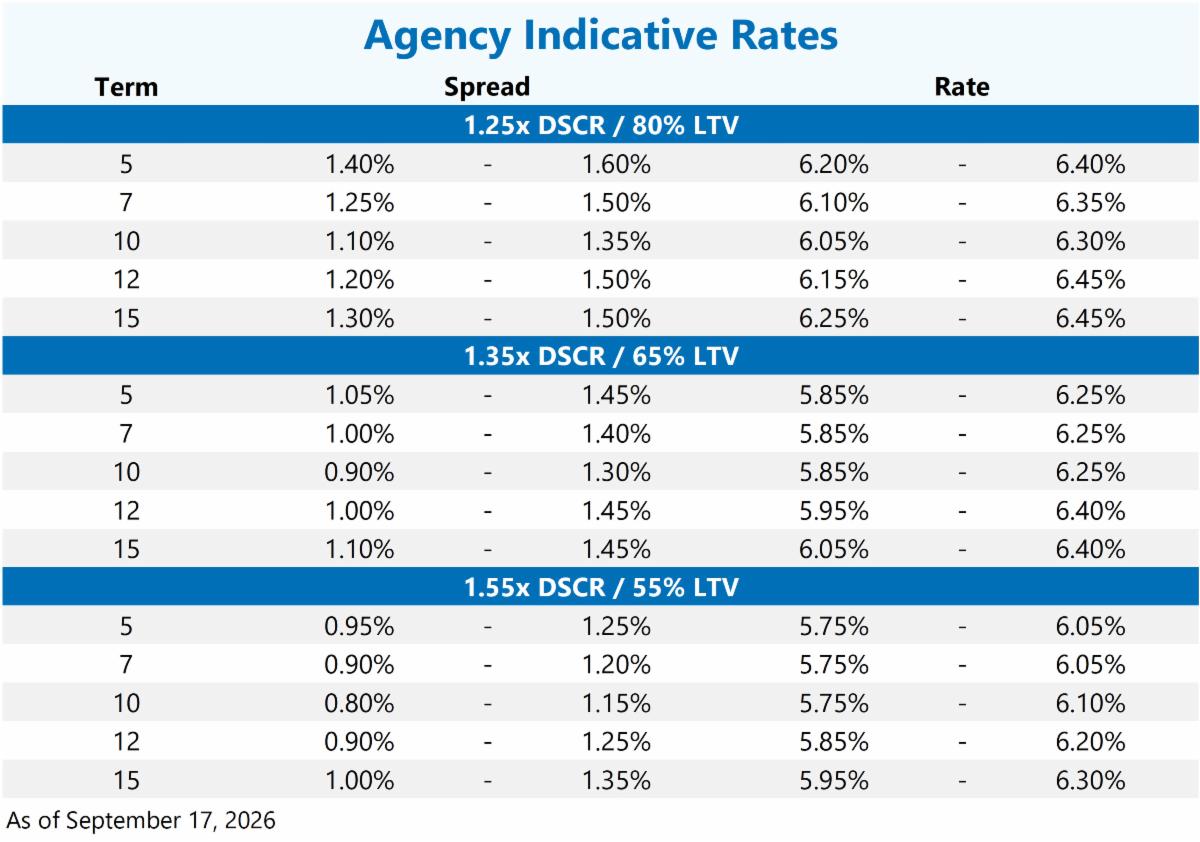
FNMA rate lock volume down: Elevated Treasury yields and a shortened holiday week kept Fannie Mae DUS/MBS lending at roughly $200 million pricing. The last time this occurred was in July 2024. Investor demand for Agency products held firm as spreads across standard structures saw little change, holding near YTD averages.
Freddie Mac resumed issuance following its customary two- to three-week August quiet period and was the more active issuer, pricing its K-182 transaction, a $1.15 billion 10-year K-Deal, alongside the ML-37 deal, a $371 million tax-exempt offering. Freddie also brought roughly $800 million of Multifamily Participation Certificates to market, including fixed-rate and callable structures ranging from 5- to 15-years and floating-rate paper in the 7- to 10-year part of the curve.
In broader credit, corporate spreads widened modestly, with the Bloomberg Single A 10-year index about 3 bps wider on the week to 68 bps, above its YTD average of roughly 62 bps, while the Markit CDX IG 5-year widened about 1-51 bps, still inside its YTD average of about 53 bps. Investment-grade desks priced nearly $68 billion of supply, just shy of the $70 billion forecasted for the week.
Quick hits
- Making deals work: Considering the current Treasury market, BWE has been pushing both Agencies to offer more aggressive solutions on opportunities that include the following features.
- 35-year amortizations for sponsors that own 2,500 units or close to it
- Lower DSCR at 1.20x combined with a 35-year amortization for clients who own close to 10,000 units
- Increased buydowns: Freddie will consider a 3% buydown for repeat clients below the normal 2%, which could translate into 62 bps lower spread on a 5-year loan
- Index locks and extended spread hold periods: Allow borrowers to lock in their interest rate to remove uncertainty during the closing process
- Spreads remain low: Sub 100 bps spreads before buydowns for low leveraged Agency loans; BWE recently quoted an 87 bps spread before buydown.
Loan highlights
Fannie Mae apartment construction takeout - Columbus, OH
- $30 million
- 65% LTV / 1.25x DSCR
- 149 bps spread, no buydown
- 7-yr term / FTIO / 35-yr amort
Freddie Mac early rate lock refinance - Richmond, VA
- $35 million
- 65% LTV / 1.25x DSCR
- 121 bps spread, no buydown, 95-day hold period
- 10-yr term / FTIO
| | |
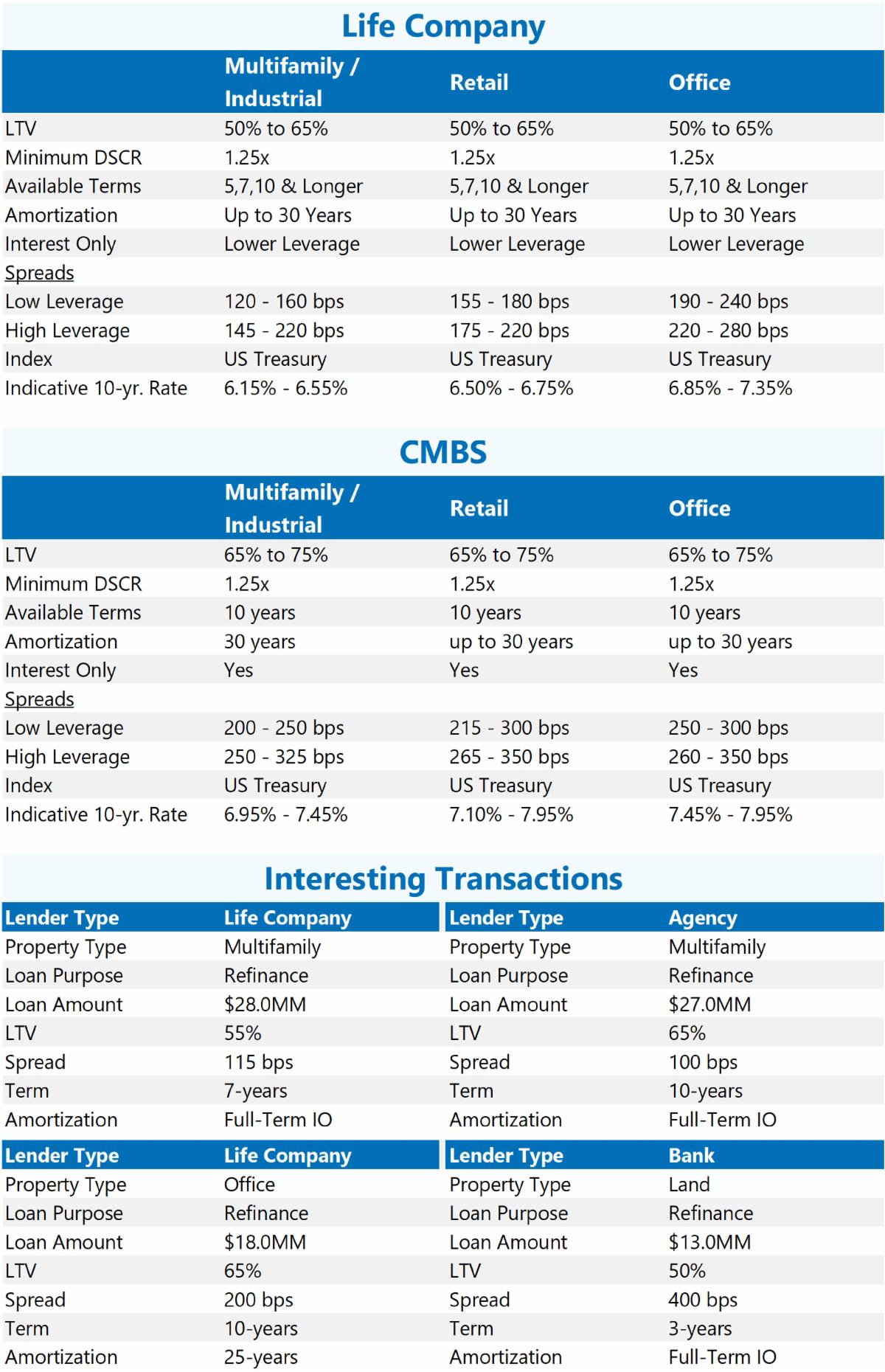
Life Company lenders have noted a lower volume of deal flow, partly due to the usual summer slowdown and partly due to the uncertainty of the rising U.S. Treasuries. Lenders have not indicated a willingness to lower spreads to offset the higher U.S. Treasuries, keeping indicative spreads unchanged and generally landing in the range of 130-180 bps for well-located, good-quality assets.
However, lenders have quoted spreads as low as 115 bps to win high-quality and low-leveraged properties. Heading into the fourth quarter, most lenders still have short- and long-term capital allocations to place with some responding to borrower demand for floating rate capital.
| | |
U.S. CMBS issuance has slowed in recent weeks and now totals approximately $91.5 billion year‑to‑date, ahead of the $83.2 billion level at this point last year. Conduit spreads have tightened recently with 10‑year AAA spreads currently at 69 bps over Treasuries, tighter than the trailing 12‑month average of approximately 75 bps. Borrower spreads have remained range‑bound over the past several months. Ten‑year CMBS loans are generally pricing at 200-225 bps over Treasuries, while five‑year CMBS loans are pricing in the low‑to‑mid 200 bps range. For high‑quality, low‑leverage transactions, pricing can be as low as 150 bps over Treasuries.
Multifamily assets continue to attract strong lender demand with CMBS lenders maintaining a willingness to offer full‑term, interest‑only structures. These loans allow borrowers to maximize proceeds with underwriting typically supporting a 1.25x DSCR on an interest‑only basis. In addition, several CMBS lenders have secured dedicated B‑buyers for multifamily‑only securitizations, enabling the introduction of “stretch senior” executions. These loans are generally priced at 180-225 bps over Treasuries and can be sized down to a 1.20x DSCR on an interest‑only basis.
Other property types including office have also benefited from the availability of full‑term, interest‑only financing. However, these transactions are subject to more conservative leverage constraints, higher debt yield requirements, and tighter overall underwriting standards compared to multifamily loans.
| | |
About BWE
Bellwether Enterprise (BWE) is one of the nation's largest privately-owned real estate financing companies. Its trusted advisors combine innovation, extensive experience and strong lender relationships to optimize a loan's capital stack for commercial and multifamily investors, developers and property owners. For more information, visit BWE.com.
| | |
Opinions, estimates, forecasts and all other information contained in this document are those of BWE and should not be construed as indicating BWE’s business prospects or expected results. Although BWE attempts to provide reliable, useful information, it does not guarantee that the information or other content in this document is accurate, current, or suitable for any particular purpose. All content is provided on an “as is” basis, with no warranties of any kind whatsoever and is subject to change at any time without notice. Information in this document may not be used without permission from BWE. This document is not intended to be an offer to buy or sell or a solicitation of an offer to buy or sell securities, if any, referred to herein.
Bellwether Enterprise Real Estate Capital, LLC (BWE) conducts business through Bellwether Enterprise Mortgage Investments, LLC – Mortgage Banker license #BK-1007784 – the Department of Financial Institutions State of AZ (Fannie Mae transactions), as well as Bellwether Enterprise Real Estate Capital, LLC – Mortgage Banker License #BK-1007825 – the Department of Financial Institutions State of AZ (all other transactions).
| | | | |