June 4, 2026 | BWE Arizona | Putting clients first. Trusted to be part of their future. | | | Agency | Life Company | | 5.25%
0.80% + 10yr UST
Low leverage multifamily refinance | 5.65%
1.20% + 10yr UST
Low leverage multifamily refinance | | | |
Key takeaways
If payrolls come in materially weaker than expected, we could see a Treasury rally and some mortgage pricing improvement. A stronger print especially alongside elevated oil prices and Middle East concerns could keep pressure on the 10-year and reinforce a “higher for longer” Fed narrative.
Global trade and geopolitics
- Market attention has shifted back toward geopolitical risk following renewed military escalation in the Middle East.
- Concerns are rising around
- Potential disruptions to shipping through the Strait of Hormuz, and
- Risks to global oil supply.
- Increased geopolitical uncertainty has contributed to a more cautious tone across broader financial markets.
Federal Reserve and monetary policy
- Markets are focused on upcoming labor market data ahead of the June FOMC meeting.
- Key economic releases this week include JOLTS job openings, ADP employment change, weekly jobless claims, and nonfarm payrolls (Friday keynote report).
- These reports are expected to play a meaningful role in shaping market expectations for Fed policy direction.
Treasury and credit markets
- 10-year Treasury yield moved higher to approximately 4.50%.
- Primary drivers included
- Rising oil prices,
- Increased geopolitical concerns, and
- Positioning ahead of major labor market reports.
- Agency CMBS and corporate credit spreads were generally stable.
- Market conditions continued to reflect
- Investor selectivity,
- Orderly credit market functioning, and
- Continued monitoring of rates, energy prices and geopolitical developments.
| | |
Rate lock volume rebounds
DUS lender rate lock activity across new issue Fannie Mae DUS/MBS breached over $1.2 billion during the holiday-shortened trading week, presenting the strongest weekly tally in seven weeks. This pick up likely reflected healthy month-end flows to rate lock and seemingly benefited from the drop in Treasury yields – though this rate movement is under pressure this week.
Rate locks included a variety of structures across the spectrum of standard 5-, 7-, and 10-year loans. Traders reported that longer-duration loans, particularly those 10 years or more, continue to draw strong client interest. Additionally, block-sized transactions of $25 million or more have drawn several aggressive client bids from investors, improving overall execution for those loans.
Spreads across standard structured 5-, 7- and 10-year Fannie Mae DUS/MBS were unchanged though there was a slight tightening in 12- and 15-year spreads. Traders report that activity in the Ginnie Mae sector remains modest with generic project loans' and construction loans' spreads holding steady to slightly wider week-over-week. Corporate credit spreads across the Markit CDX Investment-Grade 5-year Index and the Bloomberg Single-A Industrials 10-year Index were similarly unchanged.
Fannie Mae observations
- General winning trend: In loans for properties that are finishing lease up or getting close to stabilization and with limited operating history, Fannie gets to a higher NOI than Freddie Mac relying on borrower budget with solid comp support.
- Credit facility minimum dropped from $250MM to $150MM. New relationships likely must hit the $150MM and repeat customers may get flexibility.
- Structured Adjustable-Rate Mortgages (SARMs): They really want to compete here, and a SARM is where the loan starts out as an adjustable rate and then can be converted to fixed during the loan term. To compete, they are now considering a 2-year initial cap term (by waiver) and looking at rate buydowns on SARMs – a caveat is the fixed-rate equivalent has to get a buydown too.
- Modular homes: A guide adjustment is coming and may be more open to quoting modular business. Insurance has not been an issue.
- BWE positioning: Our profile with Fannie is as high as it has ever been. Submission quality is best-in-class; the customer engagement team confirmed that BWE gets the fastest turnaround in the entire DUS network.
Freddie Mac observations
- General winning trend: In acquisitions and stabilized loans coming up for refinance, Freddie offers competitive pricing/terms and wins a high percentage of these loans.
- Posture is aggressive and they are very focused on hitting their $88B allocation this year.
- Pricing 10-20 bps inside Fannie in recent competitive situations.
- Freddie will not be very competitive on sub-$20MM business, swinging hard on bigger chunk loans as rates climb and bank competition picks up.
- Time to strike while the iron is hot; general expectation is for things to swing back toward Fannie later in the year.
- For larger sponsors (~10K units): Freddie will consider 1.20x DSCR + 35-year amort on 10-year loans. May extend down to ~5K units in select markets or certain situations.
- Index locks attractive right now given Treasury volatility.
- Known challenge: Getting into Freddie’s NOI is tough, but they are willing to engage on loan dollar feedback.
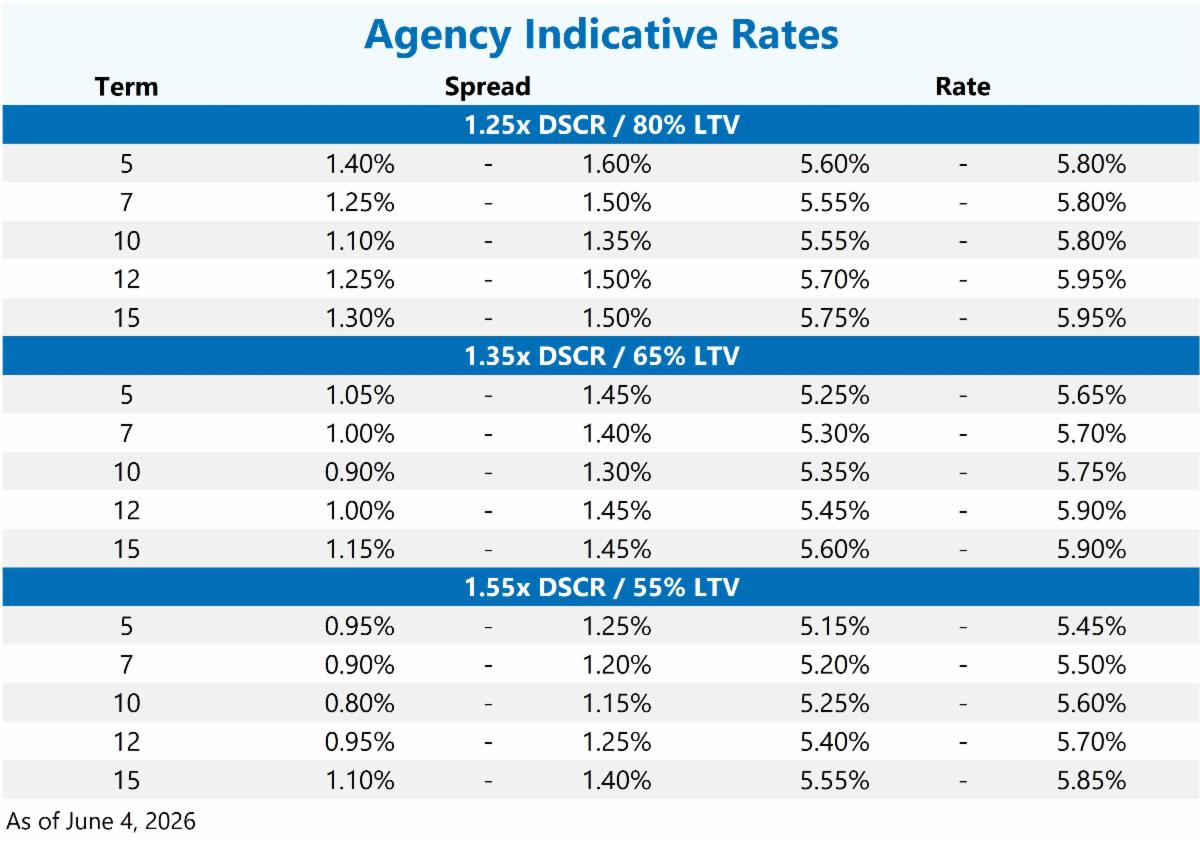
Agency spreads remain very low
- 10-year structures are seeing the lowest spreads.
- Sub 100 spreads for low leveraged, 10-year business.
- Spreads as low as 115-120 over for full leveraged 10-year business.
Loan highlights
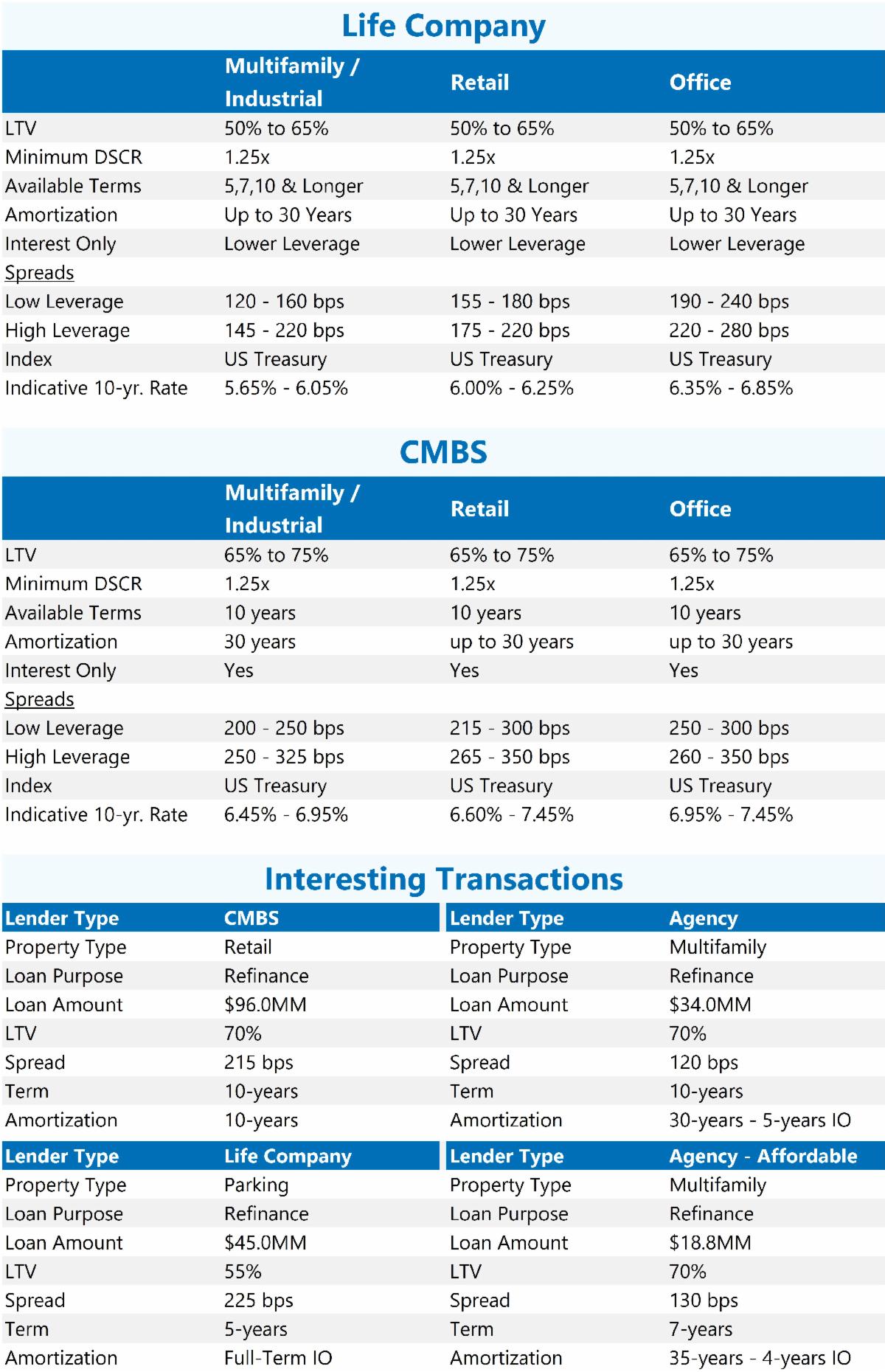
Freddie Mac Refinance
- $34 million
- 65% LTV / 10-yr term / FTIO
- 50 bps buydown
Freddie Mac TAH (Affordable) Refinance
- $18.8 million
- 70% LTV / 7-yr term / 4 yrs IO
- 35-yr amort
- 130 bps spread
| | |
Life Company origination activity remains slow but steady over the past two weeks due to the ongoing uncertainty surrounding inflation and the geopolitical tensions in the Middle East. Lender origination volume is down nearly 10% compared to a year ago but indicated there has been an uptick in 10-year loan term requests citing borrower capitulating to the fact interest rates may not materially decline anytime soon.
Recent elevated stability in the capital markets has led Life Company lenders to maintaining spreads between 130-180 bps for good opportunities on quality properties in desirable locations. Lenders have continued their use of index floors to stave off possible intra-day U.S. Treasury fluctuations, generally as a reaction to market news.
| | |
U.S. CMBS issuance has accelerated in recent weeks and now totals approximately $56.7 billion year‑to‑date, ahead of the $51.7MM level at this point last year. Conduit spreads have been largely rangebound, with 10‑year AAA spreads currently at 74 basis points over Treasuries—consistent with the trailing 12‑month average of approximately 78 basis points.
However, borrower spreads have remained range‑bound over the past several months. Ten‑year CMBS loans are generally pricing at 200–225 basis points over Treasuries, while five‑year CMBS loans are pricing in the low‑to‑mid 200 basis point range. For high‑quality, low‑leverage transactions, pricing can be as low as 140 basis points over Treasuries.
Multifamily assets continue to attract strong lender demand with CMBS lenders maintaining a willingness to offer full‑term, interest‑only structures. These loans allow borrowers to maximize proceeds, with underwriting typically supporting a 1.25x DSCR on an interest‑only basis. In addition, several CMBS lenders have secured dedicated B‑buyers for multifamily‑only securitizations, enabling the introduction of “stretch senior” executions. These loans are generally priced at 180–225 basis points over Treasuries and can be sized down to a 1.20x DSCR on an interest‑only basis.
Other property types, including office, have also benefited from the availability of full‑term, interest‑only financing. However, these transactions are subject to more conservative leverage constraints, higher debt yield requirements, and tighter overall underwriting standards compared to multifamily loans.
| | |
About BWE
Bellwether Enterprise (BWE) is one of the nation's largest privately-owned real estate financing companies. Its trusted advisors combine innovation, extensive experience and strong lender relationships to optimize a loan's capital stack for commercial and multifamily investors, developers and property owners. For more information, visit BWE.com.
| | |
Opinions, estimates, forecasts and all other information contained in this document are those of Bellwether Enterprise Real Estate Capital, LLC (“Bellwether”) and should not be construed as indicating Bellwether’s business prospects or expected results. Although Bellwether attempts to provide reliable, useful information, it does not guarantee that the information or other content in this document is accurate, current, or suitable for any particular purpose. All content is provided on an “as is” basis, with no warranties of any kind whatsoever and is subject to change at any time without notice. Information in this document may not be used without permission from Bellwether. This document is not intended to be an offer to buy or sell or a solicitation of an offer to buy or sell securities, if any, referred to herein.
Bellwether Enterprise Real Estate Capital, LLC (BWE) conducts business through Bellwether Enterprise Mortgage Investments, LLC – Mortgage Banker license #BK-1007784 – the Department of Financial Institutions State of AZ (Fannie Mae transactions), as well as Bellwether Enterprise Real Estate Capital, LLC – Mortgage Banker License #BK-1007825 – the Department of Financial Institutions State of AZ (all other transactions).
| | | | |