October 29, 2026 | BWE Arizona | Putting clients first. Trusted to be part of their future. | | | Agency
5.90%
0.90% + 10yr UST
Low leverage multifamily refinance | Life Company
6.20%
1.20% + 10yr UST
Low leverage multifamily refinance | | | |
Key takeaways
- The Fed held rates but sounded hawkish, and the data this week supports that. Growth is strong, inflation is stubborn, and real consumer income is softening.
- Elevated Treasury yields and rate uncertainty will keep weighing on refinancing, acquisition financing, and new development through year-end.
- Rate volatility is a risk for borrowers timing financing commitments.
Federal Reserve and policy
- The FOMC voted 10-2 on October 28 to hold at 3.75%-4.00%, after September’s 25 bps hike.
- Lisa Cook and Beth Hammack dissented in favor of another 25 bps hike.
- The statement upgraded growth to “strong” and said inflation “remains elevated.”
- Chair Warsh declined to signal a December move. He said he doesn’t favor forward guidance, that financial conditions have tightened, and that the post-election period is “information-rich.”
- Warsh flagged rising oil futures and said politics played no role in the decision.
- From 2027 the FOMC will hold one strategy-only meeting a year with no rate decision, rising to two of eight in 2028. Analysts expect this could raise volatility around the remaining meetings.
Rate expectations
- Markets are increasingly focused on further tightening rather than near-term easing.
- Swaps price about 80% odds of a hike at the December 8-9 meeting, slightly lower than earlier in the week.
- Some commentators’ question Warsh’s rationale for the hold, and a few have floated midterm politics, which he denied.
Treasury yield levels
- At yesterday's close: 2-year Treasury yield finished at 4.70%, 10-year Treasury yield ended at 5.015%, and 30-year Treasury yield settled at 5.34%.
- This morning, Treasury yields drifted slightly lower throughout the curve on softer tech firm earnings and an as-expected PCE inflation report.
Growth and employment
- Q3 GDP rose 3.4% annualized, up from 2.2% in Q2 and ahead of the 3.2% expected. It was the fastest pace in a year.
- Growth was led by investment (inventories and information-processing equipment), consumer spending, and government spending, partly offset by lower exports.
- Real final sales to private domestic purchasers rose 4.9%, showing solid underlying demand.
- September payrolls rose only 29,000, with unemployment steady at 4.2%. Hiring is slowing without a jump in unemployment.
Inflation and the consumer
- September CPI rose 0.6% m/m and 3.7% y/y, with energy a major contributor.
- PCE rose 3.6% y/y, in line with expectations. Core PCE rose 3.1% y/y, about 110 bp above the 2% target.
- Nominal spending rose 0.5%, but real spending was flat. Personal income rose 0.2%, real disposable income fell 0.3%, and the saving rate dropped to 3.8%.
- Consumer is stretched. Barclays’ Marc Giannoni expects spending to moderate as households run down savings.
Energy and geopolitics
- Oil is the key swing factor. Strait of Hormuz supply risks and talk of possible U.S. escalation with Iran after the midterms keep energy pass-through into inflation central to the Fed’s thinking.
| | |
It is that time of year when CRE industry conferences and events start to ramp up. Below is a shortlist of regional/national conferences where you can find us. If there is an event you think we should check out, please let us know by emailing Carla Goettsch.
November 4-6
Manufactured Housing Institute (MHI) National Communities Council Fall Leadership Forum, Chicago, IL
January 26-28
National Multifamily Housing Council (NMHC) Apartment Strategies + Annual Meeting, Las Vegas, NV
February 7-9
Mortgage Bankers' Association (MBA) Commercial/Multifamily Finance Convention and Expo, San Diego, CA
| | |
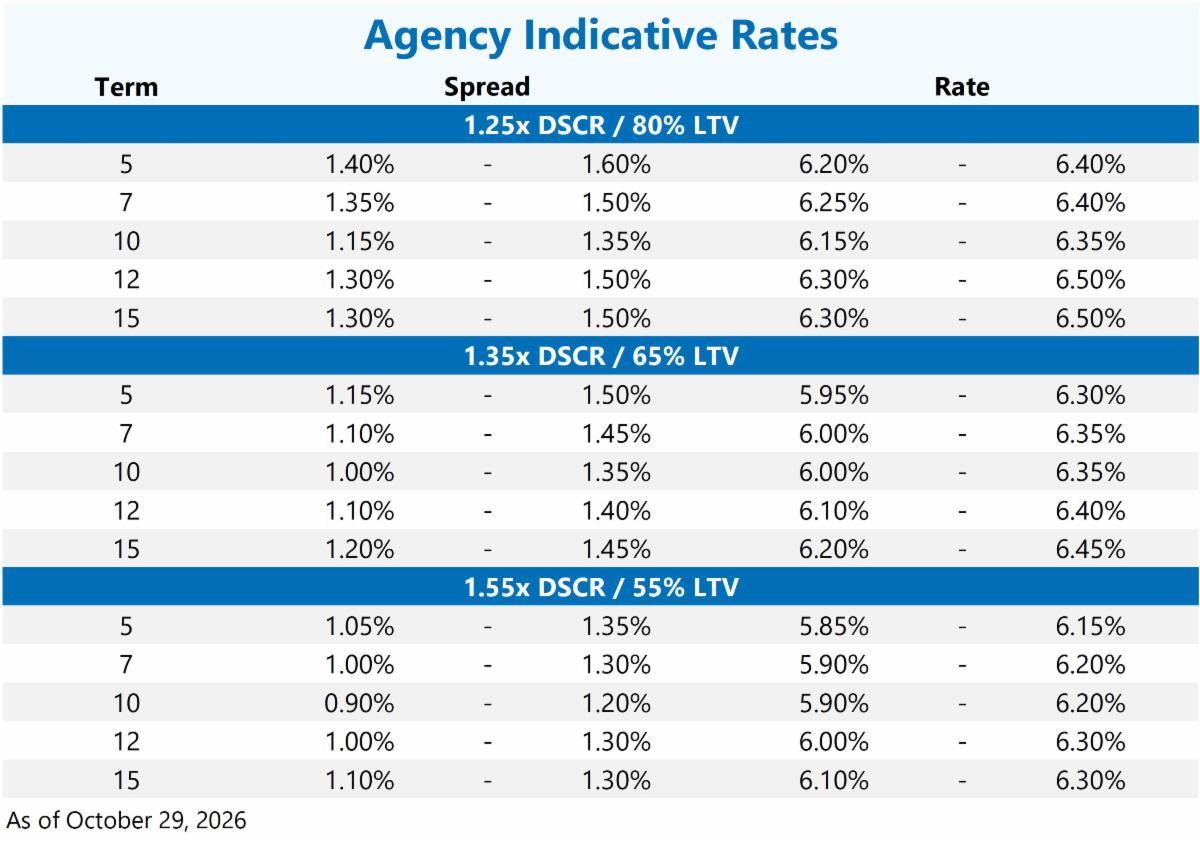
Agency CMBS issuance rescinded modestly on the Fannie Mae DUS/MBS side, totaling approximately $700 million in rate locks, surprisingly low given the move in yields. Through the past four weeks, Fannie Mae DUS/MBS rate locks have averaged approximately $820 million, roughly right on par with the year-to-date weekly figure. Freddie Mac priced its $250 million supplemental FHMS K-J55 deal last week, and this week holds their $971 million 7-year conventional transaction, the K-769 deal.
Agency CMBS spreads themselves remain in a choppy, price-discovery mode following several weeks of notable widening on longer-duration paper. The latest moves in spreads have effectively unwound the spread tightening seen during the first ~9 months of this year, whereas the current level of FNMA DUS/MBS investor spreads are approaching levels seen toward the end of 2025.
On the Ginnie Mae front, generic PL and CL credit spreads have pushed wider by 5-8 bps since last Monday on a reported $775 + million of new issue volume hitting the street last week. This week’s Fed decision, heavy Treasury auction calendar, and corporate credit trends in response to the latest tech earnings should provide a clearer read on whether that stabilizes into month-end.
Quick hits
Agency volumes through September
- Fannie Mae closed at $4.2 billion in September, bringing YTD volume to $45.9 billion. That is about 4% behind this time last year ($48 billion) and the third consecutive month-over-month decline. BWE’s Fannie business is up 9% YTD, with market share continuing to grow.
- Freddie Mac closed at $6.0 billion in September, bringing YTD volume to $47.5 billion, in line with this time last year and the third consecutive month-over-month increase. BWE’s Freddie business is up 2% YTD.
Freddie Mac index lock
- Locks the Treasury index at application. Freddie holds the quoted spread through a spread-hold period, and the full rate lock occurs at final commitment.
- Documentation is the Index Lock Agreement (ILA) between Freddie and the borrower plus the good-faith deposit. Available as soon as the application is signed; Freddie can turn the ILA same day or next day.
- Cost is roughly 5 bps added to the spread, but Freddie will waive it on competitive deals.
- The spread hold is approximately 60 days from quote, with extensions running roughly 1 bp per week. If there is a maturity or prepayment window to manage, an extended 75-90 day spread hold can be structured in on the front end rather than extending week to week.
- Proceeds tolerance is 10% of the index-locked loan amount.
- Available to any sponsor, including first-time Agency borrowers. Repeat Freddie sponsors with a recent Freddie deal can index lock ahead of the borrower due-diligence forms; first-time sponsors, or sponsors who have not transacted with Freddie in the past 24 months, complete the required due diligence first.
Fannie Mae Streamlined Rate Lock (SRL)
- A full rate lock (index and spread) taken after preliminary underwriting but before full underwriting and commitment – the alternative to the standard lock, which waits for full underwriting.
- Deposit is 2% for locks of 90 days or less and 3% for 91-180 days.
- Prior to lock, we need the preliminary underwriting package, loan committee approval, the borrower’s commitment to the all-in rate, trade setup and disclosures, and a completed SRL checklist.
- Available to new Fannie borrowers as well as repeat sponsors.
- The benefit to the borrower is a locked all-in rate weeks ahead of commitment, with the ability to pair the lock with a buydown.
- Freddie’s Index Lock gives any sponsor Treasury certainty from the day the application is signed, and Fannie’s SRL delivers a full, all-in rate lock well before full underwriting is complete.
Loan highlights
Freddie Mac refinance with 35-year amortization
- $50.6 million
- 70% LTV / 1.25x DSCR
- 105 bps over 5 year w/ 2% buydown
- 5-year term / 3 yrs IO
- Free index lock
Fannie Mae SRL with 35-year amortization
- $41.5 million
- 65% LTV / 1.25x DSCR
- 130 bps spread
- 7-year term / 2 yrs IO
| | |
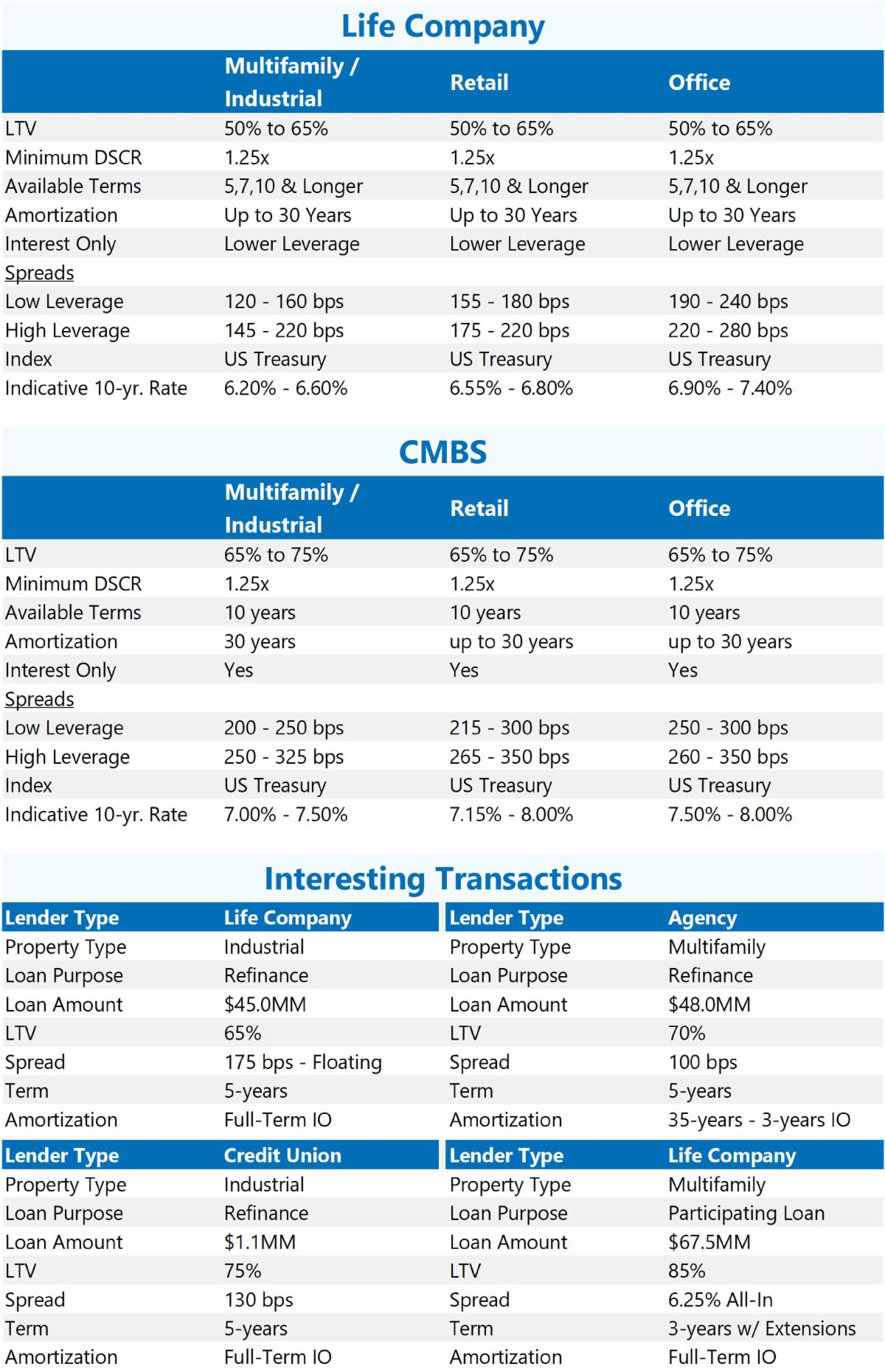
Life Company lenders have reported a slowdown in activity in the fourth quarter, primarily attributable to the benchmark 10-year U.S. Treasury rate holding at or above 5% over the past month. Fortunately, many lenders reportedly have fulfilled much of their allocation for the year and are seeking opportunities for first quarter 2027 fundings.
With limited demand for traditional 10-year fixed rate Life Company loans, lenders have pivoted and are making capital available for short-term and core floating rate requests. Life Company lenders who have these programs available noted there is strong interest, certainly from borrowers with near-term maturities.
Core floating rate programs are being priced with spreads generally between 160-225 bps over SOFR and carry a minimum interest period plus a lender origination fee. The benefit is the ability for the borrower to pay off the debt at par during the loan term. This provides a solution for borrowers in the short term and allows for a refinance into long-term debt once interest rates settle. The short-term fixed rate loans are priced over USTs with spreads generally between 130-180 bps. Lenders replace traditional yield maintenance with step-down prepayment schedules.
| | |
U.S. CMBS issuance has slowed in recent weeks and now totals approximately $108.1 billion year‑to‑date, ahead of the $99.7 billion level at this point last year. Conduit spreads have remained flat in recent weeks, with 10‑year AAA spreads currently at 76 bps over Treasuries—in line with the trailing 12‑month average of approximately 75 bps. Borrower spreads widened among recent volatility, although have remained mostly range‑bound over the past several months. Ten‑year CMBS loans are generally pricing at 200-225 bps over Treasuries, while five‑year CMBS loans are pricing in the low‑to‑mid 200 bps range. For high‑quality, low‑leverage transactions, pricing can be as low as 150 bps over Treasuries.
Multifamily assets continue to attract strong lender demand with CMBS lenders maintaining a willingness to offer full‑term, interest‑only structures. These loans allow borrowers to maximize proceeds, with underwriting typically supporting a 1.25x DSCR on an interest‑only basis. In addition, several CMBS lenders have secured dedicated B‑buyers for multifamily‑only securitizations, enabling the introduction of “stretch senior” executions. These loans are generally priced at 180-225 bps over Treasuries and can be sized down to a 1.20x DSCR on an interest‑only basis.
Other property types including office have also benefited from the availability of full‑term, interest‑only financing. However, these transactions are subject to more conservative leverage constraints, higher debt yield requirements, and tighter overall underwriting standards compared to multifamily loans.
| | |
About BWE
Bellwether Enterprise (BWE) is one of the nation's largest privately-owned real estate financing companies. Its trusted advisors combine innovation, extensive experience and strong lender relationships to optimize a loan's capital stack for commercial and multifamily investors, developers and property owners. For more information, visit BWE.com.
| | |
Opinions, estimates, forecasts and all other information contained in this document are those of BWE and should not be construed as indicating BWE’s business prospects or expected results. Although BWE attempts to provide reliable, useful information, it does not guarantee that the information or other content in this document is accurate, current, or suitable for any particular purpose. All content is provided on an “as is” basis, with no warranties of any kind whatsoever and is subject to change at any time without notice. Information in this document may not be used without permission from BWE. This document is not intended to be an offer to buy or sell or a solicitation of an offer to buy or sell securities, if any, referred to herein.
Bellwether Enterprise Real Estate Capital, LLC (BWE) conducts business through Bellwether Enterprise Mortgage Investments, LLC – Mortgage Banker license #BK-1007784 – the Department of Financial Institutions State of AZ (Fannie Mae transactions), as well as Bellwether Enterprise Real Estate Capital, LLC – Mortgage Banker license #BK-1007825 – the Department of Financial Institutions State of AZ (all other transactions).
| | | | |