|
Look at the calendar of Captain Cailloux alone, mapped across the season we are walking into right now. It is the same calendar that names the three values we hold at the André Cailloux Center. Reclamation. Remembrance. Belonging.
Reclamation. May 27. Cailloux's body lay on the field at Port Hudson for forty-seven days under Confederate guns before it could be recovered. He was identified by a ring from one of the Black mutual aid societies he had helped to lead. The very first act of honoring this man was the literal reclamation of his body. Before remembrance was possible, someone had to go back, against fire, to bring him home. That is the work the Center carries forward. We reclaim. We reclaim the story. We reclaim space. We reclaim a building on Bayou Road and we reclaim the names of the men who fell beside him.
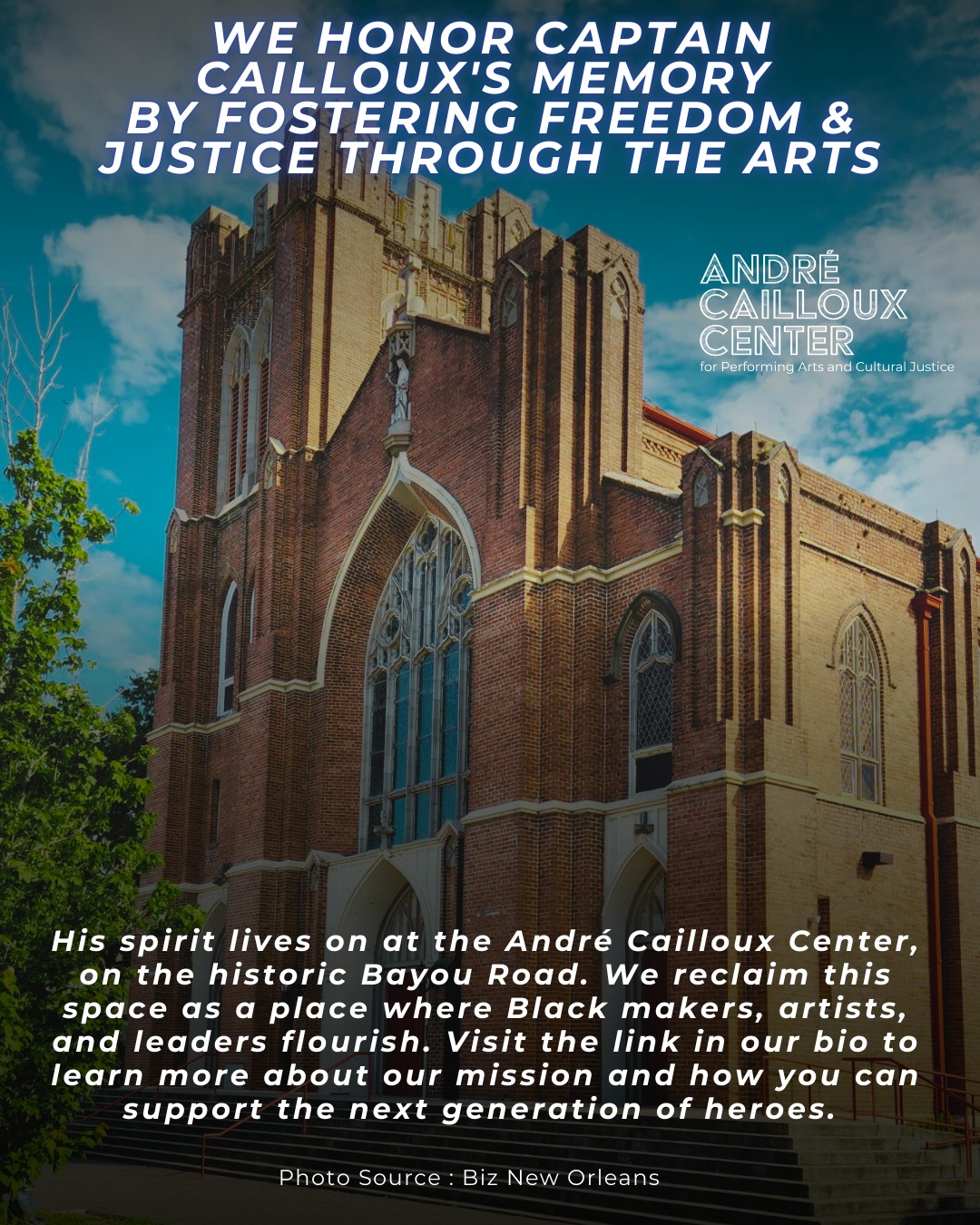
Remembrance. July 29. Thousands of Black New Orleanians walked behind his casket along Esplanade Avenue and down Claiborne. Six Black captains of the 2nd Louisiana Native Guards carried the coffin. The abolitionist priest of St. Rose de Lima Church ( now known as the Andre Cailloux Center for Performing Arts & Cultural Justice), Father Claude Paschal Maistre delivered the last rites in defiance of the city's pro-Confederate archbishop. The procession was the largest public demonstration of Black presence and Black power New Orleans had seen, and one of the largest funerals the city had ever held. The Washington Chronicle wrote that "in Captain Cailloux the cause of the Union and freedom has lost a valuable friend." That procession made grief into organizing. It made a funeral into a declaration. Remembrance is how we name who we are in the story of that sacrifice, and what we are made of.
Belonging. Born into slavery in Plaquemines Parish on August 25, 1825. Bought his own freedom by 1846. Bought his mother out of bondage the year after. Master cigar maker. Athlete. Organizer. A leader inside the Black mutual aid societies that held free people of color in New Orleans together. A man who carried himself as Black on purpose in a city that profited from making people forget. To celebrate his birth is to celebrate his existence, and to celebrate his existence is to affirm our own. We too belong in this country. We too belong in this city. We too belong to this story. At the André Cailloux Center, belonging is what we do every time we gather. Belonging through celebration. Belonging through the shared witnessing of performing arts. Belonging through the simple act of being in one another's company in a room that we own and steward.
Battlefield. Burial. Birth. Reclamation. Remembrance. Belonging. The arc of one man's life laid across the season in front of us, and the arc of how we build a cultural home in his name.
I am curious as to what this rhythm asks of us as organizers, as artists, as cultural workers building Black infrastructure that is meant to outlast us. The lesson I keep landing on is the same lesson Cailloux's life teaches, and the same lesson Felice's life teaches. We have to be both inside and outside.
Outside, the way André was. Body on the line. Visible. Courageous. At the head of the company when the bugle calls. Black movement building has always required physical presence, the kind that says no, you cannot erase us from this neighborhood, this city, this country, this story, not without a fight.
Inside, the way Felice was. In the rooms where the strategy gets made. In the records that hold the line for the long fight. In the petitions, the contracts, the by-laws, the closing tables, the letters to the government that go unanswered for years. The work that no one writes a song about, that holds the work the songs get written about.
Cailloux was both. He stood at the head of his company on the battlefield, and he had spent the years before it organizing inside the Black mutual aid societies that made Black New Orleans coherent enough to send those soldiers in the first place. Felice was both. She raised orphans by day and fought the federal government in writing for the rest of her life. Outside required inside. The march required the meeting.
This Freedom Summer 2026 is asking us to be like André and to be like Felice. Both at once. Whichever side of the work you have lived on the longest, take a closer look at the other one. Whichever side feels less like yours, this is the season to step into it.
This is the work in front of us at the André Cailloux Center this Freedom Summer. We are outside, with the tours that walk visitors through the bayou and the corridor and the story of who Cailloux was and what his people built. We are inside, with the capital campaign to permanently acquire 2541 Bayou Road for Black cultural infrastructure that is owned, governed, and stewarded by us. We are tolling the bell, and setting our own table, we are inside organizing and outside holding the line. One does not work without the other.
|