Spread the Word:
LinkedIn Share This Email

The Commoditization of Alzheimer's Disease

July 2023

Quick Links


Professional Tutoring Website


Join Me on Youtube


50 Great NCLEX-RN Practice Questions with Thoughtful, Informative Rationales


Visit My Digital Store

For the latest information please:

Join Our Mailing List!
Schedule a Private NCLEX Prep Class 

To schedule a class please contact us here


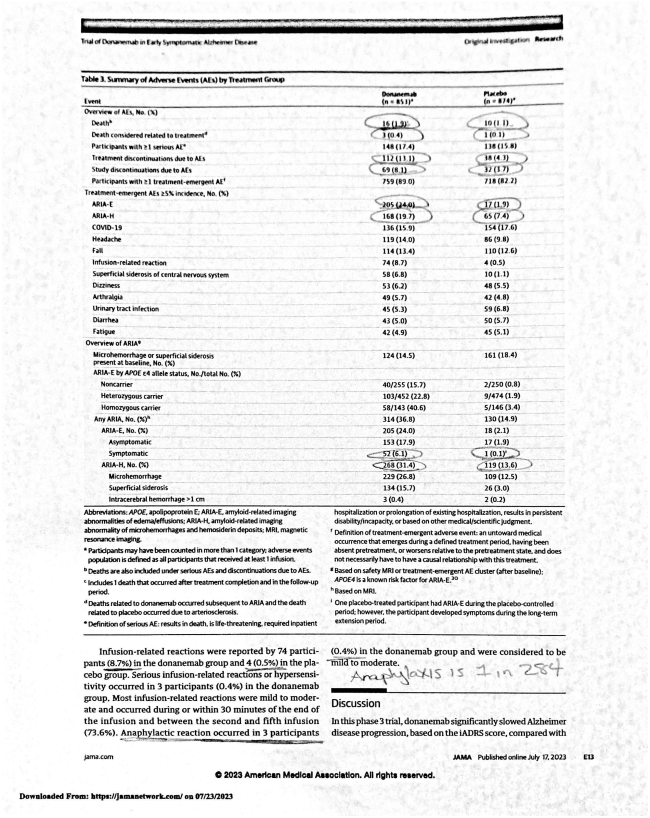
Last month I wrote about the newly approved monoclonal antibody lecanemab for Alzheimer's disease. Lecanemab has killed about 1 in every 592 (3 out of 1777) who have received it. It causes serious brain damage in > 1 in 100 and macrohemorrhage in > 1 in 200. Disturbingly, Lecanemab was approved and determined to be safe and effective by the FDA. And now here comes donanemab seeking approval after killing 1 in 284 and permanently brain damaging 1 in 122.

Donanemab in Early Symptomatic Alzheimer's Disease: The TRAILBLAZER-ALZ 2 Randomized Clinical Trial was published on July 17th. Donanemab is a monoclonal antibody designed to remove amyloid plaques. Amyloid depositing in the brain is thought to be an early event in Alzheimer's disease that triggers an "amyloid cascade" leading to progressive neurological damage. It was hoped that removing amyloid could reverse or at least halt the progression of Alzheimer's disease.


Donanemab was given by intravenous infusion once every four weeks for 72 weeks. Patients received at least two positive electron tomography (PET) scans and at least five magnetic resonance imaging (MRI) studies. So administering this drug and carefully monitoring clients is fantastically cumbersome, impractical, and expensive.


Donanemab both succeeded and failed. It largely succeeded in clearing amyloid. 76.4% of the patients treated achieved "amyloid clearance" by 76 weeks vs only 0.3% in the placebo group. That's an amazing biologic and intellectual feat. Unfortunately, like lecanemab, the removal of amyloid did not cause neurological improvement, did not halt the progression of Alzheimer's, and did not even slow the descent a clinically meaningful amount.


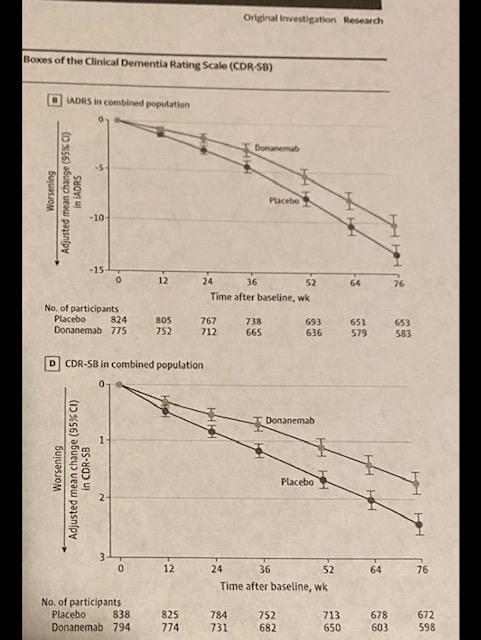
The donanemab group declined 7%, the placebo group declined 9%, so the absolute benefit was a 2% slowed rate of decline. Yet, because 7 is 23% less than 9, it can be said the donanemab slowed clinical progression a relative 23%. That number has been reported out of context to give a false impression of efficacy. Similarly, in one subgroup 32% of the donanemab patients didn't decline over the 72 weeks! But neither did 24% of the control group.


On average, the 622 of out of the original 860 randomized to donanemab who completed the trial scored about 3 points higher out of 144 vs placebo on a test of neurological function called the iASDR. It's important to note that the final analysis was only performed on the 622 who weathered treatment, so even that tiny purported efficacy is a product of a significant attrition/survivorship bias because those that died, withdrew, or suffered serious adverse effects aren't included in the analysis. That is not clinically meaningful efficacy, yet it has triggered a powerful wave of false hope driven by articles in the lay press espousing a "turning point" in Alzheimer's caused by these "breakthrough" drugs.

Importantly, there was an overall inverse relationship between amyloid clearance and neurological function. In other words, despite clearing amyloid in 76% neurological status did not improve and neurologic status continued to decline. About half of the clients who achieved amyloid clearance didn't meaningfully benefit from the drug. Those are important noncorrelations that to me argue against the amyloid cascade hypothesis and reveal curing Alzheimer's requires thinking beyond and outside of amyloid-removing therapies just as everyone is going to be going all in on amyloid-removing therapies.


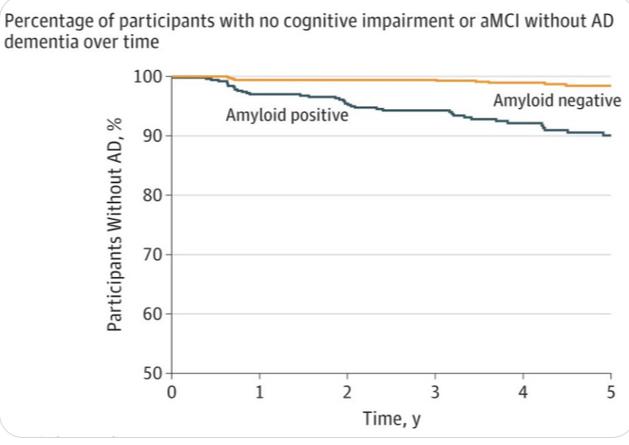
It is critical to note that amyloid deposits are a common finding in old age and their presence does not portend inevitable neurologic decline. About 28% of people with normal cognition have amyloid deposits visible on a PET scan at age 75 and many remain neurologically intact for years as shown in the image below from Prevalence and Outcomes of Amyloid Positivity Among Persons Without Dementia in a Longitudinal, Population-Based Setting

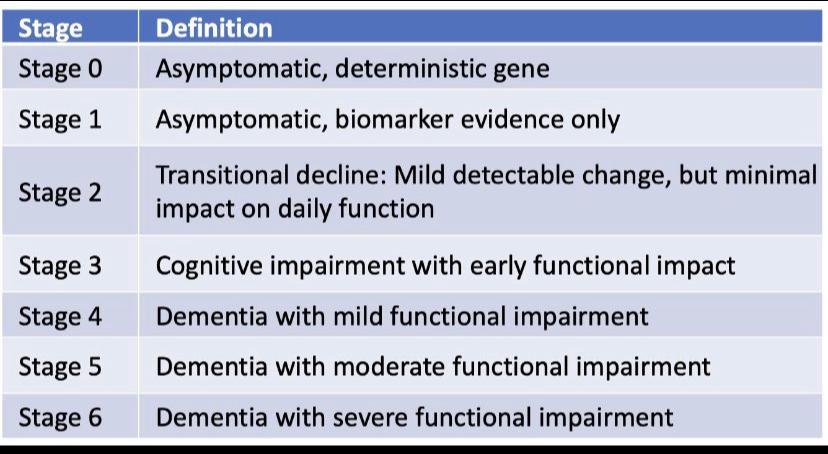
This is critically important because the Alzheimer's Association is seeking to change the definition from a clinical one based on symptoms to a biologic definition. In other words, they want to scan asymptomatic people and diagnose them with a progressive neurodegenerative disease based on nothing more than a nonspecific imaging abnormality and give them a drug like donanemab that has a 1.5% chance of either killing the patient, causing permanent brain damage, or triggering an anaphylactic reaction. And their justification for doing so, the purported benefit is that those who survived treatment declined 2% slower than placebo after 17 IV infusions, 2 PET scans, and 5 MRIs! I wish I were joking. I also wish I could say that neurologists see the inherent danger and absurdity here, but many of them don't.

Direct Harms

Donanemab directly killed 3 out of 853 (1 in 284) people who got it, permanently brain damaged 7 out of the 853 (1 in 122) who got it, caused anaphylaxis in 3 of the 854, caused symptomatic brain swelling in 6.1%, and serious brain damage (termed serious ARIA) in 1.6%. The paper also completely skipped over the condition and the prognosis of the seven people who suffered serious ARIA whose symptoms didn't improve. These were people with only mild cognitive impairment with years to go until severe dementia.

So here we go again. Here comes another monoclonal antibody that is neither safe nor effective seeking FDA approval. And it'll likely get it. The precedent has been set. The former director of the Food and Drug Administration's Office of Neuroscience Billy Dunn worked closely, congressional-investigation-about-it closely, with Biogen to help their drug aducanumab (Aduhelm) get approved in 2021. Now lecanemab (Leqembi) has been approved. In one of the least surprising events in history, less than 3 months after resigning from the FDA, Billy Dunn joined the board of directors of biotech company Prothena that has a pipeline of drugs for neurodegenerative diseases and amyloid!


There has been so much regulatory capture that the FDA, which is supposed to protect us from unsafe drugs, has actually become part of the apparatus that serves up unsafe drugs to create the illusion of progress. I think our government agencies and professional medical socities are functionally extensions of a profit-driven pharmaceutical industry that spends on advertising and can create a false reality by selectively highlighting data. Out of context, a 23% slowed rate of progression and one third of patients not progressing sounds amazing, but it's really the difference between declining at a rate of 7% vs 9%, and an analogous 24% of the placebo group didn't exhibit measurable neurological decline either.

Final Thoughts

1) Donanemab did not improve cognition in patients with early Alzheimer's

2) Donanemab slowed decline amongst those who survived treatment from 9% to 7% during the 72-week study as evidenced by the surviving members of the treatment group scoring on average 3 points better on a scale from 0 of 144 when an improvement of at least 5 was defined as the meaningful within patient change

3) 112 left the study in the donanemab group due to adverse events versus 38 who received placebo

4) Donanemab requires intravenous infusions every four weeks

4) Donanemab caused serious brain damage in 1.6% of patients

5) Donanemab caused symptomatic brain swelling in 6.1% of patients

6) Donanemab Is noncurative

7) Amyloid is found in 28% of healthy 75-year-olds

8) The presence of amyloid does not portend inevitable neurological decline and hence its presence lacks specificity to diagnose Alzheimer's disease

9) The proposed biologic definition of Alzheimer's is harmful and frankly insane

10) The government is planning to fund research to test lecanemab on asymptomatic people who only have an imaging abnormality in the AHEAD Study. That's unwise and unethical.

11) Giving drugs that cause serious brain damage in 1.2% (lecanemab) or 1.6% (donanemab) to prevent memory loss is paradoxical, but many neurologists can't see that

12) Giving a drug that causes serious brain damage in > 1% to asymptomatic people is such a bad idea that it at least borders negligence. It is almost certain to cause net harm and death

13) The current clinical definition of Alzheimer's disease is problematic because it may be a catchall for several heterogenous conditions that result in amyloid deposition and progressive neurological decline making a singular cure literally impossible

14) The proposed new biologic definition of Alzheimer's is even worse. It will erroneously attach a devastating label to asymptomatic people who will never develop dementia, pathologize a common finding of aging found in 28% of 75-year-olds, and encourage early treatment with unsafe, ineffective, preposterously expensive drugs

15) Donanemab is neither safe nor effective

16) The most logical explanation to me for why Alzheimer's disease has proven incurable is because there are probably multiple variables that can cause a similar pattern of amyloid deposition and progressive neurodegeneration. Hence there can never be a cure because there isn't a cause.


I think we're seeing the commoditization of Alzheimer's disease in real time. Failures are being spun as successes. Neurologists are seeing efficacy where it doesn't exist. Their own psychological biases are causing them to exaggerate benefits and minimize harms. We're accelerating down the wrong path. We're moving farther away from a cure for Alzheimer's and straight towards iatrogenic harm.


Best,

Dan

About The Author

Dan Clinton is a Registered Nurse, Professional Nursing and NCLEX tutor, Researcher, Writer, Entrepreneur, Father, and author of "50 Great NCLEX-RN Practice Questions with Thoughtful, Informative Rationales." Dan helps clients reach (and often exceed) their goals. Dan has helped clients who had failed the NCLEX up to nine times previously succeed and begin their career as a Registered Nurse.


Note: These newsletters speak generally about health topics and should not be interpreted as medical advice. Truly, the best advice if you have a medical concern is to discuss it with your doctor.