Wednesday Weblog for 2025 | | Leading Off: Falmouth #11 | | |
In August I will be running the Falmouth Road Race for the 11th time. Let me rephrase that. I will be participating in the race for the 11th time. I was recently diagnosed with Spondylosis, a disc problem that has been causing some leg pain.
So I have not 'run' since the Falmouth event in 2024. Recently, I have stepped up walking, been in physical therapy, and will start 'run training' this week, in the hope that I will be ready to run, or walk, the 7 miles of the Falmouth race.
For the fourth year in a row, I will be helping to raise money for the Cystic Fibrosis Foundation, a great cause where the money raised has really made a difference. You can support me here.
| | The Common Sense That Isn't Common Enough | | |
All leaders have a basic style that they are comfortable with and have used successfully (or unsuccessfully) for years. In many cases it was developed through their natural personality or strengths, in other cases they learned how to lead from a leader, mentor or manager, and in other cases they learned how NOT to lead from someone else.
All of those experiences and situations took place in my ‘leadership journey’ and, if you’ve been leading for a while, in your leadership journey as well.
There was one significant positive blip in my education that really made a difference and still benefits me to this day. It happened in Los Angeles in 1981. Since the day it happened, I modified my leadership from a ‘style’ to ‘styles’ and have had solid success as a leader, enhanced by what I learned that day. No leader is perfect, and I certainly a few regrets along the way.
- People with talent who didn’t succeed under my watch.
- People without talent I tried to lead, but didn’t succeed
- People who went on to do better without me.
| | |
But I also think if you could interview three or four hundred people who called me their leader at one point, they would come together around the fact that my leadership made a difference in their results. Some would expand that to say my leadership made a difference in their career. And a few might even say that my leadership made a difference in their lives.
Here’s the story of how the change in my personal leadership approach changed my results as a leader.
One day in my office in Santa Barbara, I picked up a piece of what we call junk mail, and it was a postcard/flyer for a one-day workshop at UCLA about leadership. Since I was going to be in LA that week and had restaurants near the college, I figured I could stop in a location before the workshop and one after it was over. I called the number and signed up.
On the designated day, I walked into a ballroom in what I think was the Ackermann Union Building on campus. There were a couple of hundred business people and students sitting on folding chairs with two guys at the front, I don’t remember their names, and a flip chart.
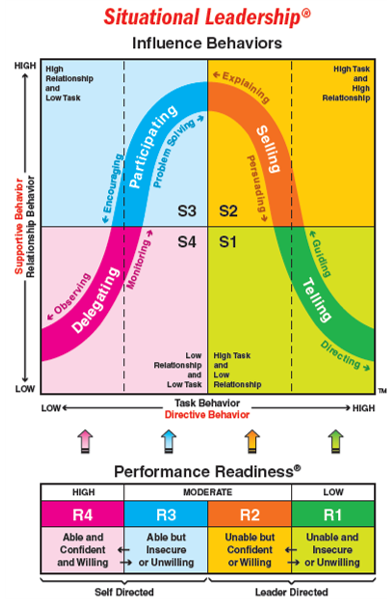
They started talking about styles of leadership and how situations really determined what leadership style was best. They called their concept ‘Situational Leadership®. One thing resonated with me immediately and it wasn’t something I had really focused on to that point in my career: Readiness.
| | |
They stressed that the leadership style that probably worked best was one that considered the ‘readiness’ of the follower for a specific task. What was readiness? They explained that it was the skill, ability and willingness to complete the task in a sustained, acceptable manner.
In a simple example, staying with the food service theme, if you are going to direct someone to prepare lasagna for a family meal, you would modify your style if that person was 12 years old, and that would be different if they were a graduate of a culinary school, and that would be different if they were in between. In this example, the three ‘degrees’ of readiness determine what the best leadership style would be.
In other words, the best leadership style is one that takes into consideration the skill, ability and willingness of the follower. The greater those things are, alone or in combination, the less task directive behavior is needed from the leader (telling in detail what to do). And the absence of those factors, the more task directive behavior is needed from the leader.
| | |
Additionally, the amount of communication and type of communication should be factored in based on those factors.
A brand-new Server, his or her first day on the job, should not be asked what they think should be the featured suggestive selling item, s/he should be told. Their ‘readiness’ to participate and make a decision is low. Conversely, the five-year veteran superstar server should probably be asked what they think would be the best to suggestive sell that day because their ‘readiness’ level is very high.
The punch line of this concept is that the best leadership style for any given task or situation really depends on the ‘performance needs’ of the follower. If that sounds like common sense, well it is.
If someone needs a lot of direction, that is how they should be led, regardless of whether or not that is the leader’s preferred leadership style. If someone knows what they are doing and has been successfully doing it for a sustained period of time, they need less direction and maybe more ‘two-way communiation’ or maybe in some cases to even to be left alone.
Failure to adjust the leadership style can result in ‘overleading’ (giving someone too much direction, sometimes referred to as micro-managing), or ‘underleading’ (not giving someone enough direction to help them succeed).
| | |
I left that ballroom, stopped by the store I had planned to visit, and started the 90-minute drive home on the Ventura Freeway, (made famous by the band America).
The entire way home I bounced the concepts I learned around in my brain. Thinking of several situations I might have handled differently had I been aware of the perspective, and committing to trying to modify my style to multiple ‘styles’ moving forward.
Two weeks passed and I was near UCLA again in my travels, and my memory was jarred as to what took place in that ballroom and I was shocked as I drove home and realized that I had ‘internalized’ much of what I heard that day. (According to ChatGPT: Internalized means to absorb and integrate knowledge, beliefs, or values so deeply that they become part of your thinking, behavior, or identity. When you internalize something, you've learned, it influences how you act and make decisions without needing constant conscious thought. Like putting your shoes on: most put the same side shoe on first).
Without checking my notes or the handout, I realized I had internalized the concepts, and even better than that, I had started using them.
| |
I guess to me they made so much common sense, and I was eager to be a better leader, I just grabbed on to the concepts and ran with them. It was easy.
Since that day in California more than 44 years ago, not only have I been using Situational LeadershipTM but I have been sharing the concepts with most of the leaders I have supervised.
It will come as no surprise that the very first thing I did when I became a consultant, was to approach the Center for Leadership Studies, owner of the intellectual property of the concept, and apply to be certified to teach it. I successfully completed the certification and since then I’ve been that guy in the ballroom drawing charts and leading discussions for a variety of organizations and leaders.
| | |
Of those who have been through the course I teach, some people find the concepts easier to ‘internalize’ than others. Some use them more than others, and some still like their own style and rarely consider the ‘performance needs’ of others. But interestingly enough, everyone who has ever attended, knows exactly how much direction and support they need when someone is leading them.
So even if they are not using what they learned to lead others, they are using it help their leader lead them more effectively, because they internalized the concept.
Think back to the great managers or leaders you’ve experienced. They likely modified their style based on the project or task and your ‘readiness.’ When they did it worked, and that’s really the goal of leadership: to get it right and to give followers what they need to be successful.
You might say, it is common sense.
| | Surprise Photo at the End: | | Joe's Positive Post of the Week | | Join the Smart Subscribers | | If you are reading this on a social media platform, click below and you'll automatically receive a 'different' story every week on Wednesday. | | |
The Roll Call of states and countries where readers reside: Arizona, California, Colorado, Connecticut, Delaware, Florida, Georgia, Hawaii, Illinois, Indiana, Iowa, Kansas, Kentucky, Louisiana, Maine, Massachusetts, Michigan, Mississippi, Missouri, Montana, New Hampshire, New Jersey, New Mexico, New York, North Carolina, North Dakota, Ohio, Pennsylvania, Puerto Rico, Rhode Island, South Carolina, South Dakota, Tennessee, Texas, Vermont, Virginia, Washington and Washington DC, Wisconsin plus Canada, Conch Republic, Australia and the United Kingdom.
| | Refer a friend to Sign Up for the Wednesday Weblog | | |
Ed Doherty
774-479-8831
www.ambroselanden.com
ed-doherty@outlook.com
Forgive any typos please.
| | | | | |