|
“what is Chanukah?”
Every Jewish holiday has many different miracles that are involved, and thus, are being celebrated. However, Every holiday has its primary miracle, which embodies the essence of the entire holiday. All miracles that happened need to be celebrated, however, once we enter into the commemoration and focus of the primary essence of the holiday, then all the details are as that of “a candle held up to the sun.”
So too it is with the holiday of Chanukah. (a) There is the miracle that was brought about by Yehudit, the daughter of the Kohain Gadol, that was brought about through dairy products. Thus, (i) while the menorah is lit, woman are not to do any work, and (ii) one night of Chanukah we should have a dairy dinner. (b) The children hid out in the mountains studying Torah with their teacher. When the one student who stood guard gave them the signal that the Syrian-Greek soldiers were coming, they hid their scrolls, took out tops and began to play. This is how the children managed to study Torah under the penalty of death. Thus, on Chanukah we play dreidel.
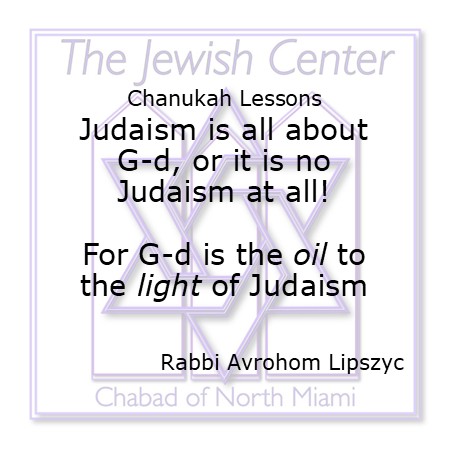
The two major miracles of Chanukah was that (a) the band of few and the weaker Jewish soldiers won over the many and the mighty and the many Syrian-Greek soldiers., and (b1) they found one jug of pure oil, (b2) which was enough to kindle the menorah in the Holy Temple for one night, and instead it burned for eight days, until new pure oil was able to be produced and brought to the Holy Temple. The Talmud, in discussing the holiday of Chanukah wants to know which is the essence of Chanukah. Thus, the Talmud begins not with a story, but with a question: “What is Chanukah?” The Talmud then answers that it is the miracle of the oil that is the essence of the Chanukah holiday. Why? Oil is the essence of all produce, from coconut oil to grape-seed oil. Thus, in Kabbalah and Chassidus, oil represents the essence. So too it is with Torah-study and with Mitzvah-observance. The wisdom of Torah, and the culture of Mitzvot have an essence to them, which is that they are, “Your Torah” and “Your will”. The Syrian-Greeks had a great respect for wisdom and culture. However, they had a problem with building it upon, and imbuing it with, a “divinity”. This wasn't just “a” problem, but rather, they saw it as a dichotomy for everything they stood for. Thus, the war of Chanukah was, “when the wicked Hellenic government rose up against Your people Israel to make them forget Your Torah and violate the decrees of Your will.” This was the essence of what Chanukah was facing, and what the miracle of Chanukah was all about. Thus, the miracle entails that the Jewish people refused to kindle the menorah with impure defiled oil, even though in a case when there is no other oil this would be permissible! They refused, because they knew, lived, and fought for, the ‘What is Chanukah?”. Thus, the Talmud speaks only of this miracle of oil.
Nevertheless, in our “Al Hanissim” prayers, we avoid the “sun” of Chanukah, so that we can also thank G-d for the “candle” of Chanukah. Thus, in this prayer, we avoid speaking of the miracle of oil, so that we can speak about and give gratitude for, “But You, in Your abounding mercies, stood by them in the time of their distress. You waged their battles, defended their rights, and avenged the wrong done to them. You delivered the mighty into the hands of the weak, the many into the hands of the few, the impure into the hands of the pure, the wicked into the hands of the righteous, and the wanton sinners into the hands of those who occupy themselves with Your Torah.”
|