Volume 5 | Issue 6 | June 2025 | | Cosmology of Light Newsletter | | |
Hello Friends,
The initiating inspiration for Pioneering New Avenues in Quantum Technology was a broad inquiry into light. In this inquiry I sought to understand why light traveled at a fixed speed - 186,000 miles per second in vacuum - and further, what reality might look like were light to travel at different constant speeds. This inquiry gave rise to the 10-volume mathematical treatise - Cosmology of Light.
Many insights arose in that journey, one of which was the idea of Nature's persistent quantum computation, in effect remaking all existence from moment to moment. This notion of quantum computation, as an arbitration between cosmic layers, gave rise to my framing of quantum computation - Quaternary Interpretation of Quantum Dynamics (QIQD) - as captured in Pioneering New Avenues in Quantum Technology. It was therefore quite fulfilling when in the last chapter I found my self naturally circling back to the cosmic level by specifically proposing how QIQD-based quantum variables could be inserted into Einstein's Field Equations to connect the micro quantum levels with the macro cosmological levels.
In fact, in QIQD, where quantum dynamics give rise to fourfold wholes at any level of granularity, such an outcome - connecting the quantum with the cosmological levels - seems inevitable since space-time-energy-gravity is nothing other than a fourfold whole.
In this newsletter I share abstracts for Chapter 1 & Chapter 2 that introduces the notion of quantum wholes, and for Chapter 24, the last chapter, that highlights the existing fourfold structure of Einstein's Field Equations (EFE) and suggests how quantum variables might be included in EFE.
Finally, I am also glad to share that this book has been selected to be part of Forbes Councils Executive Library!
Warmly,
Pravir
| | |
The following is the abstract for Chapter 1, Surfacing a W(L) Approach to Quantum Computation, which leverages the double-slit experiment to introduce the concept of quantum wholes:
"Quantum computation can be approached from distinct perspectives, illustrated by the double-slit experiment. The conventional “bottom-up” view models quantum reality from the perspective of individual photons, leading to a manufactured “r-stratum” that leverages interpreted quantum properties like entanglement and superposition for computational speed-ups and optimizations, potentially enabling qubit arrangements for simulating atoms, molecules, and even whole-chip computation. However, a “top-down” perspective views photons as constructs carrying quantum properties derived from the light source’s wholeness, suggesting an alternative approach based on “l-properties” related to W(L)—the wholeness parsed across layers of matter and life. This W(L)-focused approach offers the potential for a deeper understanding of nature and the possibility of co-creation, representing a fundamentally different pathway in the pursuit of quantum computational possibilities beyond the r-stratum’s engineered quantum effects."
Chapter 2, The Origins of a Fourfold Pattern, further illustrates such wholes. Here is the abstract:
"A thought experiment involving multiple Hilbert spaces generates a root pattern reflecting wholeness, W(L), and the four functional aspects of presence, power, knowledge, and harmony (P, Po, K, H). Beginning with an originating Hilbert space where light is imagined traveling infinitely fast, these four properties emerge. Quantization of this light into subsequent Hilbert spaces—first at a slower speed k, then at speed g, and finally at c (the known speed of light)—reveals increasingly complex structures. At speed c, a fourfold quantum object profile or code emerges, defined by space, time, energy, and gravity dimensions, which are shown to be symmetrical expressions of P, Po, K, and H. This fourfold code, reflected in the Standard Model, the Periodic Table, and cellular molecular plans, suggests a fundamental architectural principle for arising matter and life. This framework, summarized by four generated Hilbert spaces, provides a basis for understanding the evolution of quantum systems via Schrödinger’s equation, Hamiltonian operators, and eigenvalues, and a universal wavefunction to be explored in later chapters."
| | Connecting the Micro to the Macro through Quantum Wholes | | |
The following is the abstract for Chapter 24, Unifying Quantum Seeds and Spacetime:
"This chapter proposes a conceptual bridge between general relativity and quantum dynamics by embedding aspects of the quaternary framework (QIQD) directly into the Einstein Field Equations (EFE). Building on the classical curvature–energy relationship outlined by EFE, the chapter introduces an additional divergence term, ∇·(Seed Properties), representing four quantum‐functional aspects (Presence, Power, Knowledge, Harmony). By coupling these “seed dynamics” to traditional stress‐energy terms, a modified EFE that potentially unifies macroscopic spacetime curvature with microscopic quantum effects is obtained. The four seed properties collectively influence curvature, temporal evolution, vacuum‐energy balance, and local material density, offering a novel lens into phenomena such as quantum‐assisted gravitation and emergent spacetime structures. This framework also points to far‐reaching technological applications: from more stable quantum computing and advanced superconductors to quantum‐tuned navigation and AI systems. The resulting QIQD–EFE synthesis opens up new directions in both theoretical physics and engineering, suggesting that the interplay of quantum seed properties and spacetime geometry can be harnessed for breakthroughs spanning cosmology, quantum gravity, and beyond."
| | Inclusion in Forbes Councils Executive Library | | |
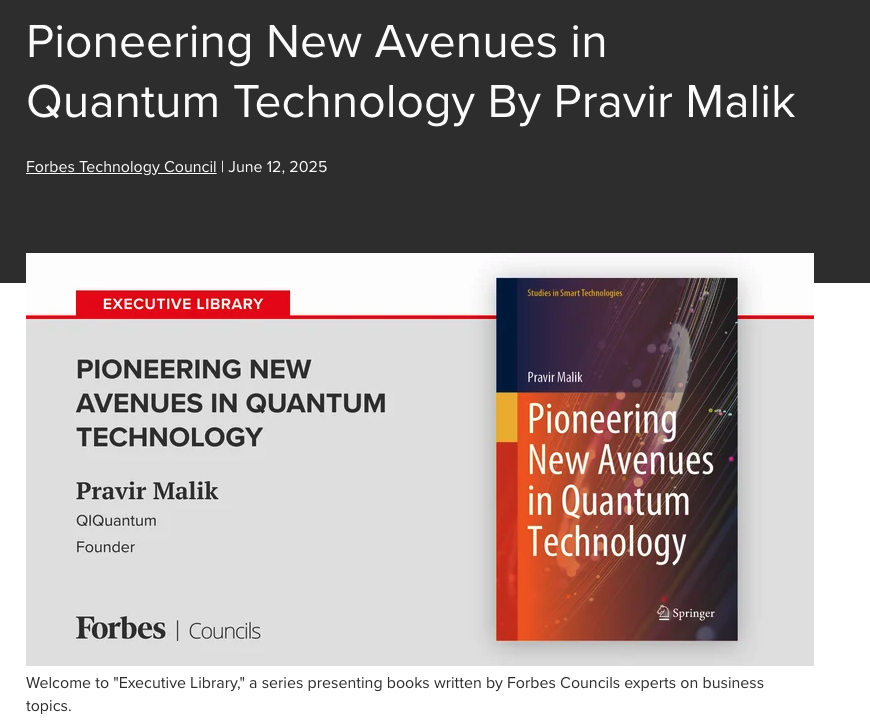
Grateful for the inclusion of Pioneering New Avenues in Quantum Technology in the Forbes Executive Library.
Here are some key points Forbes highlights about the book:
- Unconventional Strategic Vision for Quantum Futures: While the industry is largely focused on enhancing existing paradigms (e.g., gate-based or annealing quantum processors), this book introduces a quaternary interpretation of quantum dynamics (QIQD). This systemic, fractal-based framework offers an entirely new way to conceptualize quantum computation—one that aligns more naturally with the layered structure of life and matter. This is crucial for Council readers looking to position their organizations for second-generation quantum breakthroughs, not just incremental improvements.
- Executive Insight into Next-Stage Innovation: Many of the concepts discussed—such as qualified determinism, quantum certainty, and Organizing Quantum Energy (OQE)—point to new computational architectures and devices (e.g., nano-sensors, room-temperature superconductors) that could redefine what’s commercially viable. For C-suite leaders, this book offers early insight into emerging frontiers that may soon impact sectors such as energy, materials, healthcare, and AI.
- Bridging Theory to Enterprise Application: The book explicitly links theoretical innovation to potential hardware designs, algorithmic pathways, and functional applications. For technology strategists and R&D leaders, it offers a blueprint for translating novel quantum principles into disruptive products and platforms.
- Thought Leadership Rooted in Forbes-Featured Insights: Dr. Malik has published related frameworks in Forbes and has led high-level conversations with industry pioneers through the Forbes Technology Council. This book consolidates and expands on those thought pieces, making it a natural continuation for Council readers already familiar with his work.
Appreciate the recognition—and more so, the continued dialogue on shaping a bold quantum future!
| | | | |