Trouble reading this briefing? View as webpage.

Friday | Oct 30, 2026

Tech selloff drags futures lower.

  • US stock-index futures are dropping as those disappointing earnings accelerate a shift by investors out of tech stocks. Crude oil gained on signs that the US may resume military strikes against Iran.
  • The tech selloff deepens as Nasdaq-100 futures slide nearly 2% after another round of disappointing earnings. Asian shares also slip, led by South Korean and Japanese equities. Euro Stoxx 50 contracts retreat.
  • Intel plummeted in late trading after its revenue forecast missed analysts’ estimates, hurt by a PC slump and supply snags. Amazon.com also fell after reporting greater-than-anticipated capital spending and the slowest growth in the core e-commerce business in three years.
  • US Treasuries surged as the slump in technology giants spurred haven bids. T-note futures extended gains in early Asia trading. US GDP rose in the third quarter at the fastest pace in a year, fueled by feverish business investment and robust consumer spending. A separate report showed a measure of inflation increased in September by the most in six months.
  • Oil rises with Brent contracts for January trading above $112 a barrel.

The importance of returns on investment is growing as capital becomes more expensive, particularly in the AI sector.


This week, we saw growing tension between economic resilience, persistent inflation, and the rising cost of AI investment. Stronger US economic growth and continued business expansion reinforced expectations that the Federal Reserve may keep interest rates elevated, sustaining pressure on Treasury yields and borrowing costs. Meanwhile, earnings from Alphabet and Microsoft revealed diverging financial returns from aggressive AI infrastructure spending, sharpening institutional investors' focus on capital efficiency, free cash flow, and profitability. Together, the developments suggest a market increasingly focused on whether strong economic fundamentals and corporate earnings can justify elevated valuations and investment spending in a higher-for-longer interest-rate environment.


let's recap...

Fed holds rates as two officials seek hike

The Federal Reserve held its benchmark interest rate at 3.75%–4% on October 28 in a 10–2 vote, with Governor Lisa Cook and Cleveland Fed President Beth Hammack favoring a quarter-point increase. Policymakers upgraded their assessment of economic growth while acknowledging persistent inflation. Treasury yields moved in opposite directions, with shorter-term yields falling and longer-term yields rising as investors weighed the prospect of a December rate increase. (Federal Reserve)


US economic growth accelerates to 3.4%

The US economy grew at an annualized 3.4% in the third quarter, accelerating from 2.2% in the previous quarter, according to Commerce Department data released October 29. Consumer spending rose 3.8%, while business investment in artificial intelligence infrastructure and equipment supported growth. The stronger-than-expected expansion strengthened the case for the Federal Reserve to maintain restrictive monetary policy amid persistent inflation. (Associated Press)


Alphabet shares slide on AI spending concerns

Alphabet shares fell sharply after the company reported weaker-than-expected third-quarter revenue and earnings on October 28, alongside negative free cash flow of $9.07 billion. Google Cloud revenue more than doubled to $30.7 billion, but slowing search advertising growth and rising AI infrastructure spending raised questions about investment returns, adding pressure to technology-sector valuations. (Business Insider)


Microsoft earnings highlight cloud strength

Microsoft reported stronger-than-expected fiscal first-quarter results on October 28, with revenue climbing 20% to $92.28 billion and Azure revenue rising 48% to $33.17 billion. Free cash flow reached $18.6 billion despite $45.2 billion in capital expenditures, underscoring the company's ability to fund AI infrastructure expansion while generating cash. The results highlighted widening differences in profitability and capital requirements among major technology companies. (Schwab)


US business activity signals inflation risks

US business activity expanded in October, although S&P Global's preliminary composite purchasing managers' index eased to 57.6 from 58.4 in September, according to data released October 23. Strong demand supported new orders and hiring, while businesses reported accelerating price pressures, including the sharpest increase since 2022, according to Bloomberg. The figures reinforced concerns about persistent inflation and its implications for Treasury yields and Federal Reserve policy. (Bloomberg)


a little bit of cyber + AI

LiteLLM supply-chain attack traced to unrevoked security key

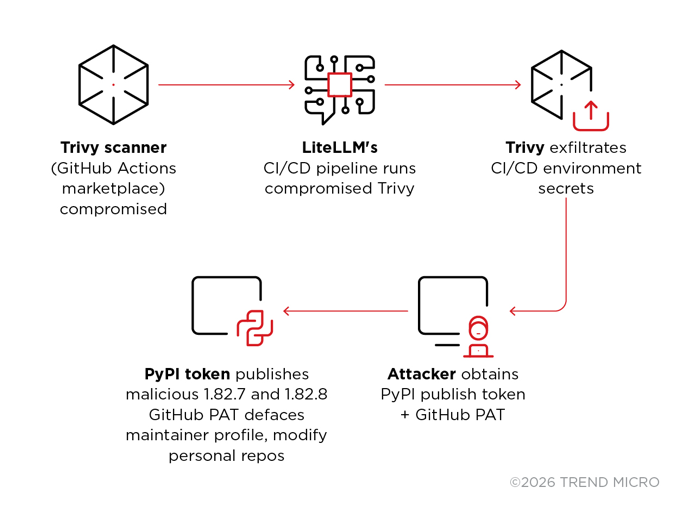
LiteLLM disclosed on October 23 that an exposed security key, left active after it was discovered in May, let attackers compromise its development infrastructure and distribute credential-stealing malware through its AI gateway software. Subsequent reporting on October 26 indicated that the compromised package had been downloaded about 49,000 times, and stolen cloud credentials were tested within hours. Microsoft confirmed that the malware could execute automatically when Python started, even without importing LiteLLM, expanding potential exposure across developer workstations, cloud infrastructure, and CI/CD environments. (The Record)


Cisco patches actively exploited firewall VPN zero-day

Cisco disclosed on October 28 that attackers were actively exploiting a high-severity vulnerability, CVE-2026-76418, affecting Secure Firewall ASA and Firepower Threat Defense software. The flaw, rated 8.6 on the CVSS scale, allows unauthenticated remote attackers to force affected devices to restart, disrupting SSL VPN connectivity and remote access. Cisco released security updates and confirmed that no complete workaround is available. Canadian cybersecurity authorities issued a separate advisory on October 29 urging organizations to apply the fixes. (Bleeping Computer)


Warp discloses breach exposing AI agent activity records

AI development platform Warp disclosed on October 26 that attackers exploited a third-party infrastructure provider, exposing limited AI agent execution traces and user telemetry. The company estimated that about 1% of its users may have been affected and said it contained the intrusion within hours after detecting it on October 23. Warp engaged CrowdStrike to investigate and notified affected users it identified. The company has not disclosed whether the exposed records included source code, credentials, or other sensitive information. (OrcaRouter Incident Analysis)


binge reading disorder

Déjà Vu: A mystery of the mind

Déjà vu, French for "already seen," is the curious sensation of experiencing something that feels strangely familiar, even when it is happening for the first time. The phenomenon extends beyond visual experiences to sounds, places, and conversations, leaving scientists puzzled by the brain's ability to create a sense of memory where none appears to exist. Is it a quirk of human perception or simply a glitch in The Matrix? Only Neo knows for sure. (Psychology Today)


Human conversation sparks more creativity than AI

Artificial intelligence may generate ideas faster, but human interaction may still hold the advantage in originality. Research suggests that conversations with other people can inspire more creative thinking than exchanges with AI, which tends to draw on familiar patterns. Researchers Clin Lai and Roger Beatty recommend talking with another person before turning to AI for creative inspiration, citing the unique experiences and unexpected perspectives that human conversations bring to problem-solving. (The Conversation)


Can dreams solve problems while we sleep?

An ancient practice known as dream incubation is attracting renewed scientific interest as a potential tool for creative problem-solving. The technique involves focusing on a question or challenge before falling asleep, with the intention of exploring possible answers through dreams. Research suggests that dreams can sometimes generate fresh insights into personal challenges, offering a different perspective on problems that resist solutions during waking hours. Perhaps sleeping on a problem is more productive than we thought. (National Public Radio)

220 x 128 px
LinkedIn