|
|
|
Call: 214-526-2800
Email:Info@turtlecreekassociation.org
Web: turtlecreekassociation.org
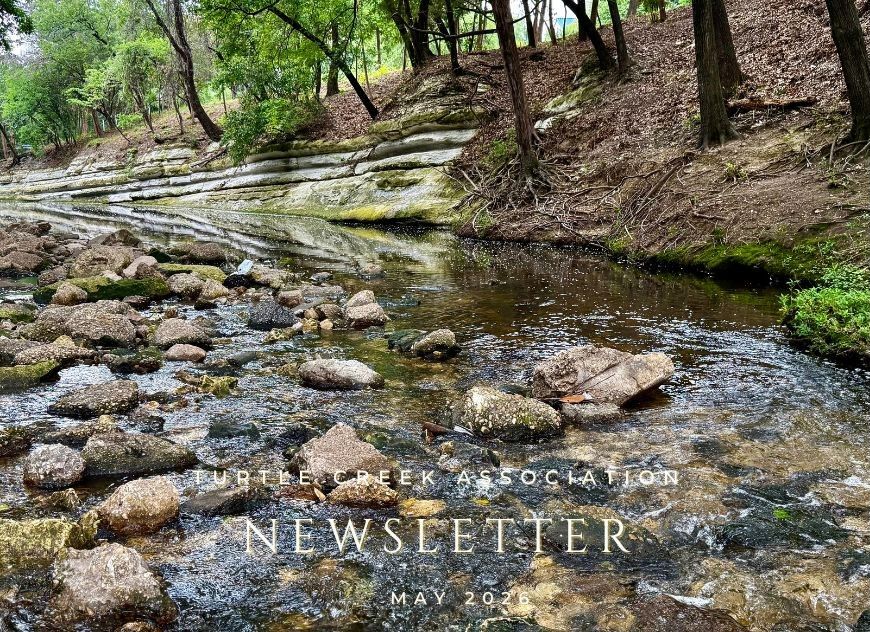
| | A hidden stretch of Turtle Creek—rediscovered. | |
A City at a Crossroads
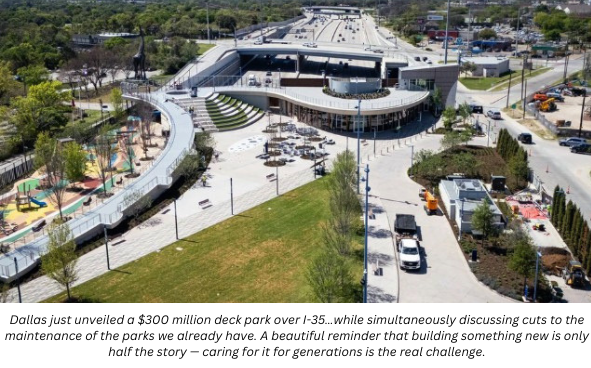
Last week, Dallas celebrated the opening of Halperin Park — an ambitious new green space years in the making and a powerful reminder of what parks can do for a city. They reconnect neighborhoods, improve quality of life, create economic value, and give people places to gather, breathe, and belong.
Yet almost simultaneously, news broke (NBC5) that Dallas Parks and Recreation is facing proposed budget reductions totaling roughly $14 million. Discussions have included possible reductions in mowing and maintenance, fewer recreation programs, reduced hours, staffing cuts, and even potential closures of some community recreation centers.
And it raises an important question:
What happens when cities can build new parks… but struggle to maintain the ones they already have?
The ripple effects are real.
| | |
Parks do far more than beautify a city. They influence public safety, neighborhood pride, property values, environmental health, recreation, tourism, and even mental well-being. When maintenance declines, the impacts are rarely immediate — but over time they become impossible to ignore. Grass grows taller. Trash lingers longer. Infrastructure deteriorates. Public spaces feel less welcoming. Invasive vegetation spreads. Encampments return. And slowly, the sense of pride people once felt begins to erode.
Here along Turtle Creek, we understand this firsthand.
Many of the improvements people now enjoy throughout the corridor — creek cleanups, invasive vegetation removal, bridge restoration, enhanced lighting, landscaping, erosion mitigation, and ongoing beautification — have happened because private donors stepped forward to help fill gaps and invest in the long-term stewardship of this special place.
Organizations like the Turtle Creek Association were never intended to replace city government. But increasingly, nonprofits and community partners are being called upon to play a larger role in preserving the public spaces that define our quality of life.
That reality may continue to grow in the years ahead.
The good news? Dallas has a long history of passionate residents who care deeply about their parks. Public-private partnerships have transformed spaces across our city, and Turtle Creek itself stands as proof of what can happen when neighbors, donors, volunteers, and civic leaders work together with a shared vision.
So what can we do now?
Stay engaged. Support organizations investing directly into our parks and public spaces. Advocate for thoughtful priorities at City Hall. Volunteer. Donate. Speak up for the places that matter to you.
Because once public spaces decline, rebuilding them becomes far more expensive — and far more difficult — than protecting them in the first place.
At TCA, our commitment remains unchanged: To preserve, protect and enhance the Turtle Creek Corridor for the benefit of the entire community.
| | |
President | CEO
Turtle Creek Association
| | Uncovering What Was Hidden | |
| |
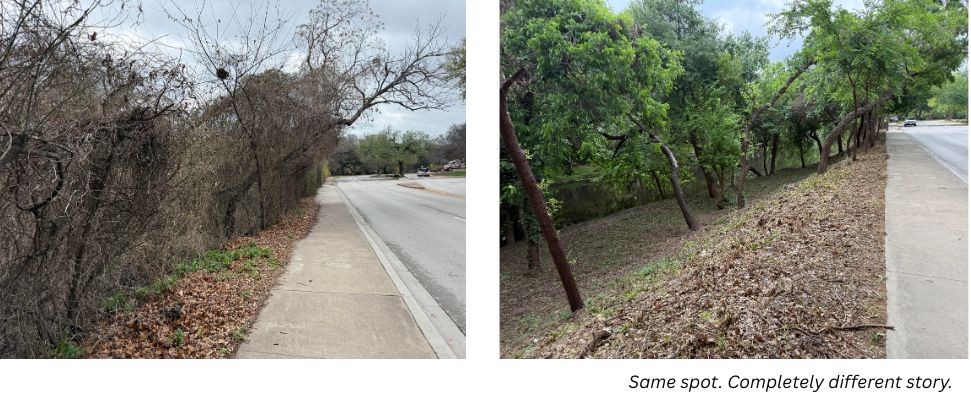
As conversations continue across Dallas about park funding and maintenance, the recent privet and brush removal project between Wycliff and Stonebridge serves as an important reminder: neglect happens slowly, but rebuilding takes years.
Over the past two months, TCA, in partnership with Dallas Parks and Recreation, led an extensive effort to remove dense privet and underbrush along Turtle Creek Boulevard between Wycliff and Stonebridge. What crews uncovered was both eye-opening and, at times, surprising.
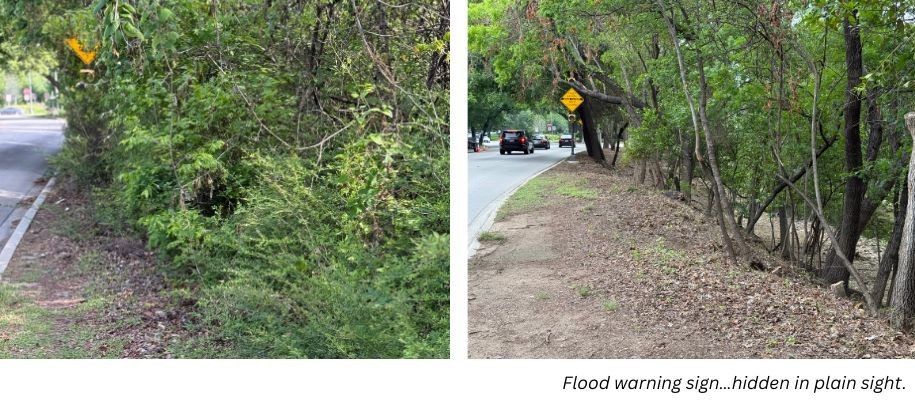
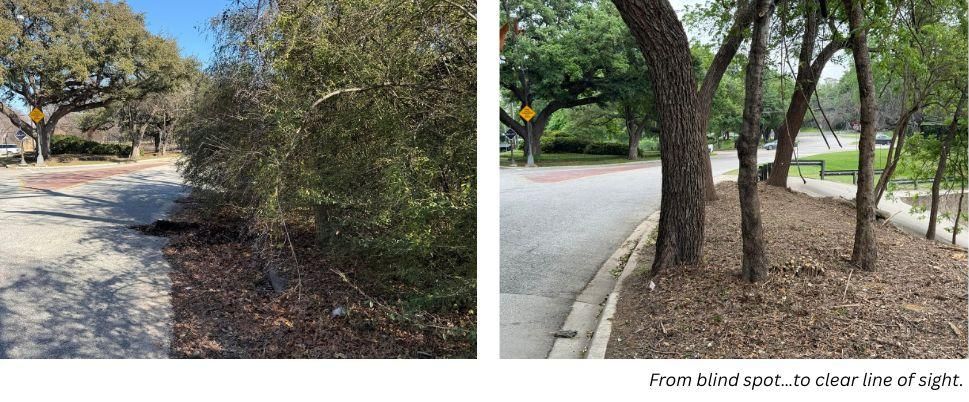
In several areas, invasive privet had grown so aggressively that it completely smothered six mature cedar trees. Sightlines for both drivers and pedestrians along Turtle Creek Boulevard had become dangerously compromised. In one instance, crews even uncovered a “Flood Warning” signal sign that had been almost entirely hidden from view.
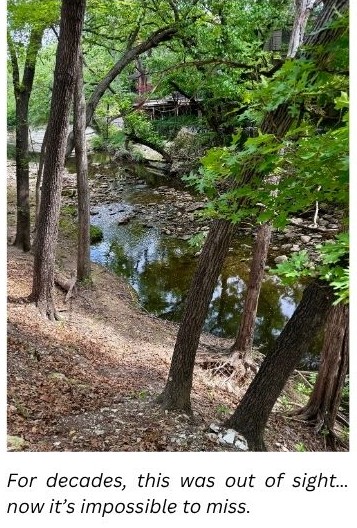
And, of course, there was the creek itself—finally visible again.
| | This was not an easy project. Crews worked through difficult terrain, steep banks, thick root systems, and yes… even the occasional snake. The effort took more than two months to complete and represents an investment of over $40,000—exclusive of the ongoing maintenance now required to preserve these improvements. | | |
Regular mowing, trimming, monthly cleaning, and continued treatment of invasive privet will now become part of the long-term strategy to keep these areas open, safe, and accessible. The first treatment has already been completed in partnership with the City of Dallas, with follow-up treatments scheduled quarterly.
What’s perhaps most remarkable is how quickly the corridor is responding.
In some sections, this is the first time sunlight has reached the forest floor in decades. Native grasses and ground cover are beginning to reappear, sightlines have been restored, and the creek once again feels connected to the surrounding parkland.
With patience and continued stewardship, this area will continue to transform—becoming healthier, more natural, and more beautiful for everyone to enjoy.
| | |
As you look through the before-and-after photos, we hope you gain a deeper appreciation for both the scale of the work and the importance of maintaining these public spaces before decline takes hold. Because once spaces are lost to neglect, restoring them requires extraordinary time, effort, and investment.
Sometimes the most meaningful transformations are not about adding something new—but simply uncovering what was there all along.
| | The Crow Has Landed...(Finally!) | |
| |
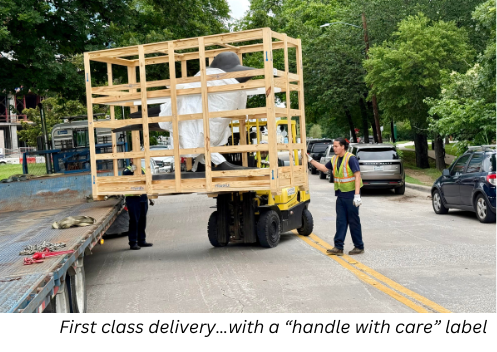
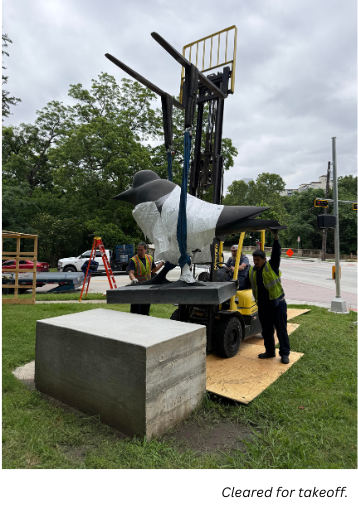
After what feels like a very long flight path…this Crow is officially on approach.
Yes, you read that right. The long-awaited sculpture is finally making its descent into the Turtle Creek corridor. And when you need a crane to guide the landing, you know it’s been quite the journey.
For those who have followed along, you know this bird has been circling the runway for quite some time. So before anyone gets too close for inspection, let’s just say…this one may need a little dusting off—a good cleaning, a bit of polish, and perhaps clearance through customs before making its proper arrival.
Now, I’m going to ask for a little patience.
| | |
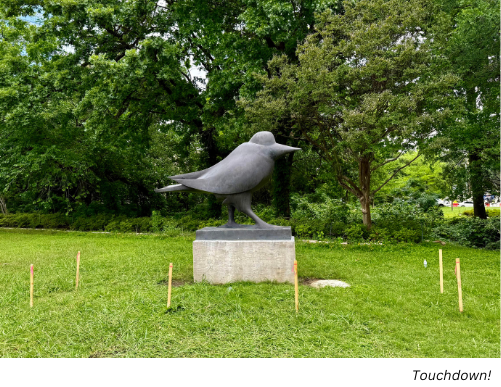
What you’re seeing today is a bit like arriving early at DFW Airport—the plane has landed, but we’re still waiting on a gate. The sculpture is now in place, but the surrounding landscaping, lighting, and gateway elements are still taxiing in behind it. And trust me, those final touches are going to completely transform the setting.
If I had my way, we would’ve kept this under wraps and staged a grand reveal—but it’s hard to hide something that arrives via crane with its own flight plan.
So, for now, consider this an early arrival while we finish deboarding the rest of the vision.
This project would not have been possible without the generosity of Brenda and Clay Cockerell, whose support helped bring the sculpture itself to life. We are also grateful to Centurion American for funding the base installation, and to Donna Zick, whose support will complete the vision through landscaping and gateway signage. Together, their contributions are helping transform this corner of the corridor into something truly special.
In all seriousness, this installation is about more than a sculpture. It’s about creating character, sparking curiosity, and giving people something unexpected to discover along Turtle Creek.
So next time you pass by, slow down and take a look. Just remember…the Crow may have landed, but we’re still clearing the runway.
Stay tuned. The final destination is going to be worth the wait.
| | A Time to Reflect. A Time to Celebrate | | |
This year’s Fourth of July carries a little more weight—and a lot more meaning.
As our nation approaches its 250th Anniversary, we’re reminded that the freedoms we enjoy today are the result of generations who came before us—those who had the vision to build, the courage to protect, and the commitment to preserve something greater than themselves.
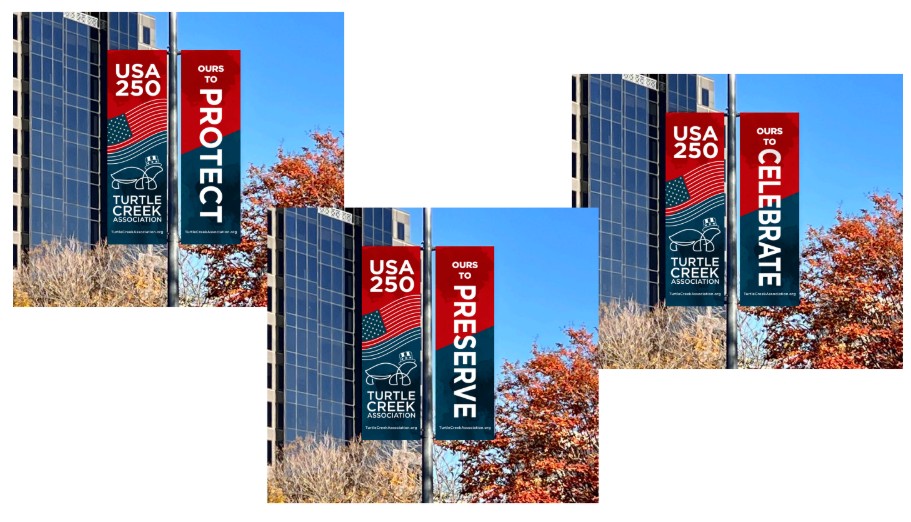
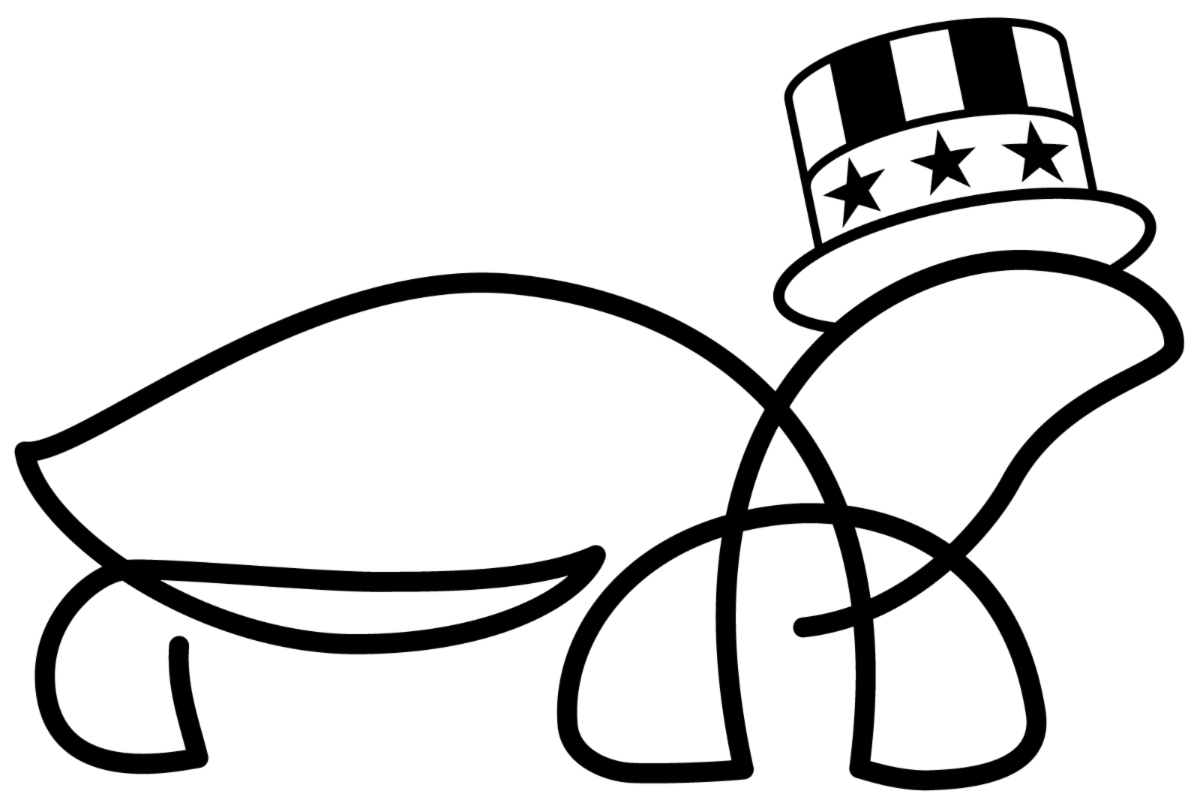
In recognition of this historic milestone, the Turtle Creek Association will be installing patriotic pole banners along the corridor the week leading into Memorial Day, where they will remain proudly on display through Independence Day. As you travel the boulevard, you’ll notice the bold “USA 250” design alongside a message that feels especially fitting—not just for our country, but for our mission: “Ours to Protect. Ours to Preserve. Ours to Celebrate.” And yes…even Toby is getting into the spirit—trading in his usual look for an Uncle Sam hat as he keeps watch over the corridor.
| | |
While these words speak to our responsibility as Americans, they also reflect the work we do every day along Turtle Creek. Our mission—to preserve, protect, and enhance the corridor—is, in many ways, a local expression of a much larger national value: stewardship.
Because the truth is, whether it’s a country or a creek, the principle is the same.
We don’t inherit these places to simply enjoy them—we inherit them to care for them, to improve them, and to ensure they endure for years to come.
So, as we head into Memorial Day and the Fourth of July, I hope these banners serve as more than just decoration. I hope they prompt a moment of reflection…a sense of pride…and maybe even a renewed appreciation for the role each of us plays in protecting what matters most.
Here’s to 250 years—and to doing our part to preserve what makes this country so great.
| | |
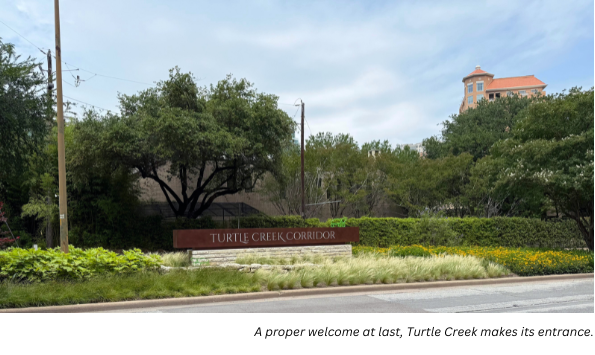
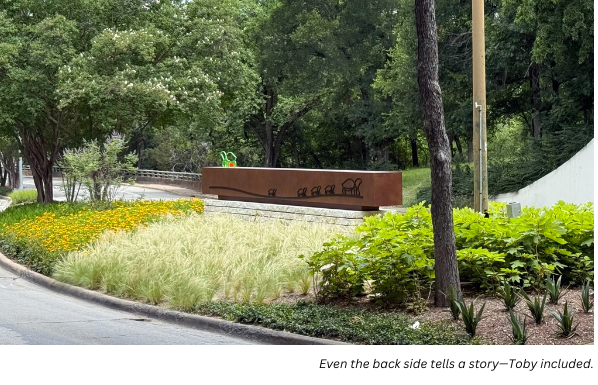
Last fall, the Turtle Creek Association completed the installation of new median landscaping and gateway signage on Cedar Springs Road, between Gillespie and the Katy Trail overpass—designed to create a true sense of arrival at the southern entrance to the Turtle Creek corridor.
Now, just months later, we’re beginning to see that vision come to life.
What started as a carefully planned installation is quickly filling in, becoming lush, layered, and vibrant. The Black-eyed Susans are already putting on a show, the native grasses are softening the edges as they move with the breeze, and the entire space is taking on the kind of natural beauty that only comes with thoughtful design and time.
And, of course, Toby is on watch—quietly welcoming those who pass by.
This is exactly how it was intended to unfold. With a focus on seasonal interest and sustainability, the plantings were selected to evolve throughout the year—meaning there will always be something in bloom, something changing, something worth noticing.
So as you pass through, take a second look. What you’re seeing today is just the beginning.
This is what thoughtful investment in the corridor looks like—not just in the moment, but over time.
| | |
Being a member of the Turtle Creek Association means taking an active role in our mission to Preserve. Protect. Enhance. one of Dallas’s most beautiful and historic treasures. Membership dollars directly support the projects that safeguard Turtle Creek and help it thrive—from restoring iconic bridges to enhancing landscaping, public art, lighting, and the overall health of the corridor. More than a contribution, membership is a partnership—one that ensures this extraordinary urban oasis remains vibrant, accessible, and inspiring for generations to come.
| |
| | | |