|
Imagine a 5-year period where we experienced these successive market drawdowns:
-34%
-5%
-25%
-10%
-9%
It may surprise you to know that we have experienced intra-year drawdowns of these magnitudes over the last five years, and with the exception of 2022, we've seen positive annual returns each of those years. In fact, during this time, the S&P 500* has annualized double-digit positive returns.
This serves as a powerful reminder that volatility is part of the investment journey. Although uncomfortable, market declines are necessary and temporary. Do you remember how you felt during the COVID correction of 2020? Were you saying “Get me out of the market!” or “What should we buy?”
In spite of this volatility, since their advent in the early 1600s, public investment markets have created extraordinary compound returns over longer periods of time.
Our biggest obstacle to long-term investment success is our own DNA. Our fight-or-flight response is a well-documented reaction that has contributed to our survival as a species. It most certainly helped our ancestors survive saber-toothed tigers and dire wolves. Unfortunately, that same instinct works against us in investing. When markets fall, our instincts scream “RUN,” and at market highs, they whisper “I want more.”
Our emotions tell us to buy high and sell low.
Consider the many factors that can cause a stock's price to go up or down: corporate profits, the Federal Reserve, China, tariffs, oil prices, unemployment numbers, and retail sales have all certainly impacted the markets in recent months. These talking points often ignite fear and greed, but the fundamental question is always the same-- are there more buyers or more sellers?
Stocks and markets reach new highs when demand is highest and supply is lowest. More people want to buy (higher demand) while fewer people want to sell (lower supply). This is often driven by emotion: “I think this stock is going to go higher, I want to buy more,” and “I feel like the market's going higher, I don’t want to sell now.”
At a certain point, when prices have increased and valuations have become inflated, we often experience some sort of catalyst that can shift the momentum. Perceived bad news (e.g. - tariffs, high inflation data, etc.) creates an increase in the number sellers and a decrease in buyers. This sudden decrease in demand/increase in supply can cause a dramatic decrease to the price of a stock. The prevailing emotion now shifts to: “I think this stock is going to go lower, sell everything!”
All of this creates a scenario where investors are often comfortable taking on additional risk in their portfolio when the market is at highs and become more risk averse when the market is in a trough.
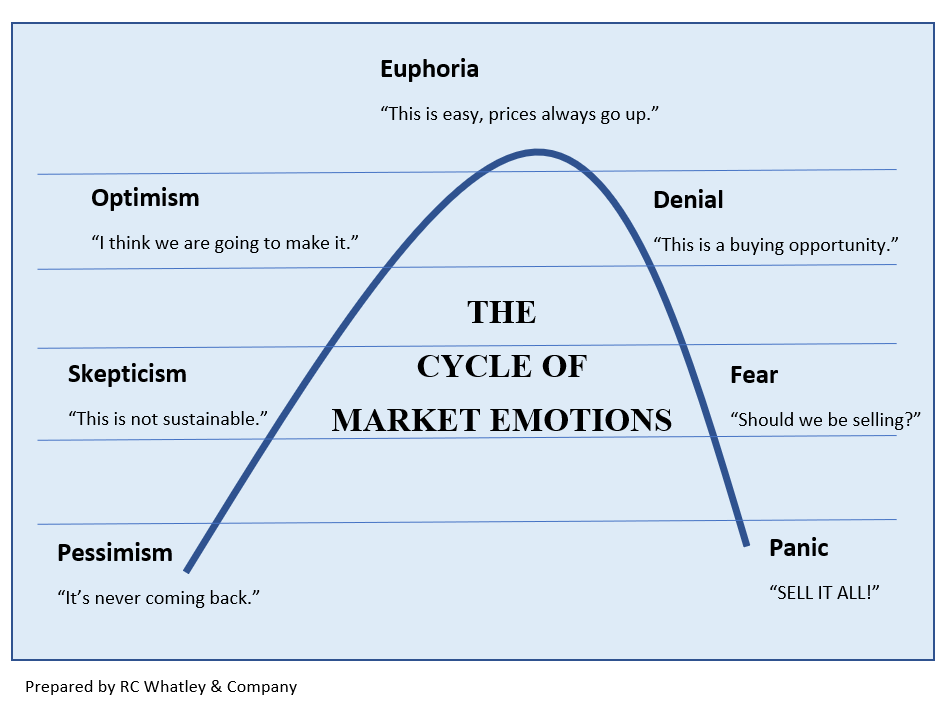
I've included a chart below that illustrates the "Cycle of Market Emotions." Times of euphoria often precedes major corrections, while broader panic and fear in the market often signal opportunity. We often reference this chart as a reminder to eliminate emotions from our investment process. Market volatility comes and goes, but we remain steadfast and disciplined in our approach to managing our clients' portfolios.
In the words of Anthony, "We will be fine."
Best,
Kent
|