|
Treasury is Paying Attention
Washington has noticed. On August 19, Treasury announced it would at least double its long-end buybacks to at least $4 billion per operation in the 10- to 30-year sectors through early November. Treasury Secretary Bessent argued that yields didn't reflect fundamentals and said Treasury would make a market in longer-dated bonds. The first reaction was what he wanted: the 10-year yield fell almost six basis points and the 30-year dropped nine. The first enlarged operation, sized at up to $6 billion, then failed to stop the selloff on a day when oil prices surged.
The question is scale, and the numbers here help, at least on the margin. The current refunding quarter, which runs from August through early November, has 18 scheduled buyback operations with a combined maximum of about $79 billion. That breaks down as follows:
• Cash management: two operations, $25 billion total, in debt maturing within two years. These are about smoothing Treasury's cash balance around tax dates, not rates.
• Liquidity support: 16 operations, about $54 billion total, spread across the curve.
• Long end, 10 to 30 years: 8 operations, at least $32 billion total. Before the August upsizing, the same schedule would have capped out at $16 billion.
Now compare that with supply. At current auction sizes, which Treasury has held steady, it sells about $231 billion of 10-, 20- and 30-year debt each quarter, or roughly $924 billion a year. Even after doubling, long-end buybacks absorb about 14% of that new supply, up from about 7% before. At the new pace, buybacks would take out around $128 billion a year of long bonds, while Treasury sells more than $900 billion.
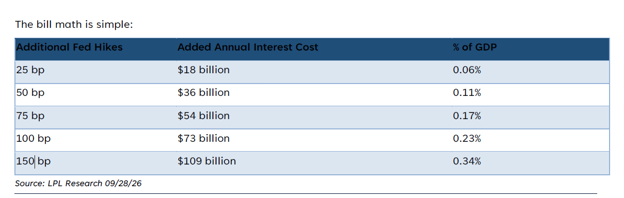
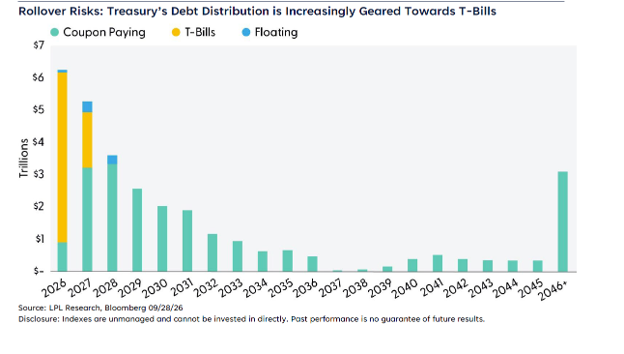
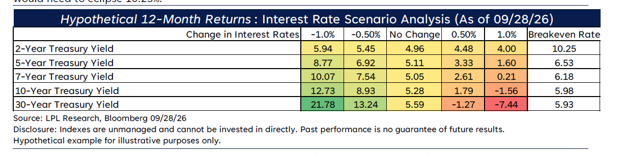
It's not nothing, but buybacks only make a difference at the margin. They also don't shrink the debt. Treasury funds them by issuing more bills, so each long bond bought back becomes short-term debt exposed to the Fed's hikes in the table above. The same tool that relieves the long end adds slightly to the front-end problem.
There are also two things buybacks can't do. They can't reach the belly of the curve, where the last five-year auction stumbled. And they can't change why investors want more yield in the first place: inflation, supply and uncertainty about policy.
So, the buybacks are more of a signal than a solution. Treasury is telling us it cares about the level of long rates. That's reassuring in one sense. It also tells the market where the pain threshold is.
What Can Treasury Actually Do?
Less than people think. Treasury controls how it borrows, not how much.
The toolkit:
• Shift issuance toward bills. This reduces long-end supply, but as the table shows, it trades duration risk for Fed risk. With the Fed hiking, that trade is more expensive than it was a year ago.
• Buybacks. Helpful for liquidity, limited for the level of rates. Roughly one dollar was bought for every seven sold.
• Guidance on auction sizes. Promising not to raise coupon sales can calm nerves, but only if it's credible.
• Encourage new buyers. Bank capital changes and stablecoin demand for bills help at the margin.
The group best placed to tell us what's coming is the Treasury Borrowing Advisory Committee (TBAC), the panel of dealers and investors that advises Treasury each quarter. Its August report was not a rescue plan. TBAC recommended keeping coupon auction sizes unchanged. It said current projections could justify larger coupon sales next fiscal year as funding gaps widen, and suggested Treasury soften its guidance to keep that option open. It also stressed that regular, predictable issuance matters most.
Read between the lines, and the message is clear: more supply is coming, and the best Treasury can do is avoid surprises. Treasury can help shape the curve. It can't set the level.
Do All Roads Lead to Yield Curve Control?
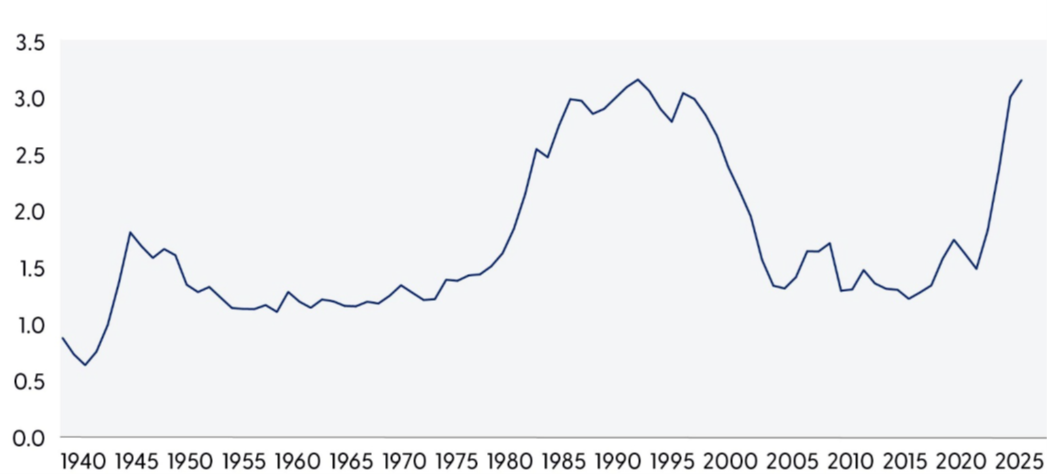
If Treasury can't bring rates down, the natural question is whether the Fed eventually will, by capping long-term yields the way Japan did for most of the last decade. Not all roads lead there, but more do than a year ago.
Current Fed Chair Kevin Warsh wants market prices to guide policy, not be managed by it. He has criticized past Fed bond buying for enabling overspending in Washington, and his stated preference is a smaller Fed balance sheet tilted toward short-term debt, which would push long yields up, the opposite of what Bessent wants.
Still, the plumbing is being laid. Earlier this year, Warsh floated a new accord between the Fed and Treasury, modeled on the 1951 agreement. We warned that tying the Fed's balance sheet to Treasury financing could start to resemble a framework for yield curve control. If we do get there, it probably won’t come as an announcement, though. It would likely arrive in steps:
1. Treasury intervenes with buybacks and a shift toward bills. We are here.
2. The Fed shifts which bonds it holds to longer-maturity securities and/or increases liquidity purchases.
3. A disorderly episode prompts temporary Fed purchases framed as restoring market function, not controlling rates. Think March 2020, or the Bank of England during the 2022 gilt crisis.
4. Temporary becomes permanent, and a cap is formalized.
The problem is inflation. Capping long yields while inflation runs above target and the Fed is raising short rates would tell markets that fiscal needs outrank price stability. That's fiscal dominance in plain sight, and the likely response is a weaker dollar and higher inflation expectations. That's why step three is the one to watch. Emergency purchases for market function are defensible. Anything beyond that, with inflation where it is, would be a regime change.
What a Crisis Would Actually Look Like
Not default. A default is either an inability or unwillingness to pay its debts. Outside of the politically charged debt ceiling debates, the U.S. has neither. The U.S. borrows in its own currency and will pay. A bond crisis is the point where borrowing costs stop responding to growth and inflation and start responding to fear of supply. Five signposts:
1. Auctions fail in sequence, not once. One weak auction is noise. Weak results across maturities with rising dealer takedowns is a signal. This week provides another potential signal with Treasury auctioning off $119 billion (total) of three-year, 10-year, and 30-year Treasury securities. Status: one clear data point, but not across all maturities.
2. Term premium becomes the story. Yields rise because investors demand more to hold long bonds, not because of the Fed or growth. Status: partially flashing but term premium has fallen recently.
3. Stocks and bonds fall together, repeatedly. Status: not yet. Bond yields are higher by 1.09% this year and equities are higher by 12%.
4. Yields up, dollar down. The emerging market signature. Status: not so far. The dollar has strengthened this year.
5. Policy blinks. Status: half. Treasury has blinked with its buybacks. The Fed has not; it's hiking.
The scorecard: maybe two out of five. Not a crisis. Normalization is under real strain, but policymakers are already reaching for tools.
The Setup for Investors
Higher for longer remains the base case, but it's a different kind of higher. The front end is anchored by a Fed that's tightening. The long end is at the mercy of supply, term premium and policy experiments.
That argues for the short to intermediate part of the curve, roughly one to five years. Starting yields provide real cushions: a five-year note at 5% can absorb about a one-point rise in yields over the next year before the total return turns negative. Moreover, to generate a negative return over the next 12 months on a two-year Treasury, its yield would need to eclipse 10.25%.
|