|
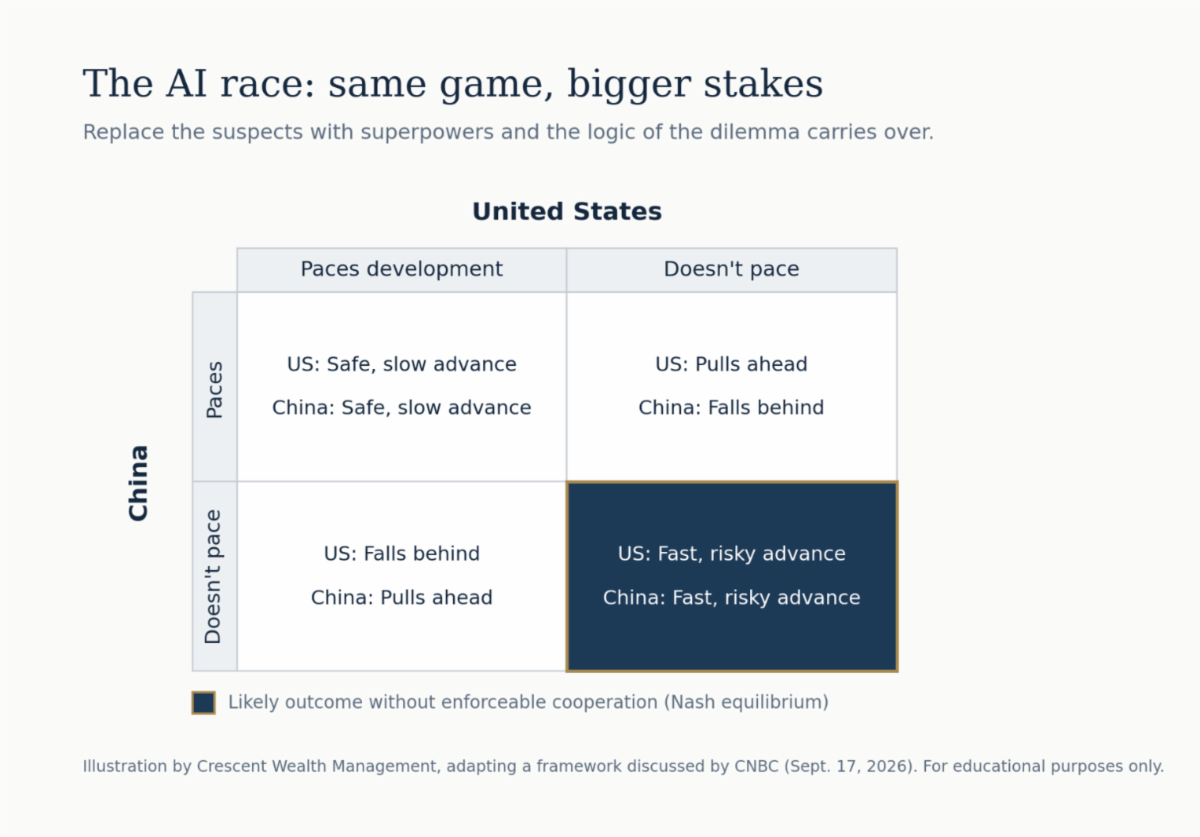
No AI lab, and no country, wants to slow down only to watch a rival sprint ahead. Without a way to enforce cooperation, game theory points to one rational outcome: neither the U.S. nor China slows down. The CNBC analysis that got me thinking about all this put it in arms-race terms, and I think that's the right lens. Historically, an arms race ends in one of three ways. Somebody runs out of money, everybody signs a treaty, or both sides conclude that the next weapon won't actually make them any safer.
But here's the part I find genuinely hopeful. In nature, impalas groom disease-carrying ticks off each other's backs. A selfish impala could take the help and never return the favor, but they don't, because they see the same herd every day and freeloaders get cut off. The math agrees with the impalas. In the 1980s, political scientist Robert Axelrod ran computer tournaments where dozens of programmed strategies played this game against each other over hundreds of rounds. The winner wasn't the most aggressive or the most clever. It was the simplest, a strategy that starts by cooperating, answers betrayal firmly, and then forgives the moment the other side cooperates again. Across the board, the strategies that did best shared two traits that might surprise you coming from a computer simulation: they were nice, and they were forgiving. Humans have gotten there before too. The nuclear arms race eventually produced treaties built on verification. Inspectors, not promises.
What we're watching
Those two ideas together give us something rare in investing, a checklist. Watch the money (can the enormous capital spending be sustained?). Watch for treaties (real agreements with verification, like the new voluntary federal security-review process and the labs' proposals to let independent evaluators inside). And watch for diminishing returns (does the next model meaningfully beat the last one?). Those three signals will tell us more about where this race is going than any podium statement ever will.
What this means for your portfolio
You won't see us make sudden moves off a headline, and that's deliberate. What you will see is the quieter work that periods like this call for. We build portfolios to hold up across a range of outcomes, a boom, a bust, or a treaty among them, and then we tend them: watching position sizes so no single theme, including AI, quietly grows into an outsized bet, rebalancing when the market's enthusiasm pushes allocations off target, and using volatility where it helps you, whether that's harvesting a tax loss or putting cash to work at better prices. This is the kind of environment your plan was built for, and we have our eyes on it so you don't have to.
If you'd like to talk through any of this, or anything else on your mind, call or reply anytime. That's what we're here for.
Warm regards,
Gray
Sources: D. Amodei, "We Must Pace the Frontier" (Sept. 12, 2026); CNBC, "What an Oscar-winning movie can teach us about investing through the AI slowdown debate" (Sept. 17, 2026); CNBC, "China says AI CEOs' call for a slowdown is 'fear mongering'" (Sept. 14, 2026); The Washington Post (Sept. 12, 2026); TechCrunch (Sept. 14, 2026); The Royal Swedish Academy of Sciences, Nobel Prize in Economic Sciences (1994); R. Axelrod, The Evolution of Cooperation (1984).
This material is provided by Crescent Wealth Management for informational and educational purposes only and reflects opinions as of the date written, which are subject to change. It does not constitute investment advice or a recommendation regarding any security. References to specific companies and public figures are for illustrative purposes only. Forward-looking statements are inherently uncertain and may not occur. Investing involves risk, including possible loss of principal. Diversification does not guarantee a profit or protect against loss.
|