|
Not everyone wants to take the plunge and invest the time and
treasure required to own a boat. But still, the sea’s siren song beckons,
and community rowing clubs provide a very special way to answer.
The clubs supply the boats; the members pull the oars.
Rowing clubs generally come in two types. Some feature the racing scull: the delicate, sliding seat, smooth-water singles, doubles, fours, and eights—the serious, varsity “crew” boat. The other kind showcases the blue-collar sweep: rugged, fixed seat, working-class vessels, solid and purpose-built for heavy duty on lumpy, rolling seas.
While all clubs are inclined to welcome new members, it’s the working boat groups that typically are quick to welcome the most rank beginners with zero on-the-water experience, rowing or otherwise. They’re happy to teach you the ropes.
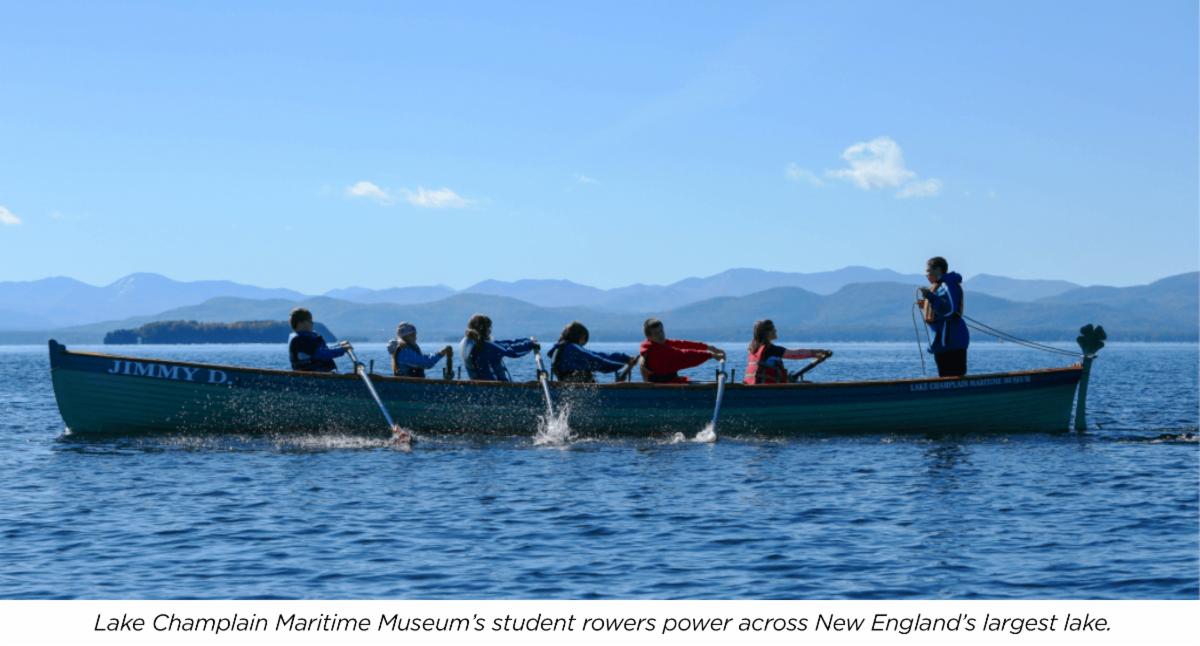
That’s certainly the case in Vergennes Vermont at the Lake Champlain Maritime Museum where their Champlain Longboat building classes flesh out the fleets for their community rowing programs. This year, 700 students and 200 adults will build or row or both. Inclusiveness is the name of the game.
The students have been building 6-seater pilot gigs and 4-seater St. Ayle’s Skiffs in the museum’s boat shop for years. This year’s creation was a 25’ Whitehall gig. What’s more, the Champlain program wraps it all up in a “forest-to-lake” continuum where the student rowers start with field trips to the local forest, learning about the trees that will become the timber, milled at the museum into the boards that will be transformed into boats. And over the winter, they’ll build one from stem to stern and launch it come spring, when rowing season begins.
“We have a recreational program, which is less intensive,” says Nick Patch, the museum’s Maritime Programs Director, “for people who want a social activity and to get out and experience the wonders of Lake Champlain. And then we have what we call Rowing for Racing for those who want to push it a little harder. And some really want a pretty significant workout.”
That would be pretty significant workouts like the Blackburn Challenge, hosted by the Cape Ann Rowing Club in Massachusetts. This summer the Lake Champlain team entered two boats in this 20+ mile, open-water marathon around Cape Ann. Check out this amazing Blackburn Challenge video for a bird’s eye view of a previous year’s event.
Meanwhile, there’s the Canadian Dory Racing Association (CDRA) in Lunenburg, Nova Scotia. Another no-experience-necessary club with a fleet of two-person/four-oared Banks Dories. As Robert Fox, president of the CDRA puts it, “The club is open to anybody that wants to join anywhere across Canada."
But, here as well, the Lunenburg rowers do have a deeply ingrained competitive streak. After all, they’ve been locked in an epic rivalry with their Gloucester International Dory Racing confrères for 72 years! This sparring tradition reaches way back to 1920 when Lunenburg first challenged Gloucester, Massachusetts to the schooner races that would make Canada’s Bluenose a global legend.
Twice each summer, once in Lunenburg and once in Gloucester, the dory mates face off for first honors at the official International Dory Races. Men’s, Women’s, Mixed, Juniors, and Over 50 in both genders—everyone gets into the fray.
Of course, it’s not all games for Lunenburg. Their Monday night fun rows at Lightship Brewery during the summer, and their Tuesday night open houses as well make plenty of room for those who enjoy more leisurely outings.
While back in Gloucester Harbor, their local program provides rower members with a series of local races, an annual cookout, invitation to all events including the Lunenburg festivities, plus 365-day access to practice dories at the Town Landing—all for $150 a year. Call it boating for less than 50 cents a day.
Anywhere there’s water, there’s apt to be a rowing club. On Maine’s Merrymeeting Bay, there’s the Bowdoinham Rowing Club; in Portland there’s Casco Bay Community Rowing. San Francisco has the Dolphin Club. Washington State has the Old Anacortes Rowing & Sailing Society. There’s the Newfound Rowing Club on Florida’s Little Torch Key. The Bay State has active clubs in Amesbury, Boston, Hull, Hyannis, Martha’s Vineyard, New Bedford, Onset, and Wellfleet to name a few.
There’s probably a rowing club near you where you can experience those magical instances when the crew is clicking, when all the oars dip the water in synchronized perfection, and the vessel shoots along, rippling through the water as if it’s come alive. And you don’t even need to own the boat; but you do get to own that moment.
|