|
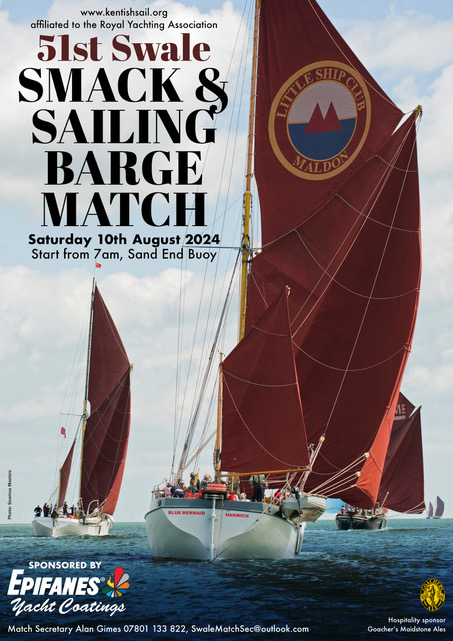
We have some friends in England, at the Kentish Sailing Association, which has hosted what appears to be a quirky, fun sailing regatta every summer since 1972. The quirk? It's a boat race for mature ages; which on the face of it means the ages of the boats. And it's called the Annual Swale Smack and Sailing Barge Match.
Think brawny, old draft horses charging gracefully through the shallows of the Kentish Flats. The KSA seems special in that, yes, it's a cadre of folks who are drawn to owning, caring for, and sailing rugged relics that plied the Thames back when motorcars were a novelty.
The Swale itself is a tidal channel off the Thames estuary. Consult a chart of the Kentish coast. You see where the Isle of Sheppey forms a sort of a chin below the mouth of the River Thames? The Swale, a wide and gently shelving channel, wraps around this protuberance and when the tide is out, it's all mud except for a narrow waterway down the middle—which also describes to a tea the River Thames through London.
Ships coming in to London, unable to tie up at docks along the riverbank, stayed put in the deeper narrows, anchoring in whatever sufficient depths were available at low tide.
Thus, the barges—smaller "lighters" to ferry cargo from large ships to shore. These were the Thames barges: shallow draft, flat bottomed craft, with lee boards in place of keels, that could nestle nicely in the mud and lift off with ease as the tide came in. Circa 1914, there were more than 2,000 of these smaller hardworking vessels handling all of London's seaborne cargo.
The Swale Match, now also open to younger, full-keeled sailboats from the 1960s, attracts probably the biggest fleet of historic sailing craft and steam vessels assembling anywhere on England's east coast including competitors coming from the south British coast and some from mainland Europe, too. The race is cousin to the Thames Matches started in 1863 by Henry Dodd to promote the value of faster barge designs and the renown of the owners and crews who were fastest at their jobs. The Thames Match is considered sailing's second oldest regatta—after the America's Cup.
At the Swale Match start there are Thames spritsail barges—including stackies and stumpies, bowsprit and staysail barges, and the larger coastal barges—East Coast smacks, bawleys (for shrimping), Whitstable oyster yawls, Humber keels, Itchen ferries, and smaller smack and barge yachts based on working boat lines.
The Dawn is a stackie and in a rather continuous state of renovation, understandably since the boat is, after all, 127 years old. Like most Thames barges, it's a floating box, 82 feet long with a 20-foot beam. Stackies would carry hay from coastal farmlands to provide for turn-of-the-century London's 300,000 horses. Then ferry nitrogen-rich manure back to the farms for fertilizer—the "hay up, dung down" trade, a virtuous "green" circle long before such an idea existed.
Deeper into the rabbit hole, beyond the Swale Match, you will find a whole world of delightful barge restoration madness.
There's Wyvenhoe, a 103-ton steel-hulled racer built in 1898 expressly for the matches but went to work as a commercial barge in 1903. You can watch Wyvenhoe being blown up in the Bond film "The World Is Not Enough," but that was just acting. The boat's fine.
Topsail Charters runs sightseeing dinners and wedding parties aboard Thistle, a coal barge built in 1895; Hydrogen (1906), the largest surviving wooden barge; and Reminder (1929) a champion of the Thames and Medway Matches.
There's Greta built in 1892 and the oldest Dunkirk Little Ship still working. England's Little Ships are held in the highest regard as they were the 700 or so, privately owned yachts, fishing boats, and odds and sods of small craft that sailed in Operation Dynamo: the nine-day scramble in 1940 to pluck 385,000 Allied soldiers, cornered on the French coast, from imminent destruction or capture by the German army.
There's Pudge, a mere 102-years-old, also a perennial Swale Match competitor and another Dunkirk Little Ship, which suffered an explosion that blew this 93-foot vessel clear out of the water. After which it landed right-side-up in the waves and carried on.
There's such tradition and charm and history and adventure in every fiber of these grand old stalwarts. If you have a soft spot for Classic (capital C) sailing vessels, this rabbit hole beckons you to England's East Coast where proud antiques like these seem to pop up everywhere—like the Swale Match. Go down to Harty Ferry and watch the spectacle—you'll discover a Wonderland of barges, smacks, and other local craft on the Kentish Coast.
|