|
With the weather slowly starting to warm up, we are spending more time outdoors, and more time transitioning between the indoor classroom and the outdoor classroom. Try these Active Supervision Strategies the next time you are outside or completing transitions.
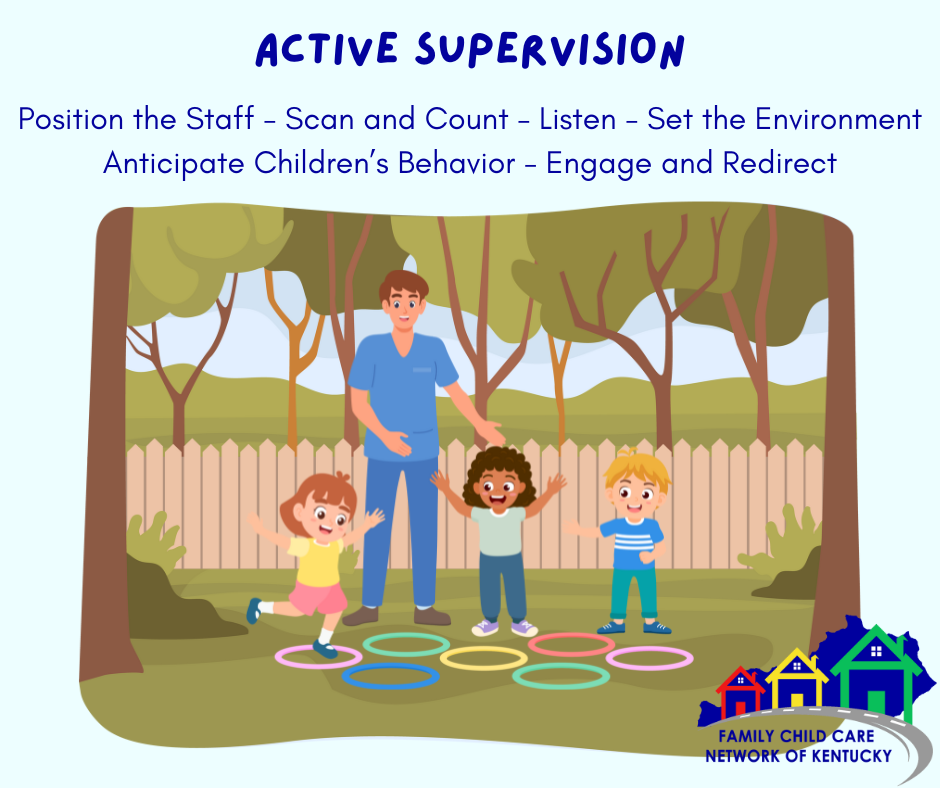
Set the Environment: When setting up your environment for the day, you will want to ensure you are able to keep children within a line of sight from any angle in the classroom. This can be done by keeping taller shelves against the wall, while shorter shelves are in the middle of the room. While outside, this blends with Position the Staff as you will be walking around the play space to ensure children are engaging in safe play.
Position the Staff: Make sure you are able to see the full environment. If you have multiple staff, have each staff member take a different side of the space to ensure all areas are visually maintained.
Scan and Count: Pairing this with Face To Name, you will want to take a moment every so often to scan the environment, count how many children you see, and ensure that everyone is still present and doing well. In addition, during transition periods, it is very important to use Face to Name to ensure you have all the children present for the day.
Listen: When you have children in your program, you want to ensure you are listening for if an intervention necessary incident is about to occur. Which brings us to our next strategy, Anticipate Children’s Behavior.
Anticipate Children’s Behavior: As you know the children in your own program, you know who is more likely to engage in risky play, who is more likely to get in an argument with another child, and who is more likely to run off and hide. It is very important to anticipate your children’s behaviors to be able to position yourself to Engage and Redirect when necessary.
Engage and Redirect: The strategy that we are most familiar with. If we see or hear a problem where we need to intervene, we will need to jump in and redirect the child to more safe, or appropriate, behaviors.
|