|
Lawyers and other professionals sometimes must make difficult decisions as to whether to try to collect unpaid fees from clients. There are many factors that go into the calculus, which is beyond the scope of this column. Here, the focus is on one tool that can be effective in fee collection litigation: the venerable account stated cause of action.
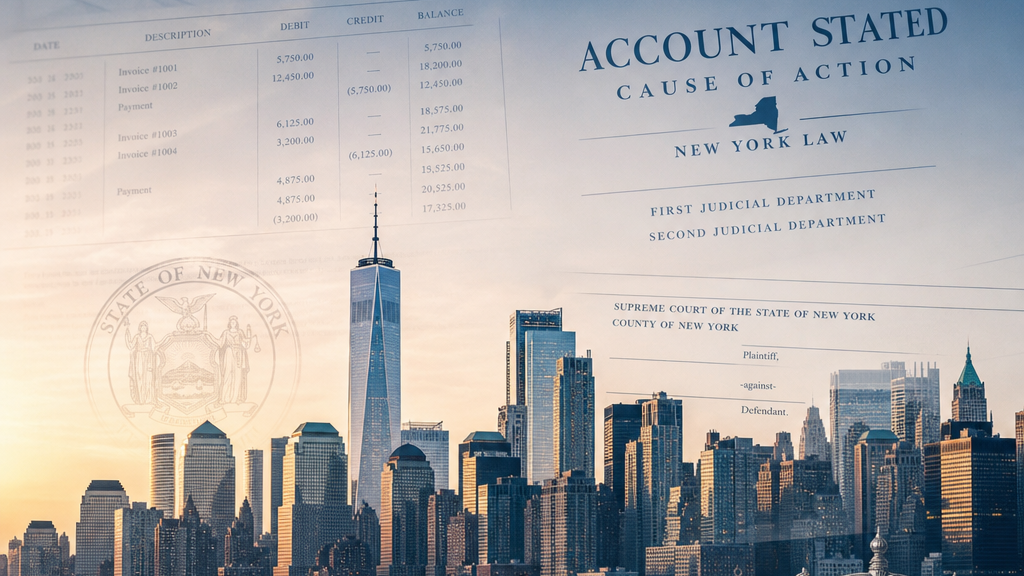
A client who receives and retains invoices from an attorney or other professional without objection within a reasonable amount of time, or makes partial payment of the invoices, will be deemed to have consented to the accuracy of the invoices. This is the foundation of the “account stated” cause of action.
The nature of a claim based upon an account stated has been explained by the Court of Appeals as follows:
“An account stated is nothing more or less than a contract express or implied between the parties. . . . As a general rule where an account is made up and rendered, he who receives it is bound to examine the same or to procure someone to examine it for him. If he admits it to be correct it becomes a stated account and is binding on both parties. If instead of an express admission of the correctness of the account, the party receiving it keeps the same by him and makes no objection within a reasonable time, his silence will be construed into acquiescence in its justness, and he will be bound by it as if it were a stated account.” Rodkinson v. Haecker, 248 N.Y. 480, 484-85 (1928).
An account stated is “an account balanced and rendered, with an assent to the balance express or implied; so that the demand is essentially the same as if a promissory note had been given for the balance.” Parker, Chapin, Flattau & Klimpl v. Daelen Corp., 59 A.D. 375, 377 (1st Dep’t 1977) (quoting Volkening v. De Graaf, 81 N.Y. 268, 270 (1880)).
The cause of action is rooted in fairness. To permit a client to belatedly challenge invoices -- sometimes even well after an attorney has completed his or her representation -- would be unjust and unwise as a matter of public policy. An attorney dealing with a client who expresses only general discontent with the cost of litigation and its progress but nonetheless continues to employ the attorney (or voices no objections whatsoever) should expect to be fully compensated.
In New York’s First and Second Judicial Departments, to establish an “account stated,” the unpaid professional must offer proof of the client’s receipt and retention of invoices without objection within a reasonable amount of time, or proof of partial payment of the invoices. Proof of either suffices. See Aronson Mayefsky & Sloan v. Praeger, 228 A.D.3d 182, 184-85 (1st Dep’t 2024); Michael B. Shulman & Assoc., P.C. v. Canzona, 201 A.D.3d 716, 717 (2d Dep’t 2022); Citibank (South Dakota), N.A. v. Abraham, 138 A.D.3d 1053, 1056 (2d Dep’t 2016); Morrison Cohen Singer & Weinstein, LLP v. Waters, 13 A.D.3d 51, 52 (1st Dep’t 2004); Ruskin, Moscou, Evans & Faltischek, P.C. v. FGH Realty Credit Corp., 228 A.D.2d 294, 295 (1st Dep’t 1996).
Click here to read the full article...
|