REMINDER: YOUR SUBMISSIONS ARE ENCOURAGED | | |
1. Bindu's Corner: This week Bindu has brought us more spiritual wisdom from Swami Vivekananda and a morning affirmation of happiness.
2. Happy New Year: Learn some of the unusual ways people around the world will be saying goodbye to 2025 and welcoming 2026.
3. From the Flock Archives: I've pulled two posts from the Flock Archives with helpful advice to make realistic, achievable New Year's resolutions.
4. A Mantra for the New Year: I ran across a little mantra that would be a nice way to start mornings in the coming year.
5. Spirituality: Take advantage of the new year as a time to re-commit to your own spirituality.
6. The Heavens: Next Saturday night, January 3rd, brings the first full moon of 2026, the Wolf Moon.
7. Wellness: The most recent issue of Sensitive & Specific: The Testing Newsletter illuminates current research on the development of a reliable blood test to identify individuals at risk for post-partum depression.
8. Dr. Hayward M. Fox, Ph.D.: I have a new post from Dr. Fox's blog for you to ponder as 2025 comes to a close.
| | |
I hope you will pick and choose, and enjoy your reads.
Please feel free to share the Flock.
| | Now, to this week's Flock. | |
1. Bindu's Corner: Wisdom & Happiness
| | Thank you, Bindu, for sharing this wisdom with us. | | |
Good and evil have an equal share in moulding our character, and in some instances misery is a greater teacher than happiness. In studying the great characters the world has produced, I dare say, in the vast majority of cases, it would be found that it was misery that taught more than happiness, it was poverty that taught more than wealth, it was blows that brought out their inner fire more than praise.
— Swami Vivekananda
| |
2. Happy New Year: New Year's Tradtions
| | I hope everybody had a lovely Christmas holiday this week, and just like that, it's time to get ready for New Year's. New Year's Eve is next Wednesday. This week, I'm looking at unusual traditions from around the world for bidding farewell to the past year and marking the start of a fresh new year. I wish everybody a wonderful 2026! | 8 New Year’s Traditions From Around the World | From Women's World, By: Malanie Aman, December 29, 2018 | |
Learning about all the wonderful New Year’s traditions around the world will make you rethink how you celebrate at home. Do you ring in the new year with a kiss at midnight, or stay up late to watch your town’s fireworks display? Maybe you prefer to stay inside where it’s warm and watch the Times Squre ball drop with your family. We’re guessing your family even has a tradition or two of its own!
All around the world, countries celebrate the new year just like us — but in totally different ways. Whether it’s the Danes who enjoy smashing plates on each other’s doors, or the Spanish who guzzle 12 grapes as soon as the clock strikes midnight, each section of the globe has its own special way of doing things
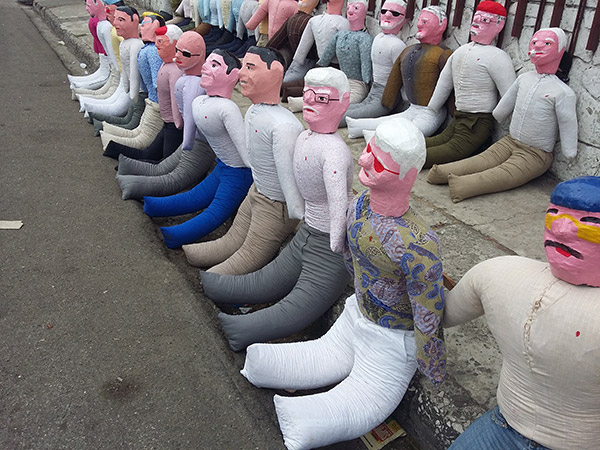
| Breaking China isn’t usually cause for celebration — unless you’re in Denmark and it’s New Year’s Eve. It’s tradition to smash plates against people’s doors in this Scandinavian country as a sign of affection and friendship. In fact, it’s a good omen if you open your doors to a large pile of rubbish, because it means you’re loved and thought of by many. And don’t worry, the Danes make sure to use plates that are already cracked or damaged instead of ruining their new porcelain. | Mannequins with firecrackers for the celebration of the new Year of Guayaquil, Ecuador | Ecuador: Burning Scarecrows | For New Year’s in Ecuador, there’s a different sort of light show. Citizens will burn effigies of politicians, cultural icons, movie characters, and more to symbolize the burning of the “año viejo,” Spanish for “old year.” Some excited celebrators will jump over the fire 12 times — one jump for each month. | | Instead of starting the New Year with a smooch, Spaniards spend the first 12 seconds eating grapes — las doce uvas de la suerte (“the 12 lucky grapes”). If you can chew and swallow all 12 grapes by the last chime of the bell tower at Real Casa de Correos in Madrid's world-famous city square Puerta del Sol, then you’re rewarded with a year of good luck. | | |
There is a similar tradition of eating grapes in the Philippines for New Year’s, but it has more to do with the idea that the number 12 symbolizes prosperity. That said, people in the Philippines also regard 12 as an important number on New Year’s. As a result, kids are told to jump 12 times at the stroke of midnight in order to grow taller.
It’s unclear when or how this tradition began, but the image of millions of children jumping is just too cute. One columnist, Rod Nepomuceno, recounts his experiences to Philippine Star: “I also remember my uncles and aunties telling us gullible kids, 'Hey, don't forget, at the stroke of midnight, jump as high as you can repeatedly so you'll be taller.' And like a bunch of idiots, we'd jump up and down at the stroke of midnight. I didn't grow up to be as tall as Yao Ming, as I had hoped (that guy probably jumped a whole lot during Chinese New Year). But luckily, I did grow up to be reasonably tall. Well, at least tall enough to have the confidence to go out on dates without feeling too insecure about my height."
| South America: Colored Underwear | |
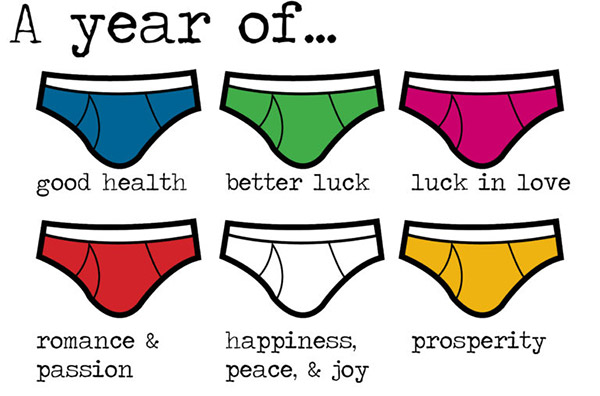
Finding the best New Year’s Eve outfit for any occasion is tricky — so why not just focus on your underwear? According to tradition in some South American countries, the color of your underwear dictates what the new year has in store for you.
There are small quirks within each country regarding the proper way to wear underwear. For example, it’s said to bring double the luck if you wear your green underwear inside out in Peru and then flip it back the correct way after midnight. In Bolivia, some ring in the new year by wearing their underwear backwards!
Red: Life (Spain) | Orange: Work success (Brazil) | Yellow: Happiness and good fortune (Chile, Colombia, Ecuador, ) | Green: Good energy (Peru) | Blue: Tranquility (Portugal) | Pink: Romance (Argentina), friendship (Bolivia)
Black: This shade is believed to bring bad luck in most South American countries, so stay away from dark underwear!
| |
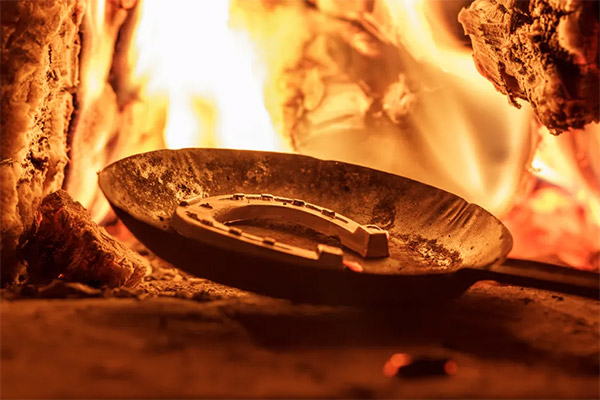
One popular New Year’s activity for Finns is the casting of tin. The way this tradition works is everyone gets a tin horseshoe, a traditional good-luck sign. Then, they melt the horseshoe and pour the molten tin into a bucket of ice water. There’s no mold for the melted tin to fill, so the metal usually solidifies in an odd shape.
The next step is to interpret the shape of the tin once it hardens, as well as the shadow it casts. Whatever the results are will predict what’s in store for you in the new year. For example, it’s considered a bad sign if the new tin cast breaks into pieces.
| | Polar bear swims, also called polar bear plunges, are common in Canada on New Year’s given the country’s cold temperatures. The Vancouver Polar Bear Club, which was started in 1920, recorded an all-time high of 2,550 swimmers in 2014. | | The origin of the German tradition of enjoying pfannkuchen, basically a jelly-filled donut, to celebrate the new year is unknown, but one thing’s for sure: They’re pretty darn delicious. You can buy pfannkuchen year round, but the New Year’s version comes with a twist. Inside some pfannkuchen is onion or mustard instead of jelly — so watch what you eat! | |
3. From the Flock Archives: Keeping Your Resolutions
| | These two posts from the December 29, 2023, issue of the Flock offer helpful tips and guidance for making realistic New Year's resolutions and staying on track to achieve your goals for the new year. | | 7 Tips to Keep Your New Year’s Resolution | | |
Making New Year’s resolutions is a yearly tradition for many people. Yet, some of us fall short of reaching our goals.
Below are seven tips to help you make and stick to your New Year’s resolutions. By following these suggestions, UC Davis Health experts say you can set yourself up for success
- Be picky about your resolutions
- Plan your resolution
- Set very specific goals
- Don’t take on too much
- Choose a new resolution
- Identify accountability partners for support
- Give your resolution time to become a habit
| | Many of us will include an exercise as one of our New Year's resolutions. If that is the case for you, the following article from Harvard Health will help you stick to the program you decide on. | | Sticking with Your Exercise Program | Exercise shouldn't be something you do only when you want to drop those 10 extra pounds or prepare for the charity 10-kilometer run. To be successful, it should be something you do as routinely as eating, sleeping, and taking your morning shower. That can be difficult, as you may already know. The article linked to below may help you stay on course when your motivation starts to flag. Remember, the result is worth the effort. | |
4. A Mantra for the New Year
| | I think this is a nice mantra to start your days with in the coming year. | |
5. Spirituality: Preparing Your Heart for the New Year
| | The new year is not just a good time to make resolutions to break bad habits or to get into better physical shape, it is also a good time to re-commit to your own spirituality. | | How to prepare spiritually for a new year? | From: C3 Powerhouse, December 3, 2025 | | To prepare spiritually for the new year, take time for self-reflection, prayer, and seeking God’s guidance for the year ahead. Engage in spiritual practices like journaling, fasting, and meditating on God’s Word to align your heart and mind with His will. | |
6. The Heavens: The Wolf Moon
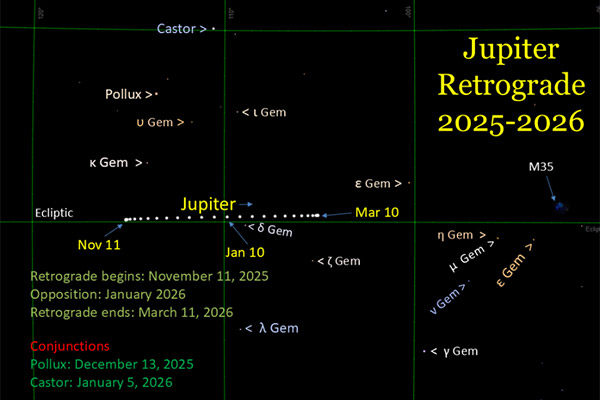
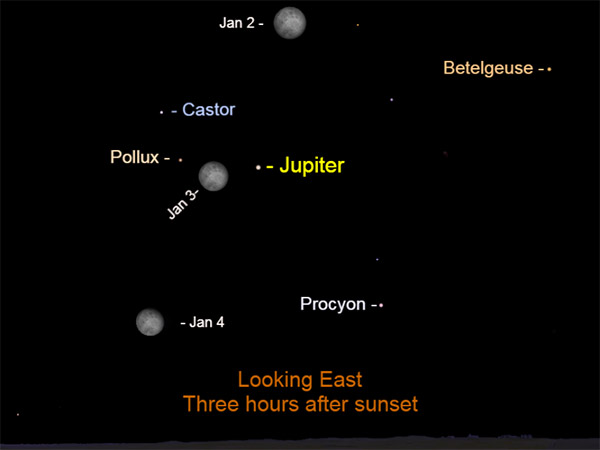
| | Next Saturday's full Wolf Moon is not only the first full moon of 2026, but it is also the first of three supermoons for 2026. You will also have an excellent opportunity to observe Jupiter in retrograde from the 2nd through the 4th by using the full moon and Pollux and Castor, the two primary stars in the constellation Gemini, as reference points. Retrograde is when a planet appears to reverse the direction of its path across the heavens from the Earth's perspective. Saturn entered retrograde on November 11th and will continue to appear to be moving east to west until March 10th. | January 2026 Full Wolf Moon | From: The Wilderness Center, December 23, 2025 | |
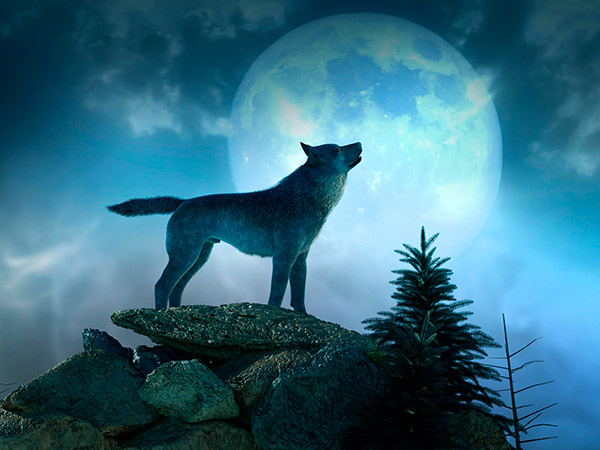
The first full Moon of 2026, the Wolf Moon, occurs on January 3, at exactly 5:03AM EST. At this moment the Sun will be at its fullest and brightest. You’ll have about three hours to enjoy this full Moon before sunrise. If you’re not a morning person, the Moon will look very full and bright when it rises later that night. In fact, it will look full and bright the evening before on the 2nd and the evening after on the 4th. January’s full Moon is the first of three full supermoons in 2026.
There are differing opinions on the origins of the name Wolf Moon. Some sources state that the name is Native American in origin and others say it is Anglo-Saxon in origin. Wolves inhabit every continent except South America and Antarctica. Their howling during the cold month of January would have been familiar to not only Native Americans but to all in the northern hemisphere. And for millennia, Native Americans and people across Europe named the months, and in turn the full Moons in those months, after characteristics they observed during the month. So, we will probably never know the true origin of the name Wolf Moon.
It was once thought that wolves howled during January because they were hungry. Turns out that’s not the reason at all they’re just very communicative. They howl to coordinate hunts, tell other members of the pack where they are or that the pack needs to meet up. A howl may warn about a predator, give the location of prey, or warn outsiders they’re straying too close to the pack’s territory. The pack will even have howling sing-alongs. Howling increases during the evening and early dawn hours when wolves are hunting and even more often during the winter breeding season when they are looking for mates.
Do wolves howl at the Moon? No, but they do point their muzzles up toward the sky when they howl. It’s all about acoustics – projecting their howl upwards carries the sound farther. Researchers have found no connection between the phases of the Moon and wolf howling. They howl more at night because they are nocturnal. Folklore connecting wolves and the Moon has been around since ancient times. As far back as the Neolithic Age we find wolves and the Moon together in images and later in literature. It’s this long history of connection that has evolved into today’s popular folklore belief that wolves howl at the Moon.
| | 2025, November 11-2026, March 10: Jupiter retrogrades about 10° against Gemini. | |
2026, January 2-4: Full Wolf Moon Approaches and Passes Jupiter and Gemini
January 2-4, 2026: The Full Wolf moon passes bright Jupiter near Pollux in Gemini. Learn when and where to look during early evening hours.
| | From: When the Curves Line Up, By: Jeffrey L. Hunt | | |
During January 2–4, the Full (Wolf) moon approaches and passes bright Jupiter during the early evening hours. With Venus approaching superior conjunction with the sun, Jupiter is the brightest starlike body in the night sky. As it nears opposition, the planet rises about 45 minutes after sundown and appears progressively farther westward as the night advances. It is high in the south after midnight and low in the west-northwest during morning twilight.
The Full moon is opposite the sun, meaning that it mirrors Jupiter’s apparent westward journey during these three evenings.
Jupiter retrogrades in front of Gemini, near Pollux, one of the Twins, and appears to move westward compared to the starry background from night to night. As opposition approaches, the planet’s westward motion is easily seen over just a few evenings. Jupiter passes Castor, the other Twin, in a wide conjunction on January 5th.
What to See Three Hours after Sunset
| | 2026, January 2-4 At three hours after sunset, the Wolf moon approaches and passes Jupiter and Pollux. | |
-
January 2: The bright Wolf moon stands nearly 40° above the eastern horizon and about 15° to Jupiter’s lower right. Jupiter is 6.9° to Pollux’s lower right.
-
January 3: The Full moon is 25° above the east-northeast horizon and lies below the Jupiter–Pollux line. The three bodies span nearly 7.0°, fitting tightly into the same binocular field.
-
January 4: The bright moon, now slightly humped (gibbous), is 13° above the east-northeast horizon. The Jupiter–Moon separation is 17.3°, while Jupiter remains 7.0° to Pollux’s lower right.
Look for the moon as it approaches and passes Jupiter and Pollux during the early evening hours.
| |
7. Wellness: Sensitive & Specific Newsletter
| | The latest issue of Sensitive & Specific: The Testing Newsletter came out last week, just before the Flock went into production. I am always impressed by the advancements in medical testing that are highlighted in each issue. This past issue reveals positive developments in identifying individuals at risk of developing post-partum depression through a targeted blood test. Stay up on the latest testing methods in medicine by subscribing. | Blood test may soon predict post-partum depression - other mental health issues are harder | From: Sensitive & Specific: The Testing Newsletter, Volume 12, Issue 27, By: Mara G. Aspinall and Liz Ruark, December 18, 2025 | |
Postpartum depression (PPD) is widespread and underreported. At least 20% of mothers are estimated to suffer from the condition, which starts in the first few weeks after giving birth. A reliable predictive test would be a breakthrough, enabling preemptive treatment that could stave off the problem. Medscape published a perspective on the prospects for such a test, planned for launch in early 2026 as an LDT.
For most people who suffer from major depression, no obvious biological changes signal its onset or even its existence (it is diagnosed qualitatively, using one of many scoring systems). PPD is very different. It occurs only as early postpartum moms undergo “hormonal whiplash” from the very high levels of estrogen present during pregnancy to the lower levels present after birth.
Early work in mice suggested that some moms were more sensitive to this sudden change than others. Human research (reported in 2013 and 2021) suggested that a blood test for abnormal methylation of two specific genes (HP1BP3 and TTC9B) was 96% accurate at predicting unusual sensitivity to this whiplash.
COMMENTARY: Biomarkers for mental-health disorders are the holy grail – immensely valuable, hard to find, perhaps illusory – but still worth the major effort directed to find them. Resolving PPD alone would be an immense achievement. Unfortunately, because it’s a response to unique and specific physical change, PPD is unlikely to serve as a model for the development of other much-needed major depression biomarkers.
Nevertheless, we remain optimistic that cheaper and more comprehensive multi-omic techniques (from genes to epigenomics, proteomics, metabolomics, and microbiomics), when submitted to the superhuman pattern-recognition skills of AI, will lead psychiatry’s long overdue entry into the scientific age.
| |
8. Dr. Hayward M. Fox, Ph.D.
| | I am very happy to have a new post from Dr. Fox's blog to close out 2025 with. Please visit Dr. Fox's website at the Institute of Personal and Transpersonal Knowledge and explore his past blog posts, guided meditations, and study guides. | | These Flock regulars are always here for you: | | Don't Be Shy: Share Your Stories! | | I'm looking forward to sharing more of your personal stories - oral, written, or otherwise, as we enter our third year. I'd so love to present them to The Flock, hit a mailbox below to share your story. | | Subscriptions & Idea Submissions
Reminder: Your submissions are always welcomed. | | |
Feel free to forward this email to a friend. If this was forwarded to you and you would like to receive your very own Flock Newsletter, you can sign up here. If you have any questions or suggestions for future Flock resources, don't hesitate to contact me.
Your fan and friend,
Beth
| | | The information and materials contained or referenced in this newsletter are for informational purposes only and not intended to be a substitute for professional medical advice, diagnosis, or treatment. Always consult a physician or other qualified medical professional with any questions you may have regarding a medical condition or treatment and before beginning a new health care regimen. Do not disregard professional medical advice or delay seeking medical advice or care based on anything contained in this newsletter. | | | | |