|
1. March is Women's History Month. I have a little history and links to some of the museums and government agencies planning special events for this month.
2. In honor of Women's History Month, we are going to feature a Woman of the Week throughout March. We are starting with Queen Liliʻuokalani, the last sovereign monarch of Hawai'i.
3. I also wanted to share a bit about my Nepali guide, Mingma Sherpa, who has helped me navigate Himalayan mountain trails and is now helping his community navigate to a better life.
4. I love to follow surfing, especially the big wave riders. This spring Nazaré in Portugal had a convergence of factors set off by an atmospheric depression that has brought the towns characteristic big waves to world record proportions.
5. In Performing Arts I'm presenting a new, contemporary Opera inspired by the stories of people wrongfully convicted of crimes alongside an operatic adaptation of the classic play, Roméo & Juliette by William Shakespeare.
6. In Wellness we look at the health benefits of Saffron, a spice once reserved solely for royalty.
7. The NCAA basketball tournament begins in three weeks, a big deal in Tucson. Here’s an update on where both the UArizona's Men's and women's teams stand going into March Madness.
8. Tennis pro Roscoe Tanner is hosting two clinics in Tucson this month. It's an opportunity to get help with your serve from the man that held the fastest serve record for 25 years.
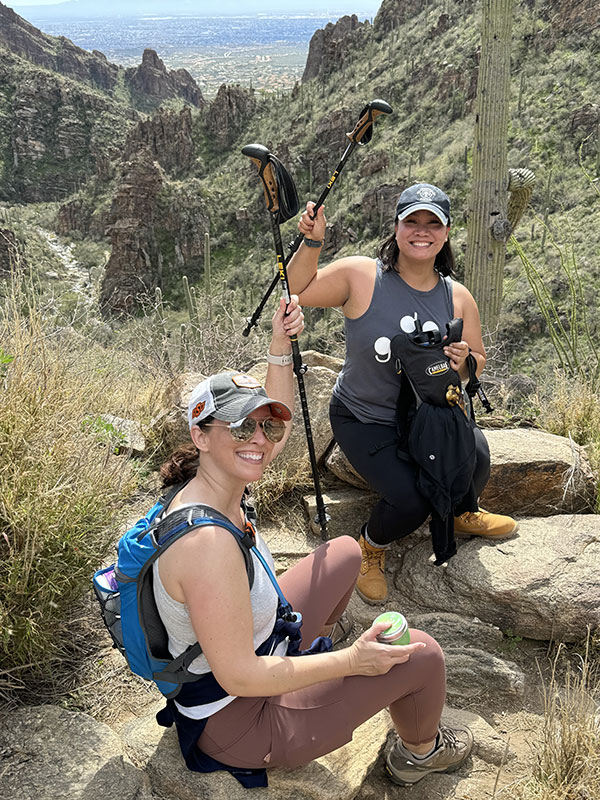
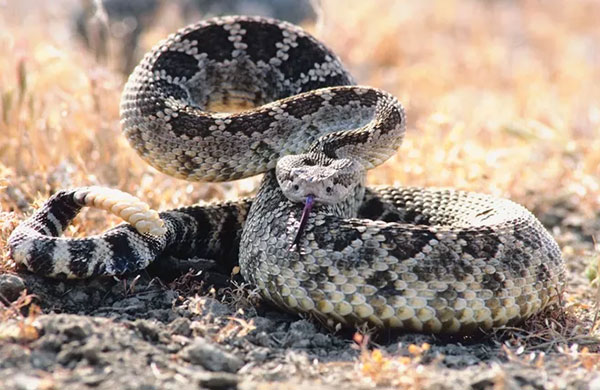
9. A recent hike in the front range of the Catalinas reminded me that as the weather warms up in Tucson, so do the rattlesnakes. I have a primer on who to look out for and how to tell them apart.
| |
Now, to this week's Flock. | |
1. WOMEN'S HISTORY MONTH: March 2024
| |
|
Every year, March is designated Women’s History Month by presidential proclamation. The month is set aside to honor women’s contributions in American history.
Did You Know? Women’s History Month started as Women’s History Week…
Women’s History Month began as a local celebration in Santa Rosa, California. The Education Task Force of the Sonoma County (California) Commission on the Status of Women planned and executed a “Women’s History Week” celebration in 1978. The organizers selected the week of March 8 to correspond with International Women’s Day. The movement spread across the country as other communities initiated their own Women’s History Week celebrations the following year.
In 1980, a consortium of women’s groups and historians—led by the National Women’s History Project (now the National Women's History Alliance)—successfully lobbied for national recognition. In February 1980, President Jimmy Carter issued the first Presidential Proclamation declaring the Week of March 8th 1980 as National Women’s History Week.
Subsequent Presidents continued to proclaim a National Women’s History Week in March until 1987 when Congress passed Public Law 100-9, designating March as “Women’s History Month.” Between 1988 and 1994, Congress passed additional resolutions requesting and authorizing the President to proclaim March of each year as Women’s History Month. Since 1995, each president has issued an annual proclamations designating the month of March as “Women’s History Month.
| |
2. WOMAN OF THE WEEK: Queen Liliʻuokalani
| |
In honor of Women's History Month, we are going to present one exceptional Woman of The Week in each issue of The Flock this Month. Our fist is a woman of many talents, Queen Liliʻuokalani of Hawai'i. | |
Musician, Composer, and Head of State Queen Liliʻuokalani | |
The last sovereign monarch of Hawaiʻi, Queen Liliʻuokalani, was a gifted musician and composer. Liliʻuokalani possessed perfect pitch and was proficient with several instruments. She composed over 200 works that blend the musical traditions of Western cultures with native Hawaiian stories, people, and sense of place. Liliʻuokalani’s best-known song “Aloha ‘Oe,” was written in 1878 as a farewell song between two lovers. After the Kingdom of Hawaiʻi was overthrown in 1893, the song acquired additional meaning as a farewell to self-governed Hawaiʻi. | |
Aloha Oe -- (Farewell to Thee) Queen Liliuokalani of Hawaii | |
3. PHILANTHROPY: My Nepali Guide
| |
When I have had the opportunity to visit Nepal and explore the Himalaya, I have relied on the help of Mingma Sherpa as my guide. Recently i have been honored to help Mingma help others in his community as well. For as little as $500 a year Mingma is able to help children in Nepal receive an education and improve their station in life. - Namaste. | |
4. SURFING: Big Waves at Nazaré
| |
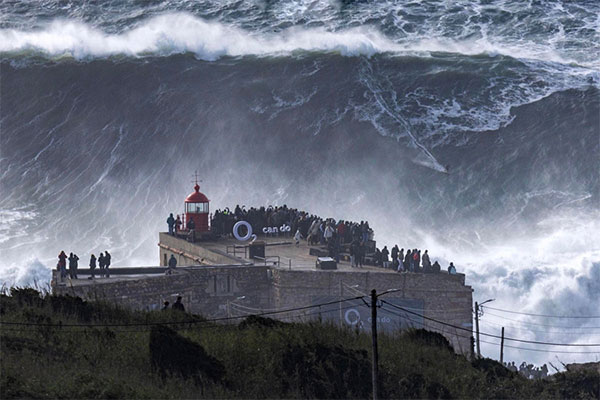
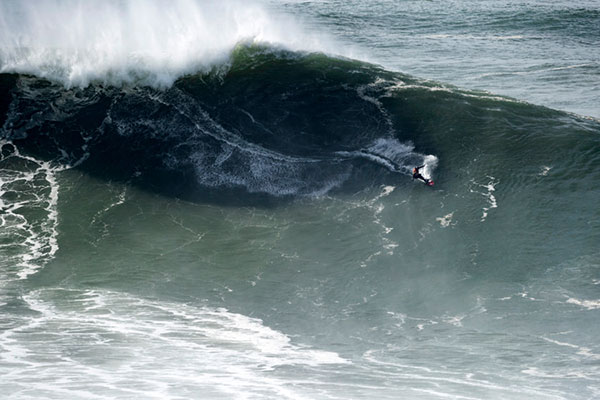
Back in December we looked at the 10 Biggest Waves Ever Surfed. Seven of those ten waves we're in Nazeré, Portugal. A recent atmospheric depression turned those already large swells into massive, near 100ft. high walls of water drawing the press and big-wave surfers to the coastal village for the chance of a World Record wave. | |
Depression Louis triggers historic XXL swell in Nazaré | |
|
Depression Louis brought some of the largest swells of the decade to Portugal, Spain, and France, courtesy of the North Atlantic winter storms. The extreme weather event raised national alerts and put big-wave surfers on hold on Europe's infamous XXL surf breaks. Most storm-chasing fraternity converged in Praia do Norte, Nazaré, for another go at the Guinness World Record race.
The Portuguese underwater canyon has been the gold mine of many athletes and media professionals eager to ride and capture the sport's superlative stunts.
The Code Black swell brought a lot of wind, gusts, and heavy rain but also plenty of record-breaking opportunities for the usual suspects.
| |
Nazaré, Portugal, a battle for the World Record | |
The Mechanics of the Nazaré Canyon wave | |
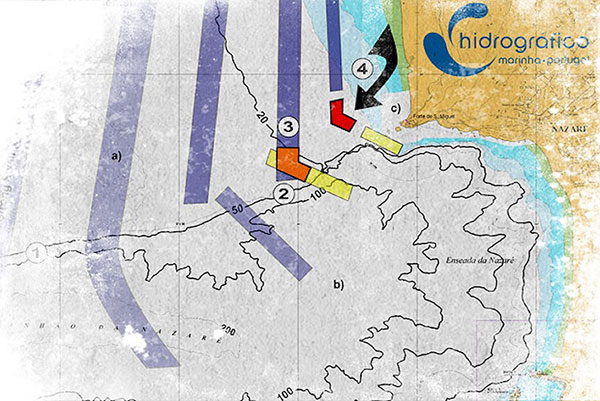
A few miles off the coast of Nazaré, there are drastic differences in depth between the continental shelf and the canyon. When swell heads to shore, it is quickly amplified where the two geomorphologic variables meet, causing the formation of big waves. | |
|
Summary of Variables
-
Swell Refraction: The difference in depths between the continental shelf and the canyon changes swell speed and direction;
-
Rapid Depth Reduction: wave size builds gradually;
-
Converging Wave: The wave from the canyon and the wave from the continental shelf meet and form a higher one;
-
Local Water Channel: A seashore channel drives water toward the incoming waves to increase their height;
| |
a) Wave Fronts; b) Head of the Nazaré Canyon; c) Praia do Norte; | |
|
Maya Reis Gabeira (born April 10, 1987) is a Brazilian big wave surfer. She surfed a 22.4 m (73 ft) high wave in Nazaré, Portugal in February 2020, recorded by Guinness World Records as the biggest wave ever surfed by a woman.She also held the previous record for biggest wave ever surfed by a woman, of 20.8 m (68 ft) established in January 2018.
Gabeira has received numerous accolades including the ESPY award for Best Female Action Sports Athlete and is the best female surfer in the world as well as one of the most influential female surfers of all time.
| |
Maya Gabeira Breaks Guinness World Record for the Largest Wave By a Woman | 73.5 Feet at Nazaré | |
5. PERFORMING ARTS: Contemporary & Classic Opera
| |
ABC News covrage of Blind Injustice. | |
A new production, 'Blind Injustice', explores the plight of wrongfully convicted and exonerated prisoners through opera. | |
'Blind Injustice' Opera Sets Out To Open Eyes About Wrongful Conviction Rates | |
From: NPR, By: Elizabeth Kramer, July 23, 2019 | |
|
Cincinnati Opera has premiered a new opera that chronicles the stories of six people wrongfully convicted in Ohio and in the process, puts America's criminal justice system on trial. The new opera Blind Injustice is based on a book of the same title by Mark Godsey, a former prosecutor and law professor at the University of Cincinnati. Godsey, who co-founded the Ohio Innocence Project, currently works with his students to crack the cases of those wrongfully convicted in Ohio.
Years before he became involved in the innocence movement, Godsey worked as a federal prosecutor in the Southern District of New York. "I'd been in denial about a lot of the problems in the system as a prosecutor and I'd been sort of arrogant about it," Godsey says.
| |
Arizona Opera
Roméo & Juliette
| |
|
Music by Charles Gounod, Libretto by Jules Barbier & Michel Carré
Tucson: Sat., March 2nd - 7:30pm | Sun., March 3rd - 2:00pm
Phoenix: Sat., March 9th - 7:30pm | Sun., March 10th - 2:00pm
| |
Gounod's romantic and rapturous music sets the stage for this tale of star-crossed lovers, based on Shakespeare’s play about the feuding Montague and Capulet families in Verona. | |
Health Benefits of Saffron | |
From: Health, By: Jillian Kubala, RD, Secember 14, 2023 | |
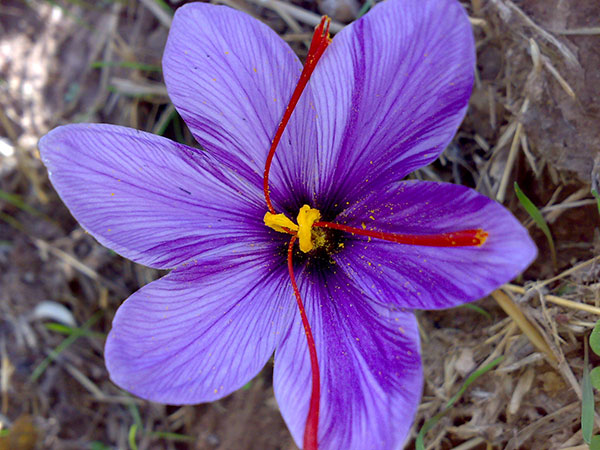
Saffron is a spice derived from the saffron crocus flower (Crocus sativus L.) that’s highly sought after due to its medicinal properties and culinary uses. Because of the popularity of saffron and the labor that goes into growing and harvesting this spice, it has a very high price tag. Saffron is currently considered the most expensive spice in the world. | |
Saffron is enjoyed in many parts of the world and is a staple in Indian, Middle Eastern, and Mediterranean cooking. The spice has an earthy flavor and bright reddish-golden color due to its high concentration of plant pigments, such as the carotenoids crocin and crocetin. These and other substances found in saffron have health-promoting properties, and studies show consuming saffron could benefit health in several ways. | |
March Madness is just around the corner. Selection Sunday for March Madness 2024 is Sunday, March 17th. The Arizona Wildcats’ men’s team ranked 6th nationally and 1st in the Pac-12 has a strong chance to earn a No. 1 seed in the tournament. The Wildcat's women's team is not ranked in the top 25 nationally and only ranked 7th in the Pac-12. But a recent victory over 3rd ranked Stanford and a game still to play against 8th ranked UCLA has ESPN placing the Wildcat's "on the bubble" with a good chance of making it into the tournament. Good showings by the teams would be a great way to welcome new Athletic Director, Desireé Reed-Francois, to Tucson. | |
NCAA Tournament projections: Arizona Wildcats basketball a No. 1 seed in March Madness? | |
|
The Arizona basketball team comes in at No. 6 in the latest USA TODAY Sports Coaches Poll, behind No. 1 UConn, No. 2 Purdue, No. 3 Houston, No. 4 Marquette and No. 5 Houston.
But could the 19-5 Wildcats be one of four No. 1 seeds in the 2024 NCAA Men's Basketball Tournament?
USA TODAY Sports has Tommy Lloyd's team, which currently has a one-game lead over Washington State in the Pac-12 Conference standings, as a No. 1 seed in its latest March Madness Bracketology.
The site lists the Wildcats as the top seed in the West Region, with UConn the No. 1 seed in the East, Houston the top seed in the South and Purdue as the top seed in the Midwest.
| |
Arizona women's basketball stuns No. 3 Stanford with late comeback | |
From: NCAA.com, By: Declan Walsh, February 24, 2024 | |
|
Like most opponents that slink into Maples Pavilion, Arizona's dreams of a stunning upset over No. 3 Stanford had crumbled into a near impossibility by the four-minute mark, trailing 58-49 with just a 1.7 percent chance of victory, per ESPN Analytics.
But Arizona ignited a stunning comeback with its trademark disruptive defense — the Wildcats rank ninth nationally in steal rate and forced four Cardinal turnovers down the stretch — and rode a legendary heater from Jada Williams across the finish line. The five-star freshman scored 14 points in the final 3:18, including a banked three with 31 seconds remaining that gave Arizona its second lead of the game and ultimately iced a 68-61 victory.
| |
8. TENNIS: Roscoe Tanner Tennis Clinic
| |
Tennis pro Roscoe Tanner will be hosting two days of tennis clinics at the Himmel Park Tennis center in Tucson on March 23rd and 24th. The Clinics are being organized by Kwevi Quaye's Diaspora Showcase, featured in The Flock last June. Roscoe Tanner won his first grand slam, The Australian Open, in 1979, was ranked number 4 in the world, held the fastest serve record at 153 mph for 25 years and was Arthur Ashe's doubles partner for several years. His two days of clinics here in Tucson will focus on serving mechanics. | |
Roscoe Tanner Tennis Clinic | |
2 days of clinics will include the mechanics of serving, stance, location, stroke, contact point and follow-through plus types of serve. | |
|
Roscoe Tanner Tennis Clinic, a 2-day clinic is set for Saturday and Sunday, March 23 and 24, 2024. The clinic will encompass the mechanics of serving including stance, location, stroke, contact point, toss, and follow-through, creating weight transfer. Roscoe will cover placement, types of serve (flat, slice, kick), and when to use it. He will also have a section on volleys and net play, so that players will learn to serve and volley. In addition, upper-level players will get instructions on tournament plays and different techniques to prepare for tournaments.
Schedule
-
Saturday March 23 – 9:00am to 11:00am - Himmel Park Tennis Center (LEVEL 2.5 - 3.0)
-
Saturday March 23 – 4:00pm to 6:00pm - Himmel Park Tennis Center (LEVEL 3.0 - 3.5)
-
Sunday March 24 – 9:00am to 11:00am - Himmel Park Tennis Center (LEVEL 3.5 - 4.5)
-
Sunday March 24 – 4:00pm to 6:00pm - Himmel Tennis Center (LEVEL 4.0 - 5.0
Clinic Sessions
The format of the clinic would be a 2-hour session. In addition to the clinic, Roscoe would give a talk on “The History of Tennis”, current players, and his own personal stories. He will also be available for book signing of his book, “Double Fault”. All players should bring their tennis racquets, two cans of balls, their drink of choice for hydration, and wear proper tennis clothing. Any additional equipment for the clinic shall be provided by the clinic organizers.
Himmel Park Tennis Center is located at 1000 N Tucson Blvd. in Tucson
| |
8. SNAKES: Rattlesnakes of the Tucson Basin
| |
Last Sunday I took a hike in Ventana canyon with two hiking enthusiasts from United way, Angie & Tina. It reminded me that it's springtime in Tucson and that means it's time to keep your eyes out for rattlesnakes. | |
Rattlesnakes of the Sonoran Desert | |
|
A rattlesnake will generally bite for one of two reasons: to inject venom into its prey or out of self defense. According to the Arizona Poison Control Center, most rattlesnake bites to humans are "illegitimate." In other words, the snake bit someone because it felt threatened by their actions. However, some rattlesnake bites are "legitimate." That is, the victim did not intentionally provoke the snake into biting. In about 25% of all rattlensnake bite cases, the snake does not inject venom.
To reduce your chances of being bitten by a snake, follow these simple guidelines:
- Do not harass or attempt to kill snakes
- If you see a rattlesnake, stay at least 10 feet from it
- Do not put your hands or feet where your eyes have not been
- Wear boots and loose-fitting pants while hiking
- Carry a flashlight after dark
If you are bitten by a rattlesnake, call 911 immediately. Do NOT attempt to treat a snake bit yourself.
| | |
|
|
Western Diamond-backed Rattlesnake
(Crotalus atrox)
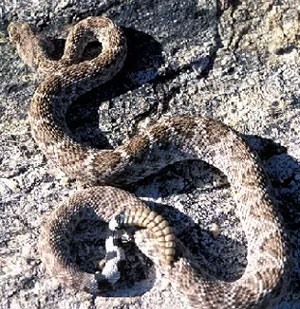
The western diamond-backed rattlesnake is the largest rattlesnake in the western U.S. It gets its name from the diamond-shaped markings on its back. It lives in a variety of habitats in arid and semi-arid regions of the west. This snake is dangerous, not only because of its size, but also because of its attitude. They often hold their ground and defend themselves when approached. If you come across one, the best thing you can do is give it plenty of room and leave it alone.
| | |
|
|
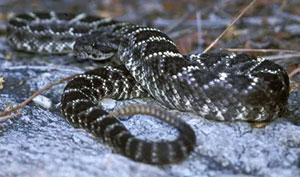
Mojave Rattlesnake (Crotalus scutulatus)
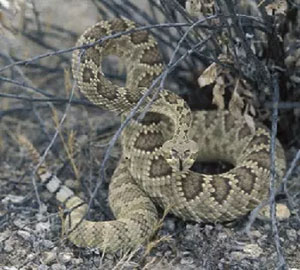
Unlike many rattlesnake species, which hibernate in large groups, the Mojave hibernates alone or in groups of two or three individuals. Though somewhat difficult to tell apart from the western diamond-backed rattlesnake, mojaves are often slightly greenish in coloration, and their tail bands have thick white bands with narrower black bands; the diamond-backed has more uniform band widths. The venom of the Mojave rattlesnake is a potent blend of hemotoxins (which break down cells and tissues) and neurotoxins (which effect the nervous system and can cause heart failure and/or respiratory paralysis) and is extremely dangerous.
| | |
|
|
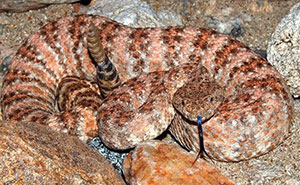
Tiger Rattlesnake
(Crotalus tigris)
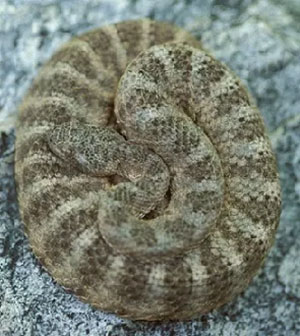
This relatively small rattlesnake is only found in the Sonoran Desert region, and is recognized by its small head, large rattle, and many closely spaced bands on its back and sides. The fangs of the tiger rattlesnake are proportionately shorter than that of other rattlesnakes, however, this does not limit their effectiveness as a hunting tool or defensive weapon.
| | |
|
|
Black-tailed Rattlesnake
(Crotalus molossus)
This montane rattlesnake is usually found in rocky aras of pine-oak woodland or coniferous forests, thought they can also be found amongst saguaros in the Sonoran desert upland. Easy recognizable by their namesake blacktail, they are often found in tree branches and shrubs several feet above the ground
| | |
|
|
Speckled Rattlesnake
(Crotalus mitchellii)
This ground-dweller can be active around the clock when conditions are favorable. Most sightings occur on spring mornings. It is primarily diurnal and crepuscular in spring and becomes nocturnal and crepuscular in late spring and summer. It hibernates during the cold months of late fall and winter. When encountered this snake often remains motionless, presumably to avoid detection. Like the other “pit-vipers” (members of the subfamily Crotalinae) this snake uses heat sensing pits (one on each side of the face between the eye and nostril) to detect warm-blooded predators and prey.
| | |
|
|
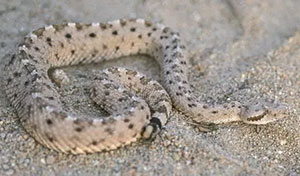
Sidewinder
(Crotalus cerastes)
The sidewinder is usually found in sandy areas of the Sonoran Desert, where their unique form of locomotion comes in most handy. When sidewinding, the sidewinder throws a loop of its body in the direction that it wants to travel, and then pulls the rest of its body to the loop and repeats the process. Because sidewinding reduces contact between the snakes body and the ground, it minimizes slippage on loose soils. Sidewinders can be easily distinguished from other rattlesnakes by the hornlike scales on top of their heads.
| | |
|
|
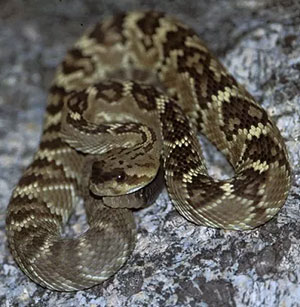
Arizona Black Rattlesnake (Crotalus cerus)
The Rincon Mountains represent the most southern location for this snake, often considered a subspecies of the prairie rattlesnake, C. virividis cerberus, or the Western rattlesnake, C. oreganus cerberus. Young rattlesnakes vary greatly in color and may have a complex color pattern that can lead to confusion with other montane species. Adults in the Rincons are a striking black color, with smaller individuals a light gray.
| |
How to Disinguish the Mojave Rattlesnake From the Western Diamondback | |
|
The ranges of the Mojave rattlesnake, also known as the Mojave green rattlesnake, and the western diamondback rattlesnake overlap in certain areas. If you hike out in this country, it wouldn't hurt to know which ones you stumble upon -- and it could save your life. The Mojave rattler and the western diamondback resemble each other, but certain distinguishing characteristics make identification fairly reliable for the amateur.
Mojave Rattlesnake
While Crotalus scutulatus, the Mojave rattlesnake, looks a lot like the western diamondback rattlesnake, it usually has a greenish tinge that the other snake does not. That's probably the easiest way to tell the difference without getting dangerously close. The Mojave rattlesnake also boasts two or three large scales between the eyes, near the top of the head, which the western diamondback doesn't have. At maturity, this snake grows between 2 and 4 feet long.
Western Diamondback
While Crotalus atrox, the western diamondback, is named for that telltale diamond pattern, the base coat varies according to habitat. It can range from from dark red to pinkish, yellow, beige, brown and gray. It has a white stripe that extends from the eye to the mouth, not characteristic of the Mojave rattlesnake. Larger than the Mojave rattlesnake, the western diamondback matures between 2 and 7 feet long.
Pattern Differences
The diamonds on both of these species' backs are what make the two snakes look so much alike. Both snakes also have white and black rings on their tails. The white rings on the tail of the Mojave rattlesnake are wider than the black rings, and the dark diamond pattern fades as it reaches the tail. The western diamondback's rings are of equal width, and the diamond pattern fades less.
| |
Mojave Rattlesnake vs. Western Diamondback- What are the differences? | |
|
These Flock regulars are always here for you:
In Coming weeks: we'll be sharing more investigative articles from our roving reporter William George, original writing from Flock favorite Dino DeConcini, and an update on Marolt brother's coming expedition to Argentina.
| |
Don't Be Shy: Share Your Stories! | |
I'm looking forward to sharing more of your personal stories - oral, written, or otherwise, as we enter our second year. I'd so love to present them to The Flock, hit a mailbox below to share your story. | |
Subscriptions & Idea Submissions | |
|
Feel free to forward this email to a friend. If this was forwarded to you and you would like to receive your very own Flock Newsletter, you can sign up here. If you have any questions or suggestions for future Flock resources, don't hesitate to contact me.
Your fan and friend,
Beth
| | |
The information and materials contained or referenced in this newsletter are for informational purposes only and not intended to be a substitute for professional medical advice, diagnosis, or treatment. Always consult a physician or other qualified medical professional with any questions you may have regarding a medical condition or treatment and before beginning a new health care regimen. Do not disregard professional medical advice or delay seeking medical advice or care based on anything contained in this newsletter. | | | | |