|
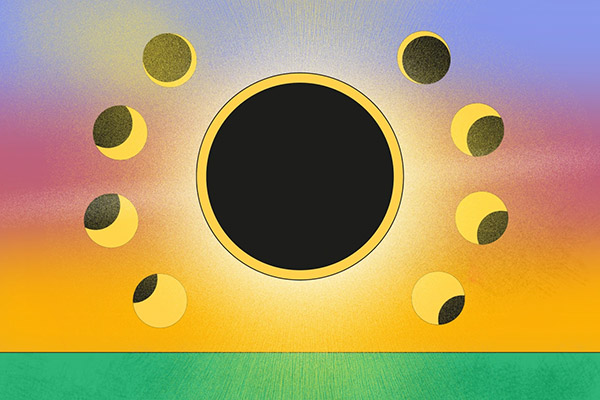
This week, I'm doing something a little different and focusing the entire issue on the Monday's total solar eclipse.
1. I hope you are somewhere you can see the total eclipse, or at least a partial one. I'm going to miss the eclipse this time, but I’m still at one of my favorite places in the world, so I'm happy with where I'm at. See if you can guess where that is.
2. I've compiled lots of information on how, where and when to view April 8th's total solar eclipse, and how much of an eclipse you can expect to see.
3. Next we look at the cultural and religious significance eclipses have had throughout history.
4. In the Kid's Corner we have some eclipse facts for young minds, and instructions for building a pinhole eclipse viewer.
5. If you're concerned about flying during the eclipse, the only thing to worry about is crowded airports. Planes will be full of travelers headed to optimum viewing destinations. There are even some flights being scheduled specifically to allow passengers to view the eclipse from their plane.
6. I'm continuing the new Religious Holidays section we added in March and providing a list of holidays that fall in April.
7. In this week's Pet's Corner, we welcome back an old friend, Snowball.
| |
Now, to this week's Flock. | |
1. Where in the World is Beth?
| |
Can you identify where Beth is this week? Here's a hint, Beth is not in the path of the total solar eclipse and will only see around 22% coverage of the sun during Monday's event. Scroll to the bottom of the newsletter for the answer. | |
2. SOLAR ECLIPSE: April 8th, 2024
| |
This coming Monday, April 8th, there will be a total solar eclipse viewable over North America, starting at the East Coast of Canada and cutting a path through the United States and Mexico before it concludes over the Pacific Ocean. Those outside of the path of the Total eclipse will see a partial solar eclipse. Europe will see the next total solar eclipse in August of 2026. Australia will follow with a total solar eclipse in July of 2028. In September of 2035, Asia will get it's next eclipse with the path of totality crossing over China, North Korea, South Korea, and Japan. There will not be another solar eclipse over North America until 2044, one year later South America will experience their next solar eclipse. | |
Why You Owe It To Yourself To Witness April 8’s Total Solar Eclipse | |
From: Forbes, By: Jamie Carter, March 30, 2024 | |
|
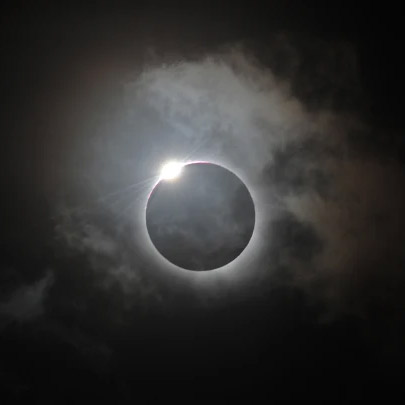
If you haven’t experienced a total solar eclipse, you haven’t lived.
On Monday, April 8, an incredibly rare and spectacular experience will be on offer to hundreds of millions of people in North America.
Most will miss it, instead having a peek at a partial solar eclipse many hundreds of miles from where the action really takes place—the path of totality.
For many, a trip to the path of totality will be impossible, with work, school, family commitments or an inability to travel hampering their ambitions.
Millions of others, however, will be—and likely already have been—dissuaded from embracing April 8’s total solar eclipse because of the media’s developing obsession with traffic, safety and weather.
| |
Why April's total solar eclipse will be a historic event in the US
The next total solar eclipse in the contiguous U.S. won't be until August 2044.
| |
From: ABC News, By: Leah Sarnoff, April 4, 2024 | |
|
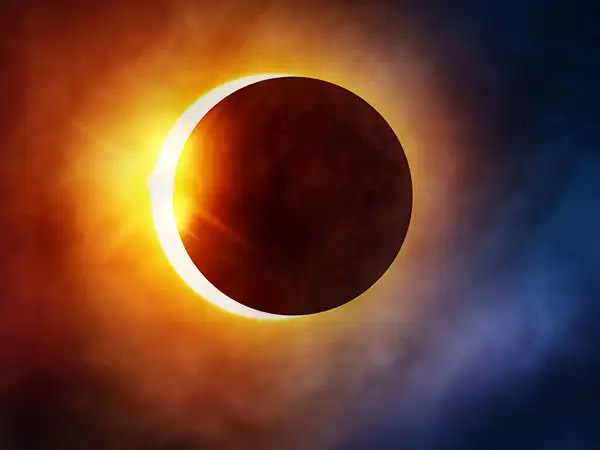
When the moon traverses in front of the sun on April 8, parts of North America will be plunged into darkness, marking a rare celestial phenomenon that will not return for decades.
A total solar eclipse occurs when the moon passes between the sun and the Earth and, for a short time, completely blocks the face of the sun, according to NASA.
| |
2024 solar eclipse: what to know | |
|
"When the sun's disc is completely covered by the moon, daylight suddenly changes from bright sunlight to a very eerie twilight in a matter of seconds," Fred Espenak, a former astrophysicist from NASA Goddard Space Flight Center and author of "Road Atlas for the Total Solar Eclipse of 2024," told ABC News.
"It becomes dark enough to pick out bright stars and planets, so it's very dramatic, very startling," Espenak said. "Most people get a very visceral reaction to seeing a total eclipse."
"Eclipse Across America," will air live Monday, April 8, beginning at 2 p.m. ET on ABC, ABC News Live, National Geographic Channel, Nat Geo WILD, Disney+ and Hulu as well as network social media platforms.
| |
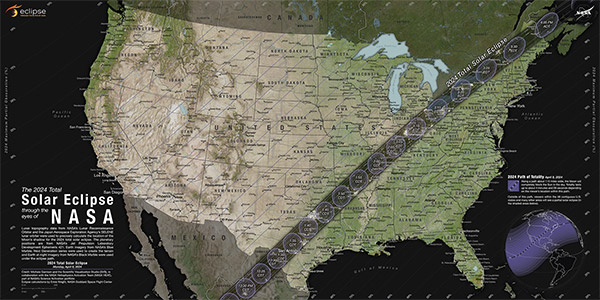
The total solar eclipse will be visible along a narrow track stretching from Texas to Maine on April 8, 2024. A partial eclipse will be visible throughout all 48 contiguous U.S. states. | |
NASA has an interactive Eclipse Explorer on their website where you can follow the path of the eclipse and see where and when the best opportunities to view the eclipse will be. You can also enter your zip code to find out how much of the eclipse you will be able to see. | |
2024 Total Eclipse: Where & When | |
|
The Monday, April 8, 2024, total solar eclipse will cross North America, passing over Mexico, the United States, and Canada. The total solar eclipse will begin over the South Pacific Ocean. Weather permitting, the first location in continental North America that will experience totality is Mexico’s Pacific coast at around 11:07 a.m. PDT.
The path of the eclipse continues from Mexico, entering the United States in Texas, and traveling through Oklahoma, Arkansas, Missouri, Illinois, Kentucky, Indiana, Ohio, Pennsylvania, New York, Vermont, New Hampshire, and Maine. Small parts of Tennessee and Michigan will also experience the total solar eclipse. The eclipse will enter Canada in Southern Ontario, and continue through Quebec, New Brunswick, Prince Edward Island, and Cape Breton. The eclipse will exit continental North America on the Atlantic coast of Newfoundland, Canada, at 5:16 p.m. NDT.
| |
A Tour of NASA’s 2024 Solar Eclipse Map | |
Viewing The Eclipse Safely | |
|
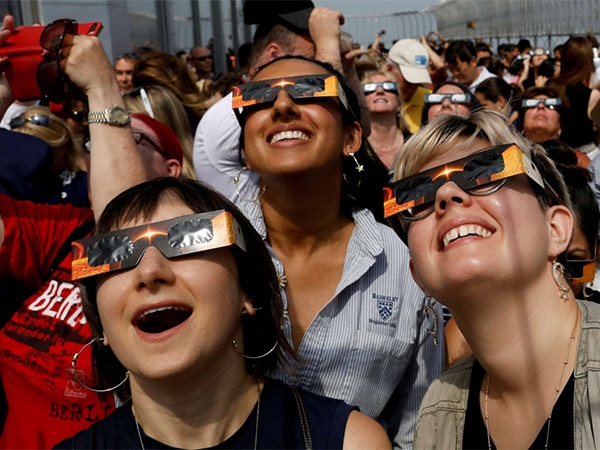
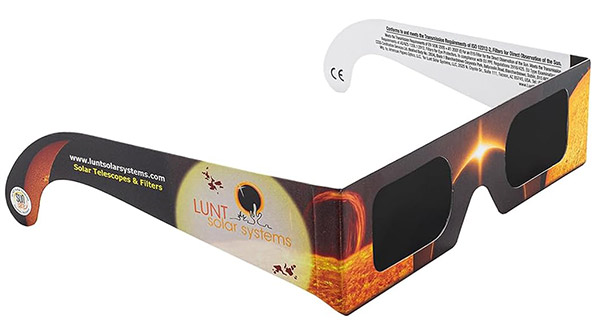
It is never safe to gaze directly at the sun, even when it is partly or mostly covered by the moon. Special eclipse glasses or pinhole projectors are required to safely view solar eclipses and prevent eye damage. Failing to take the proper precautions can result in severe eye injury, according to NASA.
Eclipse glasses are thousands of times darker than normal sunglasses and specially made to enable wearers to look at the sun during these kinds of celestial events.
Sky-watchers should also never view any part of the sun through binoculars, telescopes or camera lenses unless they have specific solar filters attached. Eclipse glasses should not be used with these devices, as they will not provide adequate protection.
However, during the few minutes of totality, when the moon is fully blocking the sun, it is safe to look with the naked eye.
| |
|
Beware of fake eclipse glasses. On legitimate pairs, the lenses should have a silver appearance on the front and be black on the inside. The manufacturer’s name and address should be clearly labeled, and they should not be torn or punctured. Check, as well, for the ISO logo and the code “IS 12312-2” printed on the inside.If you don’t have eclipse glasses, you can make a homemade pinhole projector, which lets sunlight in through a small hole, focuses it and projects it onto a piece of paper, wall or other surface to create an image of the sun that is safe to look at.
All you need is two pieces of white cardboard or plain white paper, aluminum foil and a pin or thumbtack. Cut a 1- to 2-inch square or rectangle out of the center of a piece of white paper or cardboard. Tape aluminum foil over that cut-out shape, then use a pin or thumbtack to poke a tiny hole in the foil.
During the eclipse, place a second piece of white paper or cardboard on the ground as a screen and hold the projector with the foil facing up and your back to the sun. Adjusting how far you hold the projector from the second piece of paper will alter the size of the image on the makeshift screen.
| |
|
Solar Eclipse (1900) - the first moving image of an astronomical phenomenon
The magic of a real solar eclipse filmed on 28 May, 1900 by a famous magician, Nevil Maskelyne, while on an expedition by The British Astronomical Association to North Carolina.
| |
3. HISTORY: Cultural Significance of Solar Eclipses
| |
A facsimile of the Isaiah Scroll, one of the Dead Sea Scrolls | |
Different cultures and religions have attached special, even supernatural significance to solar eclipses throughout world history | |
What did Biblical Prophets Say About the Solar Eclipse | |
This solar eclipse, while a marvel of modern astronomy, also beckons us to ponder the universe's mysteries and our place within it, as generations before us have. | |
|
Nearly a hundred years have passed since the last solar eclipse graced New York’s skies, and the city’s anticipation has reached fever pitch. Preparations have spanned months, with both residents and tourists poised to witness this rare dance of the cosmos.
The eclipse is expected on Monday, April 8th. Yet, amidst the scientific fervor, some are turning to ancient scriptures, seeking connections between this modern marvel and the prophetic celestial imagery found in the Old Testament.
The Bible, a document as much historical as it is spiritual, recounts several instances that scholars and believers interpret as references to astronomical phenomena akin to a solar eclipse. In these ancient texts, celestial events often symbolize divine messages or judgments. Here, we explore these passages to understand the deep connection humanity has with the cosmos, as seen through the eyes of those who lived thousands of years ago.
Isaiah 13:10: The stars of heaven and their constellations will not show their light. The rising sun will be darkened and the moon will not give its light.
This passage reflects on the darkening of celestial bodies, perhaps a reflection of the awe and fear that an eclipse can inspire.
Ezekiel 32:7: When I extinguish you, I will cover the heavens and darken their stars; I will cover the sun with a cloud, and the moon will not give its light.
Here, the eclipse imagery serves as a metaphor for divine judgment, a theme common in prophetic literature.
| |
Krishna and his family admire a solar eclipse. | |
The Following article from Britanica discusses the history of how solar eclipses were viewed in Chinese, Indian, Incan, Native American, West African, and Egyptian civilizations. | The Sun Was Eaten: 6 Ways Cultures Have Explained Eclipses | |
Without a scientific explanation, the darkening of the Sun (or Moon) during an eclipse would be a startling event, to say the least. Throughout history, eclipses have been seen as a disruption of the natural order, and many groups have believed them to be bad omens. Many ancient (and not so ancient) peoples had spiritual explanations for solar and lunar eclipses to help them make sense of these seemingly inexplicable and random phenomena. Read on to learn some of these theories from around the world. | |
Eclipse tales: EAT the Sun | |
|
Mount Yoshino MIdnight-moon: Iga no Tsubone
The earliest historical record of a total solar eclipse in Japan dates to A.D. 628, and in Korea independent reports of eclipses begin around A.D. 700. Ceremonies were performed to save the sun and moon from being consumed, and artistic representations often associate eclipses with spectral apparitions, such as in Yoshitoshi Taisō's depiction of the heroic lady Iga no Tsubone confronting a ghost.
photo: Princeton University Art Museum
| |
4. KID'S CORNER: Eclipse Facts & Activities
| |
What Is the Sun's Corona? | |
|
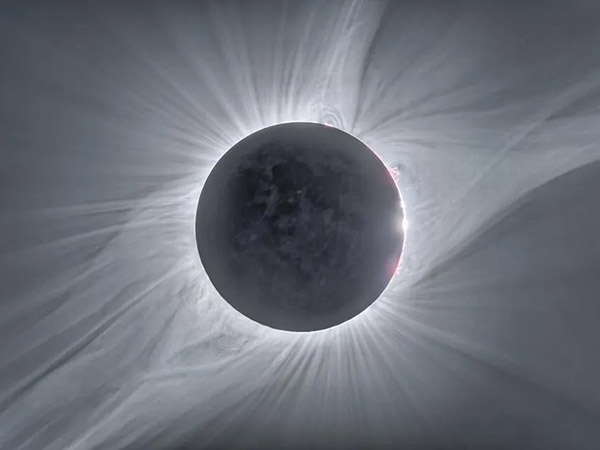
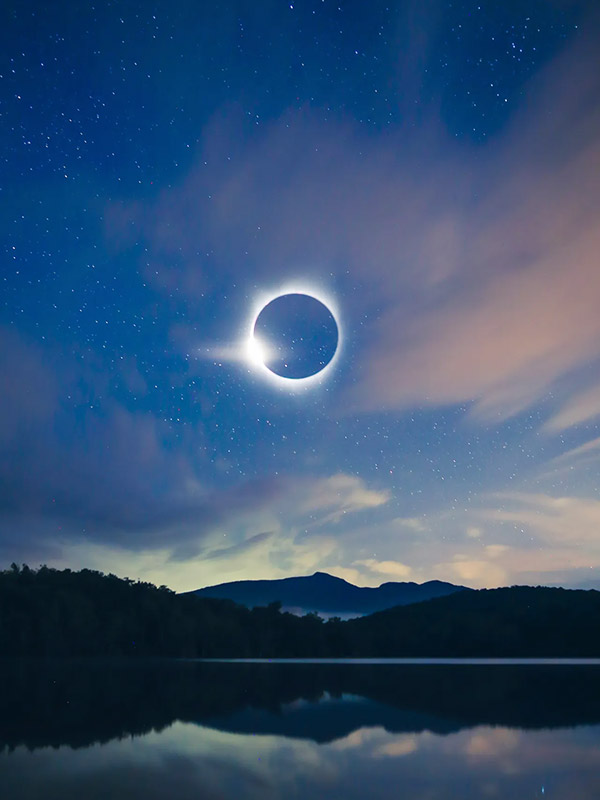
Our Sun is surrounded by a jacket of gases called an atmosphere. The corona is the outermost part of the Sun's atmosphere.
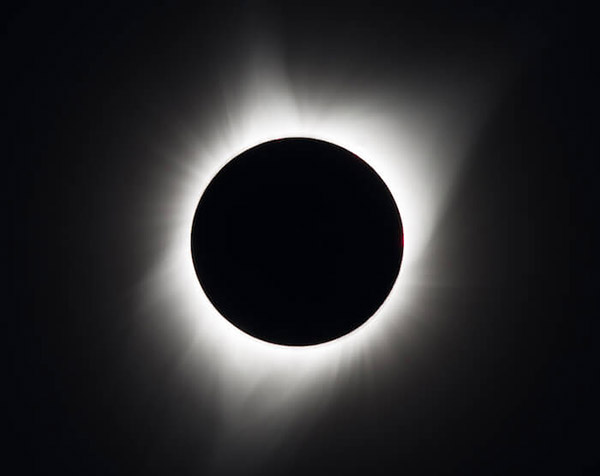
The corona is usually hidden by the bright light of the Sun's surface. That makes it difficult to see without using special instruments. However, the corona can be seen during a total solar eclipse.
During a total solar eclipse, the moon passes between Earth and the Sun. When this happens, the moon blocks out the bright light of the Sun. The glowing white corona can then be seen surrounding the eclipsed Sun.
| |
How Do You Tell the Difference Between Total, Annular, Solar, and Lunar Eclipses? | |
|
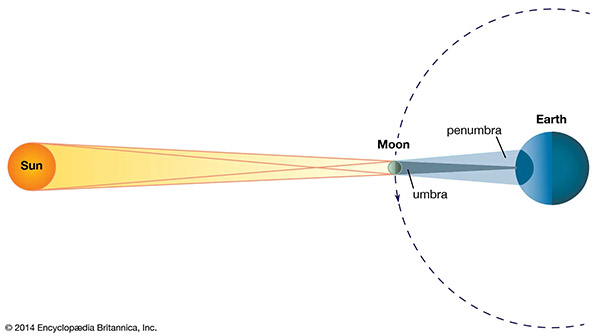
Solar eclipses occur when the Moon passes between Earth and the Sun, leaving a moving region of shadow on Earth’s surface. Lunar eclipses occur when Earth passes between the Sun and the Moon, casting a shadow on the Moon.
Solar eclipses may be classified as either total, in which the Moon completely covers the Sun, or annular, in which the Moon obscures all but an outer ring of the Sun. Whether an eclipse is total or annular depends on the distance between these three objects. Earth travels in an elliptical orbit around the Sun, and the Moon travels in an elliptical orbit around Earth, so the distance between these celestial bodies changes. When the Sun is nearest to Earth and the Moon is at or near its greatest distance, the Moon appears smaller than the Sun in the sky. When an eclipse of the Sun happens in this situation, the Moon will not appear large enough to cover the disk of the Sun completely, and a rim or ring of light will remain visible in the sky. This is an annular eclipse.
| |
|
geometry of a total solar eclipse
The geometry of a total solar eclipse. The shadow of the Moon sweeps over the surface of Earth. In the darkly shaded region (umbra) the eclipse is total, and in the lightly shaded region (penumbra) the eclipse is partial. The shaded region on the opposite side of Earth indicates the darkness of night. (Dimensions of bodies and distances are not to scale.)
| |
There are no annular lunar eclipses because Earth is much bigger than the Moon, and its shadow will never be small enough to leave a ring. However, the Moon does experience total eclipses. If the eclipse is a total lunar eclipse, the Moon will pass through the umbra (area of total shadow) created by Earth over the course of about two hours. Viewers will notice that the Moon does not typically go completely dark; it often takes on a red color, because the redder parts of sunlight that penetrate Earth’s atmosphere are refracted into the umbra, and this light reaches the Moon. | |
How to make a solar eclipse viewer | |
5. TRAVEL: Flying during the Eclipse
| |
Many travelers may get lucky on Monday, getting a view of the eclipse from their airplane seat as their flight crosses the eclipse's path. If you're flying Monday, you might want to bring some eclipse glasses with you just in case. Some airlines have even added flights they hope will offer a view of the eclipse. Before booking one of these, keep in mind that weather and flight delays could be a factor in successfully timing an eclipse encounter. | |
The Best Flights to View the 2024 Solar Eclipse From the Sky | |
|
April 8 is shaping up to be a busy day for US airlines, as travelers chase the total solar eclipse sweeping across the nation from Texas to Maine—a rare event that won’t be visible from the contiguous US again until 2044.
While many eclipse-chasers are booking up hotels and Airbnbs located along the path of totality, some travelers are taking to the skies in order to get as close to the celestial event as humanly possible.
Ideally, these eclipse flights will allow for prime viewing of the moon passing in front of the sun, since the atmosphere tends to be clearer above the clouds. But with the eclipse only lasting between one to four minutes, there are "many challenges with trying to time being on a commercial airplane during an eclipse flight,” airline industry analyst Mike Arnot tells Condé Nast Traveler.
| |
6. RELIGIOUS HOLIDAYS: April 2024
| |
Last month, I added a new section where we list the upcoming religious holidays for that month. The following is a list of religious holidays for April 2024. | |
Religious Holidays: April 2024 | |
|
Feast of the Annunciation
April 8, 2024
The Feast of the Annunciation commemorates the visit of the archangel Gabriel to the Virgin Mary, during which he informed her that she would be the mother of Jesus Christ, the Son of God.
Affiliation: Christian/Catholic
| |
|
Eid al-Fitr
April 9 - April 10, 2024
Eid al-Fitr is the earlier of the two official holidays celebrated within Islam. Eid al-Fitr is celebrated by Muslims worldwide because it marks the end of the month-long dawn-to-sunset fasting of Ramadan.
Affiliation: Islam
| |
|
Vaisakhi
April 13, 2024
Vaisakhi, also pronounced Baisakhi marks the first day of the month of Vaisakh and is traditionally celebrated annually on 13 April and sometimes 14 April. It is seen as a spring harvest celebration primarily in Punjab and Northern India. Further, other Indian cultures and diaspora celebrate this festival too.
Affiliation: Sikh
| |
|
Rama Navami
April 17, 2024
Rama Navami is a Hindu festival that celebrates the birth of Rama, one the most popularly revered deities in Hinduism, also known as the seventh avatar of Vishnu. He is often held as an emblem within Hinduism for being an ideal king and human through his righteousness, good conduct and virtue.
Affiliation: Hindu
| |
|
Ridván
April 20 - May 2, 2024
Riḍván is a twelve-day festival in the Bahá'í Faith, commemorating Bahá'u'lláh's declaration that he was a Manifestation of God. In the Bahá'í calendar, it begins at sunset on the 13th of Jalál, which translates to the 20th or 21st of April, depending on the date of the March equinox.
Affiliation: Bahá'í
| |
|
Passover
April 22, 2024 - April 30, 2024
Passover, also called Pesach, is a major Jewish holiday, one of the three pilgrimage festivals, that celebrates the Biblical story of the Israelites' escape from slavery in Egypt.
Affiliation: Jewish
| |
7. PET'S CORNER: Petra & Snowball
| |
This week we have an encore appearance from Snowball, a miniature English bull terrier who loves the snow at her Aspen, Colorado home. We first met Snowball in January of last year. Snowball's mom Petra is a good friend and mother to Flock alumni Ana and Zoe Crimmel. | |
Appropriately named, Snowball just loves jumping to catch snowballs. | |
|
These Flock regulars are always here for you:
In coming weeks: we'll be sharing more investigative articles from our roving reporter William George, original writing from Flock favorite Dino DeConcini, and an update on the Marolt brother's coming expedition to Argentina.
| |
|
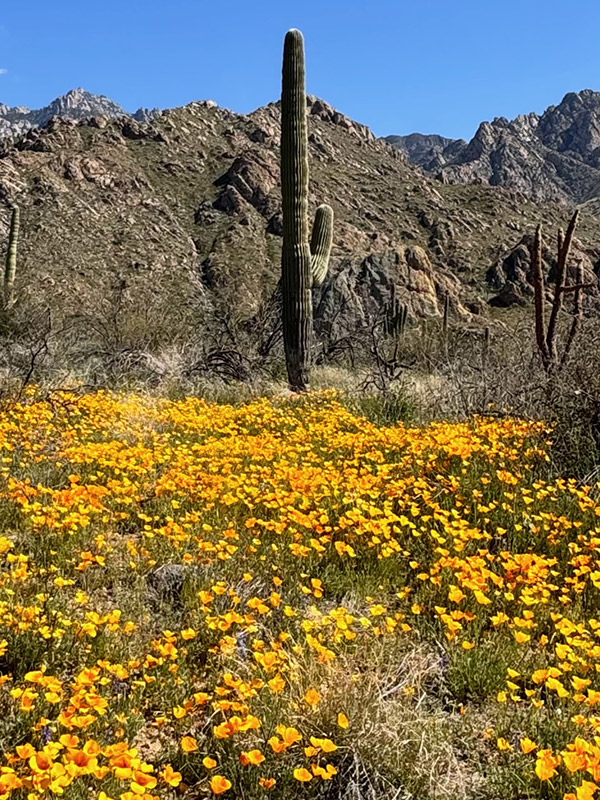
California Poppies blooming at Catalina State Park in Tucson, AZ
photo:Linda Fulgenzi
| |
Beth is in beautiful Kailua-Kona, Hawaii. | |
Don't Be Shy: Share Your Stories! | |
I'm looking forward to sharing more of your personal stories - oral, written, or otherwise, as we enter our second year. I'd so love to present them to The Flock, hit a mailbox below to share your story. | |
Subscriptions & Idea Submissions | |
|
Feel free to forward this email to a friend. If this was forwarded to you and you would like to receive your very own Flock Newsletter, you can sign up here. If you have any questions or suggestions for future Flock resources, don't hesitate to contact me.
Your fan and friend,
Beth
| | |
The information and materials contained or referenced in this newsletter are for informational purposes only and not intended to be a substitute for professional medical advice, diagnosis, or treatment. Always consult a physician or other qualified medical professional with any questions you may have regarding a medical condition or treatment and before beginning a new health care regimen. Do not disregard professional medical advice or delay seeking medical advice or care based on anything contained in this newsletter. | | | | |