Wednesday, September 2, 2026 | |
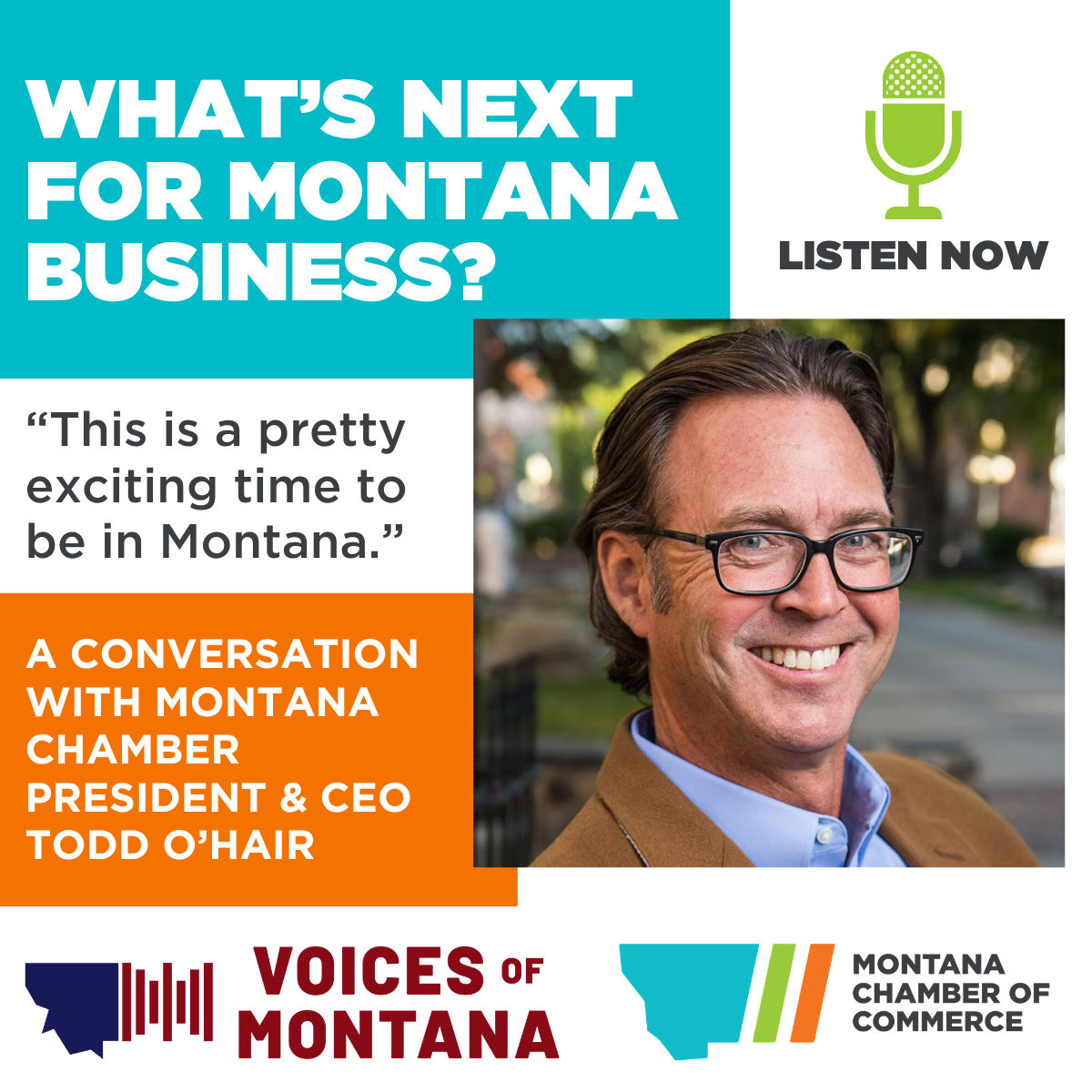
| Todd O'Hair Discusses Future of MT Business on Voices of Montana | | |
What's next for Montana business? What does Montana’s business climate need to look like five years from now?
In a recent episode of Voices of Montana, Montana Chamber of Commerce President & CEO Todd O’Hair joined guest host Steve Arveschoug for a conversation about the opportunities and challenges facing Montana businesses. The discussion covers the potential economic impact of data centers, the Chamber’s new five-year strategic priorities, what businesses want from the 2027 Legislature, and whether Montana should rethink its approach to economic development.
Listen to the discussion at the link below or wherever you get your podcasts.
| |
| | Governor Gianforte's Energy Task Force Issues Final Report & Recommendations | | |
Governor Gianforte's Unleashing American-Made Energy Taskforce delivered its final report last week. In September 2025, Gov. Gianforte created the task force through an executive order and charged the task force with providing short- and long-term recommendations and strategies for Montana to increase the supply of affordable and reliable energy options. The Energy Task Force created three subcommittees to tackle issues related to generation, growing demand, and transmission and markets.
In the final report of the Task Force, members provided 20 recommendations spanning 7 different themes including on utility regulation, energy leadership in Montana, infrastructure development, grid utilization, and consumer energy costs, among others. The Task Force embraced an all-of-the-above approach to energy, eyeing solutions that support a diverse energy portfolio for Montana. Members identified roadblocks that could be addressed to unlock further potential for the development of specific resources.
The first recommendation listed in the report involves reforming utility regulation in the state, stating, "The Montana Legislature should pursue statutory changes to reform the Montana PSC to improve regulatory efficiency, transparency, and consistency in decision-making. Structural reforms should include consideration of transitioning the PSC from an elected body to an appointed body. The legislature should incorporate best practices, in its judgment, from peer commissions across the region." Reform of the PSC is a priority area of the Montana Chamber of Commerce this interim and heading into the next legislative session.
The full report is linked below.
| | What Even is a Data Center? Information from MT Electric Cooperatives' Association | | |
As Montana considers the opportunities and challenges associated with data center development, a recent feature from the Montana Electric Cooperatives' Association takes a closer look at the experience of Quincy, Washington, a community of roughly 7,500 people that has seen significant investment and economic growth alongside the development of multiple data center campuses.
The article explores how data centers can contribute beyond technology and construction jobs, including through property tax revenue, workforce development, education, community investment and new career opportunities for local graduates.
This information is the first in a series called "Deciphering Data Centers" by the Montana Electric Cooperatives' Association. We appreciate their work and hope to share their information here.
| | Montana’s Judicial Climate Matters to Business | | |
The Montana Supreme Court plays an important role in shaping the legal and regulatory environment Montana businesses operate in. A recent guest column by Judge Nels Swandal examines Supreme Court candidate Amy Eddy’s record and questions whether her approach is consistent with the nonpartisan role expected of Montana judges.
The Montana Chamber of Commerce has endorsed Judge Dan Wilson, Eddy’s opponent, in the November Supreme Court race. The Chamber’s endorsement reflects the importance of Montana’s judicial climate to businesses, economic development and the state’s long-term business environment. As Montana continues to grow, having a judiciary that applies the law consistently and respects the proper role of the courts is critical to maintaining a predictable environment for employers and investors.
| | Montana Chamber Foundation News | | Montana Chamber Foundation Adds Workforce Strategist to Staff | |
| | | |
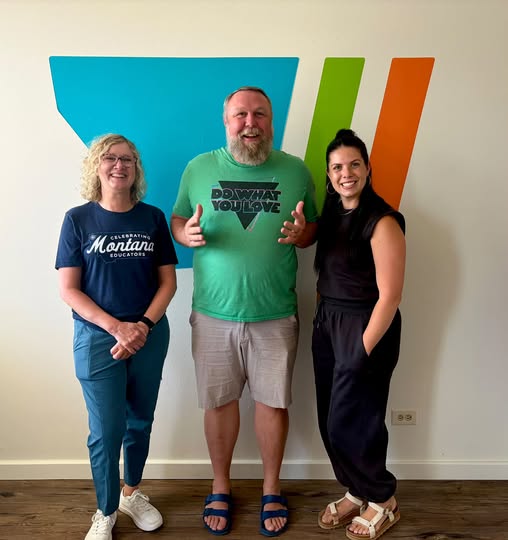
We're excited to share that the Montana Chamber Foundation Staff is growing!
This August, Michele Holmes joined the team as a Workforce Strategist. Holmes is a rockstar educator with 21 years of experience, and we are excited and fortunate to have her on our team!
She’s excited to get into classrooms to support teachers, work on upcoming Cultivating Careers events, and dive into The Prospects!
The MCF team can’t wait to connect with you and see all the amazing things happening in Montana classrooms!
| | Upcoming Cultivating Careers Events | |
| |
This fall, the Montana Chamber Foundation is holding Cultivating Careers events in Miles City, Glendive, and Missoula. Any interested businesses or community partners can register for any of these upcoming Cultivating Careers opportunities by clicking on the links below or contacting James Easton (james@montanachamber.com) or Michele Holmes (michele@montanachamber.com) for more information. These events aim to bring career awareness experiences to students within their own communities, illustrating different possible careers close to home.
| | Follow the Montana Chamber Foundation on Social Media! | |
| Shaping Montana State University's Next Strategic Plan | |
Having just completed the Montana Chamber's own Envision 2031 strategic plan, we appreciate the effort by our Treasure State level member Montana State University.
MSU has launched their process to create a new plan that will guide the university for years to come, and your voice is essential to setting its direction. They are asking for a few minutes to share your ideas, priorities and aspirations for the future of MSU. Learn more here: https://www.montana.edu/strategicplan/
| | VisionNet Launches Montana's AI-Ready Fiber Network | |
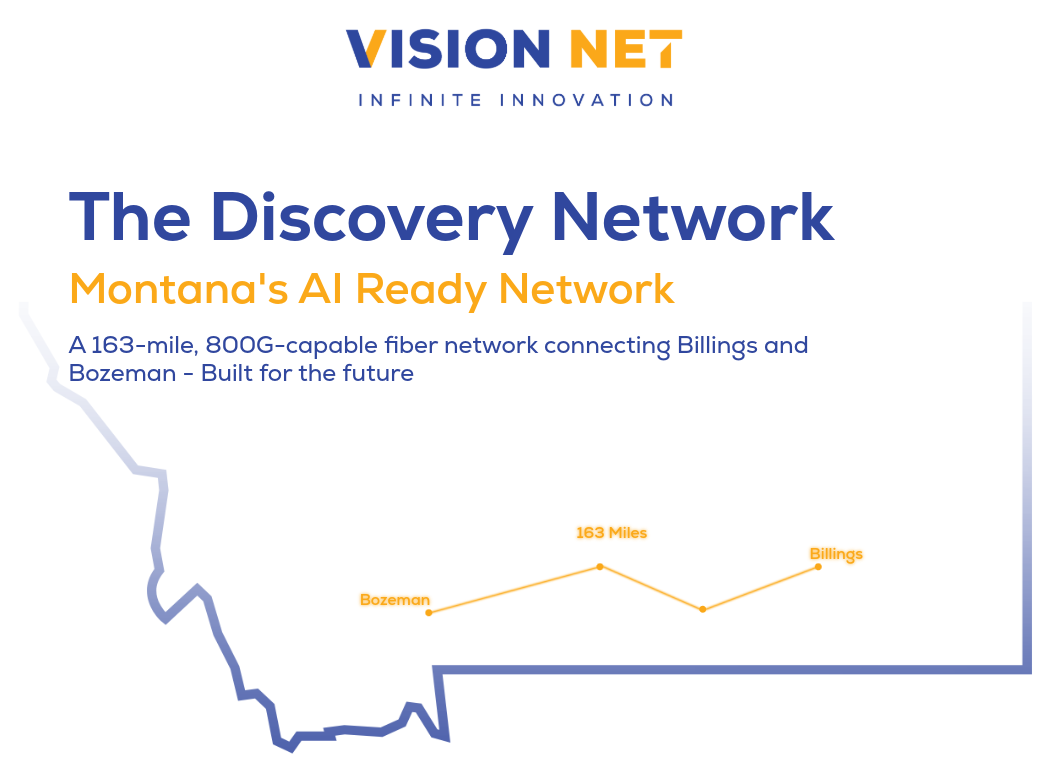
Last week, Vision Net announced the launch of the Discovery Network, a 163-mile, 800 Gbps-capable fiber corridor connecting Billings and Bozeman. The $42 million private investment is designed to support the growing demands of artificial intelligence, advanced research and other data-intensive applications.
"The future of artificial intelligence will not be built solely in hyperscale data centers," said Rob Worden, President and Chief Executive Officer of Vision Net. "It will be enabled by intelligent, high capacity state-wide networks that move research, enterprise and wireless carrier AI workloads between edge data centers and closer to where people live, work, learn, and innovate.”
About Vision Net: Vision Net is Montana’s state-wide fiber optic network, premier data center, and communications technology company. Founded in 1996 and headquartered in Great Falls, Montana, Vision Net is leading the communications technology industry through Infinite Innovation supporting its customers, employees, shareholders and communities with next-generation digital infrastructure and services.
| | Do you have news to share about your business or organization? Let us know - we'd love to share it! Send your press releases or articles to Sheridan Hoyer at sheridan@montanachamber.com. | | Montana Chamber & Foundation Events | | Register for the Big Sky, Bright Future Economic Summit - Oct. 15, 2026 | | |
Join business leaders, policymakers, economic development partners, and community stakeholders at the 2026 Big Sky, Bright Future Economic Summit, co-hosted by Governor Greg Gianforte and the Montana Chamber of Commerce.
Taking place October 15 in Bozeman, the Summit will feature timely discussions on Montana's economic future, opportunities to connect with key decision-makers, and insights into the issues shaping our state's business climate. Secure your spot today and be part of the conversation.
Sponsorship information is available here. For any questions, please contact Stacye Dorrington at stacye@montanachamber.com.
| | The Future of Artificial Intelligence | | |
AI is on everyone's mind these days. Here are two opportunities to learn more about the potential that this industry holds!
The Future of AI Summit @ MSU - Exploring the possibilities and challenges of AI for human knowledge.
Sponsored by the Interdisciplinary Institute on Artificial Intelligence at Montana State University.
Dates: October 1-2, 2026 (Bozeman, MT)
Register Here: https://www.montana.edu/ai/the-future-of-ai/
The Montana AI Summit @ UM - Happening now at the University of Montana. A two-day event exploring how artificial intelligence is transforming higher education and government across Montana.
Learn more here: https://carahevents.carahsoft.com/Event/Details/797771-Montana
We'll also be discussing AI at our Big Sky, Bright Future Economic Summit on October 15, 2026 in Bozeman.
| | Headwaters Tech Hub Summit - Sept. 9-11, Missoula | | |
Montana’s technology ecosystem is coming together September 9-11 at the University of Montana for the 2026 Headwaters Tech Hub Summit.
The three-day event will bring together industry, higher education, economic development, government and nonprofit leaders to explore innovation, workforce development, entrepreneurship, research and technology-driven economic growth. Attendees will also have opportunities to see technology in action through a Lubrecht Forest testbed demonstration and connect with leaders working to strengthen Montana’s tech ecosystem. Find more information and the full agenda at the link below.
| | |
Defensible Pay in a Noisy Market
Written by Jessa Remington, HR Business Partner
Employees today are more vocal, informed, and willing to challenge pay decisions than ever before. This shift isn’t limited to states with pay transparency laws—it’s cultural. Employers are increasingly being asked not just what they pay, but why. Compensation decisions are easier to defend—legally and culturally—when they are grounded in credible, methodologically sound data rather than anecdotes, assumptions, or internet noise.
While access to compensation data is more widespread than ever, not all data sources are created equal. Many HR professionals have experienced an employee or applicant arriving with a screenshot of a competitor’s job posting or a job board salary estimate as justification for higher pay.
The challenge with having so much information at our fingertips is that many easily accessible sources lack job-matching rigor, rely on self-reported data, and blend vastly different markets, company sizes, and experience levels. The resulting rates or ranges can be inflated, inconsistent, or misleading. Using this type of data to set wages, ranges, or pay increases can lead to internal inequities, unwarranted adjustments, and increased legal or regulatory exposure if decisions are challenged.
So what does defensible compensation data actually mean?
-
Consistent, informed job matching: Reputable sources provide sufficient job detail to evaluate how closely a survey role aligns with internal job duties and requirements. Job titles alone are rarely enough; a meaningful match typically requires substantial overlap in responsibilities, education, and experience.
-
Known data sources and validation: Defensible data clearly explains where, when, and how information was collected and validated.
-
Appropriate market comparisons: Strong data allows employers to evaluate relevant subsets—such as industry, geography, and organizational size—to support more accurate, apples-to-apples comparisons.
-
Documented methodology: Reputable sources publish their methodology, including how data was collected, analyzed, and categorized.
Employers should also be cautious of warning signs that a data source may not be defensible. Red flags include vague or unpublished methodology, reliance on self-reported data, limited ability to refine by industry or organization size, outdated data, and sources that rely heavily on job titles without meaningful job content or validation.
Although obtaining high-quality data may require more effort and investment, it pays dividends when used to support pay equity reviews, promotion decisions, responses to employee questions, and overall compensation strategy. Defensible compensation isn’t about paying at the top of the market—it’s about being able to explain decisions with confidence.
Beyond legal defensibility, solid data provides everyday leadership benefits. Managers feel more comfortable discussing pay, conversations become calmer and more productive, employees gain clarity on how pay increases are earned, and fewer reactive adjustments are driven by pressure rather than planning.
Many employers review compensation early in the year, making this a natural time to evaluate whether pay practices are grounded in sound, defensible market data.
| | |
The Montana Chamber of Commerce is pleased to welcome Workday as a new member.
As a leading provider of enterprise cloud applications for finance, human resources, planning, and analytics, Workday empowers organizations to adapt, grow, and thrive in an ever-changing business environment.
We are excited to have Workday join our statewide network of businesses and leaders!
| | Are you interested in joining the Montana Chamber of Commerce? Fill out the form below and we'll be in touch! | | This Business Brief is Sponsored by Treasure State Member | | To learn more about Treasure State Membership benefits for your business, contact Matt Olson, Chief Strategy Officer, at Matthew@montanachamber.com | 406.360.6443 | | Follow us on Social Media | | | | | |