Vol VI, No 2 - February 20, 2024 | |
|
It's February and the groundhog did NOT see its shadow. So what does that mean for us? Spring is around the corner. I cannot wait. Green daffodil stems shooting up out of the ground is one of my all-time favorite sights. You can pop the bulbs in the ground in October and during February and March they inch their green stalks up little by little until they are ready to smile at you with their happy yellow faces. The nice thing about daffodils is they are very hearty. They will grow in many different types of soil. They will take full sun or partial shade. They come back year after year. And they are even deer and rodent resistant! (As someone who found out the hard way that tulips are called "deer candy" where I live, this is real bonus.)
So what does this have to do with homeschooling gifted/2e kids?
Not all of our exceptional students are like daffodils. If you plant them in an educational setting in the fall, they are not always ready to bloom there in the spring. Some kids need different soil, different sun, different environments in which to thrive.
Last month Lisa Jobe talked about how to advocate for your gifted child within their current educational environment. This month, Lisa addresses the tough question of: when is it time to make a school change? Specifically, when should one consider homeschooling? Read down for Lisa's tips on the best ways to guide your child in a smooth transition to homeschooling and how to prepare yourself to serve as home educator.
In other news, GHF is thrilled to welcome a brand new President, Kasi Peters, a veteran GHF Board Member, supporter, and homeschooling parent. Kasi's welcome note is below. We also send huge thanks to Lisa Sticca-Conrod for her great work as our former GHF President and devoted board member.
Happy (almost) Spring to everyone and happy student planting,
-- Marna
| |
|
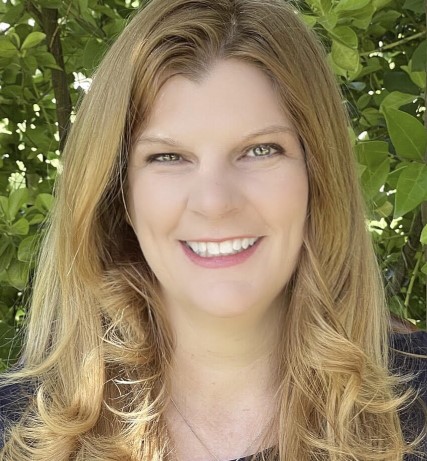
Marna Walthall Wohlfeld is a mom of four, a former non-profit director and journalist, and now a doctoral student at Bridges Graduate School of Cognitive Diversity in Education. She has deschooled, unschooled, and homeschooled various kids at various stages. She loves learning about and championing kids' unique brains and learning styles. She hopes to use her graduate degree to support parents and caregivers of twice-exceptional children as they move through the journey of parenting their wonderfully complex kids. She also hopes to advocate for 2e students by creating greater understanding about the need for strength-based approaches and support for vulnerable nervous systems in education and life. Marna is a trained SENG facilitator. She has presented at NAGC and WCGTC and has written for 2e News.
| |
|
Hello GHF Community,
I’m so excited to be writing to you as the new GHF President! GHF has been a huge part of my life for the past 12 years when we first started our homeschooling journey. Since then it has been my passion and mission to support families who are intentional and proactive about their educational choices. I learn a tremendous amount from not only the amazing professionals GHF brings to our programming, but from the intelligent, wise and compassionate families that GHF serves.
I am also so fortunate to have made lifelong friends with members of the GHF Board and our volunteers. Needless to say, GHF is a special place, and a warm and inviting community that I am so grateful to be part of, and now I am excited to take on this role to continue to bring programming and support to our families! Working alongside our new GHF Vice President, Marna Wohlfeld is an honor! And, I continue to be extraordinarily grateful to the GHF Board who bring their passion and expertise to everything GHF has to offer: Erinn Fears-Floyd, Lisa Jobe, Lin Lim-Goh, Carol Malueg, Ric Mejia, and Kathy Turner dedicate precious time to bringing you the best of the best in the gifted, twice-exceptional and homeschooling world.
On that note, we have a solid foundation due to the leadership provided by our outgoing President, Lisa Sticca-Conrod. We are grateful for her time and wisdom.
I invite you to reach out to me at any time with questions, comments or ideas about GHF. Thank you for showing up for GHF and being part of our growing, supportive group!
-Kasi
kasi.peters@ghflearners.org
| |
|
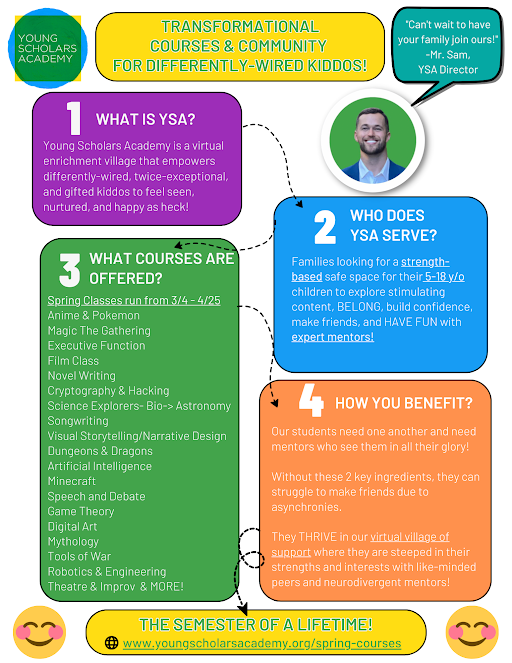
Our friends at Young Scholars Academy are offering some pretty darn exciting Spring Courses that your 5-18-year-old differently-wired kiddo will love!
These Courses empower your child to explore their interests, passions, and curiosities, all while making new friends and learning from expert mentors who absolutely adore them!
Courses include: Anime, Automotive Engineering, LEGO Lab, Film Class, Magic The Gathering, Novel Writing, Pokemon, Minecraft, Artificial Intelligence, Songwriting, Passion Project Fellowship, Game Theory, Coding, Debate, Robotics, D&D, Adulting 101, Cryptography, AP Courses, Philosophy, Threatre, STEAM Lab, WWI Weaponry, Anatomy, History Detectives, Creative Writing, and over 20 more!
They have parent classes, too!
Save 15% when you use this code: YSAGHF15
Enrollment is only open for a few more days!
Head on over to Young Scholars Academy's Spring Courses today!
https://youngscholarsacademy.org/spring-courses
| |
 | |
Searching for The Proverbial Unicorn:
The Ideal Learning Environment for Our Exceptional Learners
Part 2: Making the Leap with School Change
by Lisa Jobe
Spring semester is well underway. So too may be that growing realization that your learner’s school environment isn’t the right fit for their social, emotional, or academic needs. What do you do now?
School change, particularly transitioning to homeschooling, is common for gifted/2e learners. Our childrens’ asynchronicity, needs for advanced content, or advanced abilities combined with learning challenges are often difficult for even the most supportive classroom educators to meet. This is why so many gifted/2e families transition to homeschooling.
“Homeschooling” is, for many families, an umbrella term that takes an ala carte approach to the best of all educational options. Families create ideal menus for their particular learners. Homeschoolers are rarely at home, unless that is their specific choice. The selections of local and virtual homeschool classes, activities, and social connections are immense, more so with the growth of hybrid public homeschool charter options and post-Covid virtual offerings.
Having multiple options can feel overwhelming, though, so where do we begin?
- Imagine the Ideal Education for Your Learner. What would that look like? When my family began homeschooling, I knew my young son needed access to advanced curriculum and hands-on learning that didn’t require significant handwriting. He also needed social activities and peers who “got him,” and these weren’t always same-age peers. For these reasons, we found a flexible homeschool charter that had multi-grade enrichment classes while providing engaging field trips. Other families may find that their children thrive with more or less structure, or incorporate travel into their learning. Homeschooling looks different for every family, and often evolves with your learner’s needs and interests.
- Build Support Networks. Begin connecting with other gifted homeschool families. There are a multitude of options on Facebook that bring together home educators with varying things in common such as learners who are gifted, 2e, gifted with ADHD, or unschooling. GHF Learners’ Facebook group is an active discussion board where new families are welcome to ask questions. In addition to online support, what local support networks are available to you that would facilitate your homeschooling? Are there homeschool charters that might help finance your curriculum? There may be local community co-ops where homeschool families pool resources to provide classes and meet up for park days, as well as drop-off enrichment programs and parent groups. Nature centers, museums, and theaters often have homeschool programs, as well.
Virtual connections also provide tremendous support, from gifted homeschool advisors who can provide your family with educational support to one-on-one mentors, tutors, classes, and parent groups. GHF now provides a virtual homeschool co-op for gifted/2e families!
What other support might you need? When my family began homeschooling, my younger son was still an active toddler. I often hired a teen “mother’s helper” to entertain the baby or take him to the park so that I could give my complete focus to my older son for a learning project. Years later, when I began working again, I likewise hired an older teen to drive my sons to classes and activities.
- Build Up Your Family’s Social Network. For those considering homeschooling, social connections are a common concern. Yet, most children already have strong friendships outside of the classroom. Sports, scouts, theater, youth groups, even the local neighborhood or family cousins provide meaningful peer connections. If your child isn’t already in an after-school activity that provides this social avenue, consider joining one now before their transition. These ongoing relationships, along with the routine, will provide social stability until your child’s social networks expand.
- Foster Current Friendships. Likewise, if your learner has friends whom they enjoy seeing in their current school environment, continue to foster those relationships. As you make your transition, schedule playdates or hangouts that they can look forward to. It is important for the youth to see that they can maintain that friendship beyond school.
- Take Your Time Finding the Right Learning Resources For Your Learner. Before you go out and replicate school textbooks, take some time to find out what type of learning works best for your learner. Traditional workbooks may be efficient for large group teaching, but there are many more interesting and authentic ways to learn. Many students prefer experiencing “living history” through field trips, cooking and crafts, and documentaries; hands-on science also creates much more meaningful learning for most. Throw an authentic Victorian tea party; grow a garden; hatch butterflies or baby chicks, mummify an apple. Working with a homeschool coach or exploring homeschool discussion boards will help you discover learning resources to explore with your student.
How do you let your current teachers and friends know about your decision to change? If the relationships are positive, I often find that letting the teacher and friends know a few weeks before the transition works well. Use positive language that leaves doors open, thanking teachers for their support and perhaps indicating that this is just a trial period to provide your child more time to explore areas of interest. If possible, transition at a natural break, such as a holiday or summer vacation.
Your child may also want to “say goodbye” to the class. When my son transitioned from kindergarten to homeschooling before winter break, he presented the class with his favorite book, which the teacher invited him to share and read in a small celebration followed by cupcakes. Unbeknownst to my son, the teacher had the class make him “friendship cards,” which turned the last day into a joyous occasion.
Finally, build in some downtime after you leave to “deschool,” which provides yourself as well as your learner time to decompress and switch mindsets. Do not be afraid of a few weeks that may look “academically unproductive”--this is important processing time, particularly for any children who are coming out of a negative school experience. Kids who had a particularly tough time in traditional school environments may need longer "deschooling" periods to heal. When beginning to recharge, start with those subjects they enjoy the most, encouraging their buy-in of how they want to learn and providing choices where you can. Homeschooling does not need to look like school: they can sleep in, read while hanging upside down off the couch, do math at a coffee shop, have playdates in the middle of the day, and take breaks whenever they need. This is all consistent with learning and excelling, in healthy and joyful ways.
Making any educational change, particularly when beginning homeschooling, can feel daunting at first. You are not alone. It’s helpful to remember that families always have educational options and can transition again any time. Home district public school must always be available to enroll your learner, and many other programs have rolling enrollments throughout the school year.
Our exceptional youth’s changing needs necessitate a flexible mindset. As we recognize that nearly any educational model requires adaptation for our unique learners, it gives us the freedom to try new ventures and to create a more ideal learning journey best suited for our families.
| | |
|
|
Lisa Jobe is a national gifted consultant and parent advocate specializing in providing support for profoundly gifted/2e learners and their families. Lisa pivoted from her corporate law career to homeschool her profoundly gifted sons, and has now devoted the past 16 years to teaching and advocating for the gifted community. She has served on numerous boards and advisory groups, including here at GHF as a board member and Director of the Virtual Co-Op.
Lisa is co-founder of Sequoia Gifted and Creative LLC, which serves gifted and twice-exceptional families nationally with individualized learning and advocacy support. She is also a doctoral student at Bridges Graduate School, studying cognitive diversity in education. Lisa has several areas of passion, including individualized learning, strengths-based education, creativity, and acceleration advocacy. Please feel free to reach out to her at lisa.sequoiagifted@gmail.com.
| |
|
Parents today lead busy lives and it’s difficult to “get it all done.” Gayle and Lin have created a guide encouraging parents to strengthen their connection with their youngsters using shared reading time. This book provides a selection of carefully curated picture books that can be used by parents to address important issues with their children, such as worry, perfectionism, and managing “big feelings.” Gayle and Lin also provide expert advice to gently guide parent-child conversations using simple, science-backed methods, including ways to help your child develop empathy, self-regulation, and self-acceptance. All of this is artfully accomplished as the authors share both research-based strategies and their own parenting experiences to bring out the very best in children using a strength-based approach.
Purchase Using Picture Books to Help Little Ones Learn About Themselves here.
| |
A Supportive Community for Gifted Learners | |
Come join us in the GHF Forum, our online community where we share all of our services and resources. | |
FREE ACCESS to:
- Discussion groups
- Parenting Gifted
- Professionals
- Parenting 2e
- Homeschoolers
- Live Gifted Home Ed Conference
- Live GHF Conversations Mini-Cons
- Live Monthly GHF Expert Series
- DIY Education Homeschooling Parent Course
UPGRADE to GHF Choices Membership:
- GHF Expert Series Library
- GHF Member Discounts
- Forever Access to Gifted Home Ed Conference & Conversations Recordings
| |
|
For those of you who can give at least $500 we have created a special recognition program where you will be listed on the GHF website and in our monthly newsletter, The GHF Journey, as valued members of the community. Donations may be kept anonymous.
- Tricia Delles, CPA
- Catherine Gruener, M.A., M.A., LCPC, LCMHC, NCC, BC-TMH, Gruener Consulting LLC
- Rosemary Guillette
- Kelly Hayes, Wonder Homeschool Center
- Dr. Melanie Hayes, Big Minds Unschool
- Jen Merrill, Laughing at Chaos
- Heidi Molbak, Seed Starter Educational Consulting
- Dan Peters, Summit Center
- Kasi and Rob Peters
- Magalie Pinney, State Street’s Do More Grant
- Deborah Reber, Tilt Parenting
- Elizabeth Ringlee, The Champion Project
- Jade Ann Rivera
- Lin Lim-Goh, The Quark Collaboration
- Debbie Steinberg-Kuntz, Bright and Quirky
| |
MISSION
To empower every gifted family to make strategic, proactive, and intentional educational choices.
VISION
A diverse world of multi-generational families, educators, and professionals supporting each other through community, education, and creating content relating to gifted home education.
#GIFTEDHOMEED
Empowering gifted families to make strategic, proactive, and intentional educational choices.
VALUES
GHF values the uniqueness and humanity of each person in our community. We treat each other with love and kindness and particularly abhor bullying and negativity of any kind. We accept that it is our job to examine each day with a fresh perspective and continue to improve the organization to pursue our mission.
| |
GHF is a 501c3 organization. Please consider supporting our community with your most generous gift today. For more information on our organization, please feel free to contact us. Thank you!
| | | | |