|
How Can You Prove that Homeschooling is Working?
By Linda Kreger Silverman, PhD
Gifted Development Center
A decade ago, our merry band of Gifted Development Center (GDC) associates (Kim Boham from Omaha, Nebraska; Linda Leviton from Southern California; Anne Beneventi from Northern California; and me from Colorado) embarked upon a journey to uncharted territory. Families in Northern California had been waiting a year for the Gifted Development Center (GDC) to come back to the Bay Area to test children. Most of our families were homeschoolers who had heard of us through Bay Area Gifted Homeschoolers (BAGHS). I learned so much from them about the phenomenal resources available for homeschoolers in the Bay Area. But there was no place to test them, and the hotel rates were outrageous. Yet, the stars must have been aligned. Something new was born there!
We had tested our first child four years earlier, when she was just turning six. That is the ideal age for testing gifted children, because they can take the Wechsler Intelligence Scale for Children (WISC-V) at 6 years 0 months. The WISC-V goes up to 16 years 11 months. The most important element of testing gifted children is a high ceiling on the test. There has to be sufficient room at the top for them to demonstrate their advanced reasoning. The Wechsler scale for younger children, the Wechsler Preschool and Primary Scale of Intelligence (WPPSI-IV) has too low a ceiling to capture the full strengths of a gifted child. It only goes up to 7 years 7 months. GDC contracted with Pearson Assessments for an entire year to try to create extended norms for the WPPSI-IV, but the ceiling of the test was too low. So, if you only have a WPPSI-IV on your child, you probably have an underestimate of your child’s abilities.
You probably think that a ceiling as high as 16-11 is plenty of room for 6-year-old gifted children to demonstrate all that they know. Our research tells a different story. In 2009, Bobbie Gilman, Kathi Kearney (homeschooling guru), and I conducted a study of the percentage of 104 gifted children assessed at GDC who answered items correctly at or near the highest level of the WISC-IV, never reaching a stopping point. It is necessary for the child to miss a certain number of consecutive items in a subtest for the examiner to feel confident that the child could not have passed more difficult items. This is the discontinue criterion. In our study, 95 of 104 gifted children did not reach a discontinue point on at least one subtest (Gilman, Kearney & Silverman, 2009). For nearly all of the children, the test did not have a sufficient ceiling to be certain that the scores were valid estimates. For 74 percent of the sample, discontinue criteria were not met on Similarities. In the 9 to 12 year old range, 30 of the 31 children met no discontinue criteria on one to seven subtests, and 25 of 33 six-year-olds did not reach discontinue criteria on one to five subtests (Gilman, Kearney & Silverman, 2009; Silverman, 2018).
Sheila Stone (pseudonym) was tested at 6-0. She was unhappy at school because she was not being sufficiently challenged. I recommended that her parents homeschool her. Her mother, Gabriella, loved the idea. Her husband was skeptical, to say the least. Gabriella thoroughly researched the resources available in the Bay Area, and then she decided to create a custom-tailored educational program for Sheila. Dad reluctantly went along with the plan, but he was never convinced that it was the right thing to do. Now, Sheila was 10, and there was a war going on at home. Her Dad was adamant that she should be placed in a new school with all the bells and whistles.
We had administered the Woodcock-Johnson Tests of Achievement when Sheila was 6, and again when she was 10. The night we tested her, I was troubled. I am usually a good sleeper, but at 2:00 am I woke up and could not fall back to sleep. I had heard that when you are awakened in the middle of the night, you should write and see what emerges. I went to the computer, opened it up and stared at it. And then the Muse visited me. I was directed to look closely at Sheila’s grade equivalents on her achievement tests.
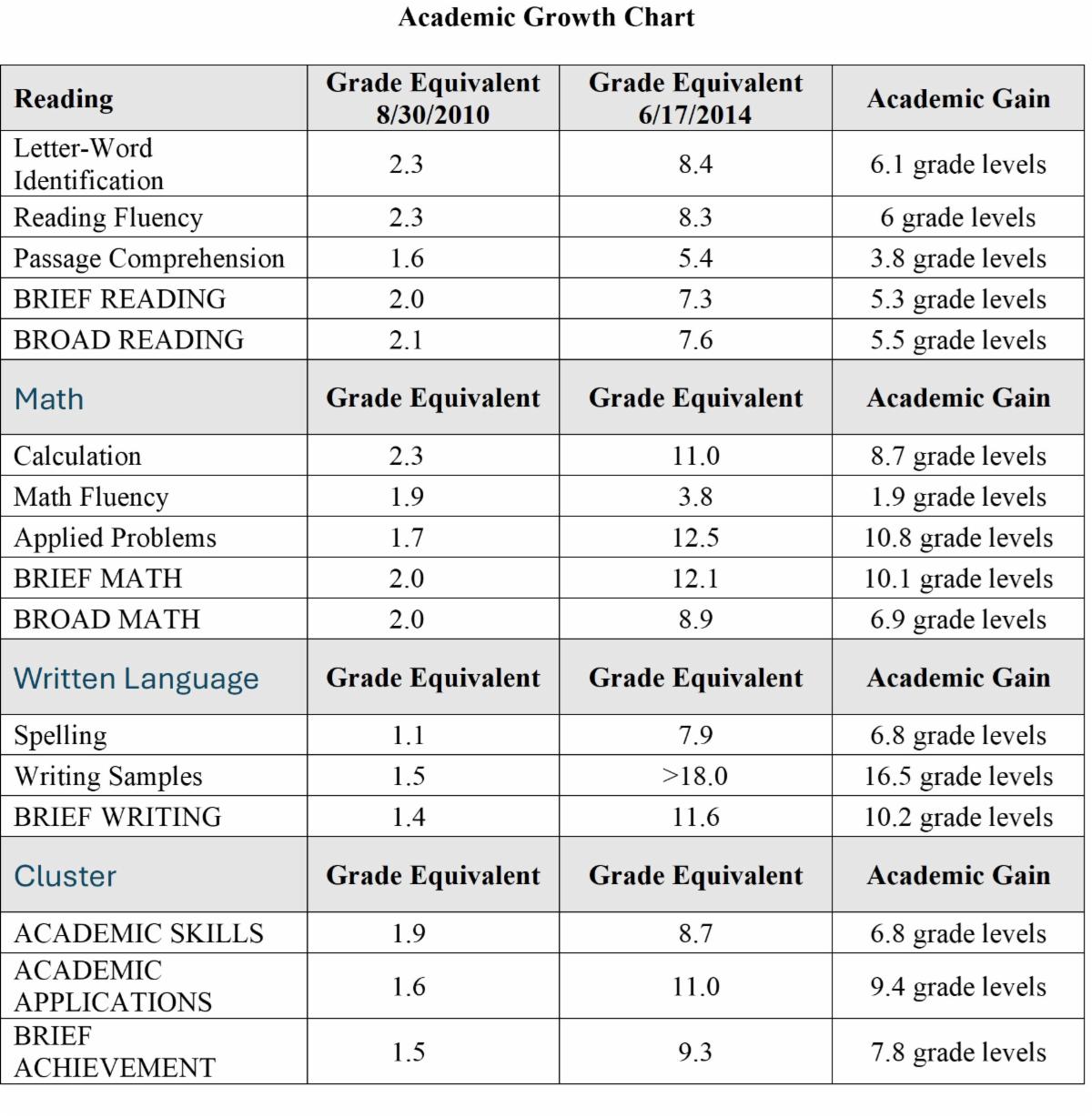
I made a chart of the two sets of grade equivalents on the Woodcock-Johnson from when Sheila was 6, and at age 10, and a column entitled Academic Gain. Instead of the 4 years of growth that would have been predicted in 4 years of school, remarkable gains had been made through homeschooling. The greatest growth was in Writing Samples (16 grade levels)! Applied Problems (math reasoning) demonstrated a 10.8 grade level gain. The only areas where the growth was less than 4 years were in Math Fluency and Reading Comprehension, both indicators of visual processing weaknesses.
I inserted into Sheila’s report the Academic Growth Chart (included at the end of this article) along with this written description:
Sheila Stone was tested at the Gifted Development Center on September 4, 2010. She was 6 years 0 months. As Sheila was not challenged in school, her mother, Gabriella, decided to homeschool her. After thoroughly researching the available resources, Gabriella created a custom-tailored educational program for her daughter. This section documents Sheila’s progress in custom schooling, reveals her personal strengths and weaknesses, as well as the strengths and weaknesses of her academic program.
While grade equivalents provide only a rough estimate of the performance of average students on specific tasks, when the WJ-III is administered periodically, grade equivalents are useful for documenting rate of academic growth. This is particularly valuable information for homeschooled children. Had Sheila remained in a school setting, her predicted rate of progress would be one grade level for each school year (< 4 grade levels). In her individualized custom schooling, Sheila achieved well beyond the expected 4 years of growth in nearly all areas.
Sheila’s most impressive gain was in Writing Samples. In less than 4 years, she went from performing at the mid-first grade level to the level of an average graduate student, a gain of 16.5 grade levels. Her customized writing program has been highly effective and should be continued. Her Applied Problems score increased 10.8 grade levels, bringing her to the performance level of an average senior in high school in the 5th month of school. Calculation more than doubled the expected growth at 8.7 grade levels, bringing Sheila to the level of performance of a student starting her junior year in high school. Spelling showed a gain of 6.8 grade levels. Reading decoding (Letter-Word Identification) and Reading speed (Reading Fluency) both improved 6 grade levels. Sheila’s composite scores in writing, mathematics and reading, as well as her cluster scores, all reflect these strong gains. Sheila’s Academic Skills increased 6.8 grade levels. Her Academic Applications (Reasoning) gained 9.4 grade levels. And her Brief Achievement improved 7.8 grade levels. These scores document the success of Sheila’s custom schooling.
Passage Comprehension was commensurate with Sheila’s grade placement (a 3.8 grade level gain in 3 years 9 months), but significantly lower than her other areas. This relative weakness had an impact on Sheila’s Brief and Broad Reading scores. Brief Reading showed a 5.3 grade level improvement and Broad Reading demonstrated a 5.5 grade level improvement. Sheila had less growth in reading than in mathematics and language arts.
Sheila’s Math Fluency (speed of computation) gained half as much as expected: 1.9 grade levels, which seriously depressed her Broad Math score. Her Brief Math score, which eliminates Math Fluency, indicated that she had jumped over 10 grade levels in mathematics. By comparison, her Broad Math score increased 6.9 grade levels. Her speed brought her Broad Math score down over 3 grade levels.
Passage Comprehension and Math Fluency are the two sections of the WJ-III most affected by visual processing weaknesses. They do not reflect negatively in any way on Sheila’s curriculum. On the contrary, growth of 10 grade levels in mathematics and 6 grade levels in reading are commendable, suggesting that Sheila’s customized program is allowing her to progress at an advanced rate in both areas. It is likely that Passage Comprehension would have increased commensurate with her other reading scores, if her visual processing skills were optimal.
Sheila is talented in mathematics, is working with an excellent mentor to develop her math talent, and they should continue to focus on math reasoning, not speed. Vision therapy has a strong track record of improving Passage Comprehension and Math Fluency in approximately 6 months.
Overall, the WJ-III demonstrated marked improvement and documented that Sheila’s custom schooling program has been exemplary.
The Academic Growth Chart worked! The chart clearly demonstrated the success of homeschooling and provided a basis for educational planning for Sheila. Sheila loved her homeschool program and wanted to continue. She had visited the school Dad wanted her to attend, and she was not happy there. Upon seeing the academic gains that his daughter had made in homeschooling, he finally conceded that it was working and backed off his insistence that Sheila attend a brick-and-mortar school. (I think I may have saved their marriage!)
Upon receiving her report, Sheila’s mother wrote:
All I can say is “Wow.” Thank you for such a thorough, encouraging, and thoughtful report. I cannot tell how much I appreciate it. The recommendations are so complete. I hope we can institute many of them. Thank you so much, and thank you to GDC. Thank you for truly “seeing” our child and providing seasoned, expert recommendations.
References
Gilman, B. J., Kearney, K. & Silverman, L. K. (2009, Nov.). Conceptual challenges to measuring the full range of giftedness. Paper presented at the National Association for Gifted Children 56th Annual Convention, St. Louis, MO.
Silverman, L. K. (2018). Assessment of giftedness. In S. Pfeiffer (Ed.), Handbook of giftedness in children: Educational theory, research, and best practices (2nd ed., pp.183-207). New York: Springer Science.
Silverman, (2014, Sept. 4). What can be gained through homeschooling? Guest blog for the Gifted Homeschoolers Forum. http://giftedhomeschoolers.org/guest-post/can-gained-homeschooling/
|