|
The Ideation-Production Bottleneck:
When Bright Learners Know More Than They Show
by Dr. Lisa Jobe
Jake
Jake is a 13-year-old gifted homeschooler who frequently refuses to engage in written assignments. His family has spent a lot of money trying and discarding different curricula and online classes. While Jake readily participates in discussions, he shuts down when asked to complete writing assignments. His mom is exasperated.
Molly
Molly is a 10-year-old fifth grader with a rich imagination who attends the gifted program at her school. She beams with excitement as she elaborately describes the fictional meta-world she envisions. She spends hours a day jotting down ideas in her journal, drawing complex illustrations, and explaining intricate details to anyone who shows interest. Her self-declared goal is to write a novel.
Yet, when Molly’s teacher hands out the first writing assignment of the new school year, Molly becomes stuck. Writing a three-paragraph essay about what she did over the summer makes her anxious. She worries she won't have anything interesting to share. Her parents encourage her to write about creating her meta-world, but Molly can't find a way to explain all of her ideas within such a narrow assignment. She gets hung up trying to find just the right words and can't even create an introductory sentence. Homework time results in tears of frustration; by bedtime, she has only a basic draft ready to turn in. Her parents wonder how a child with so much to say could struggle so much with a three-paragraph essay.
Impact of Gifted and 2e Writing Challenges
Jake’s and Molly’s writing challenges are very common among gifted and twice-exceptional (2e) learners. Homeschool families may find themselves trying and discarding one curriculum after another, hoping the next writing program or online class will be the one that works. Sometimes the content is a good fit, but the writing expectations bring everything to a halt. School families often see similar frustrations. Homework that seems like it should be easy takes entire evenings, and the emotional dysregulation that often results significantly impacts children and their parents. A work product that fails to reflect the learner’s conceptual knowledge or readiness for advanced content may shape how teachers view the learner, impact their grades, and even block access to gifted programming.
What is making production so difficult for these bright learners, and what can we do about it?
Ideation-Production Bottleneck
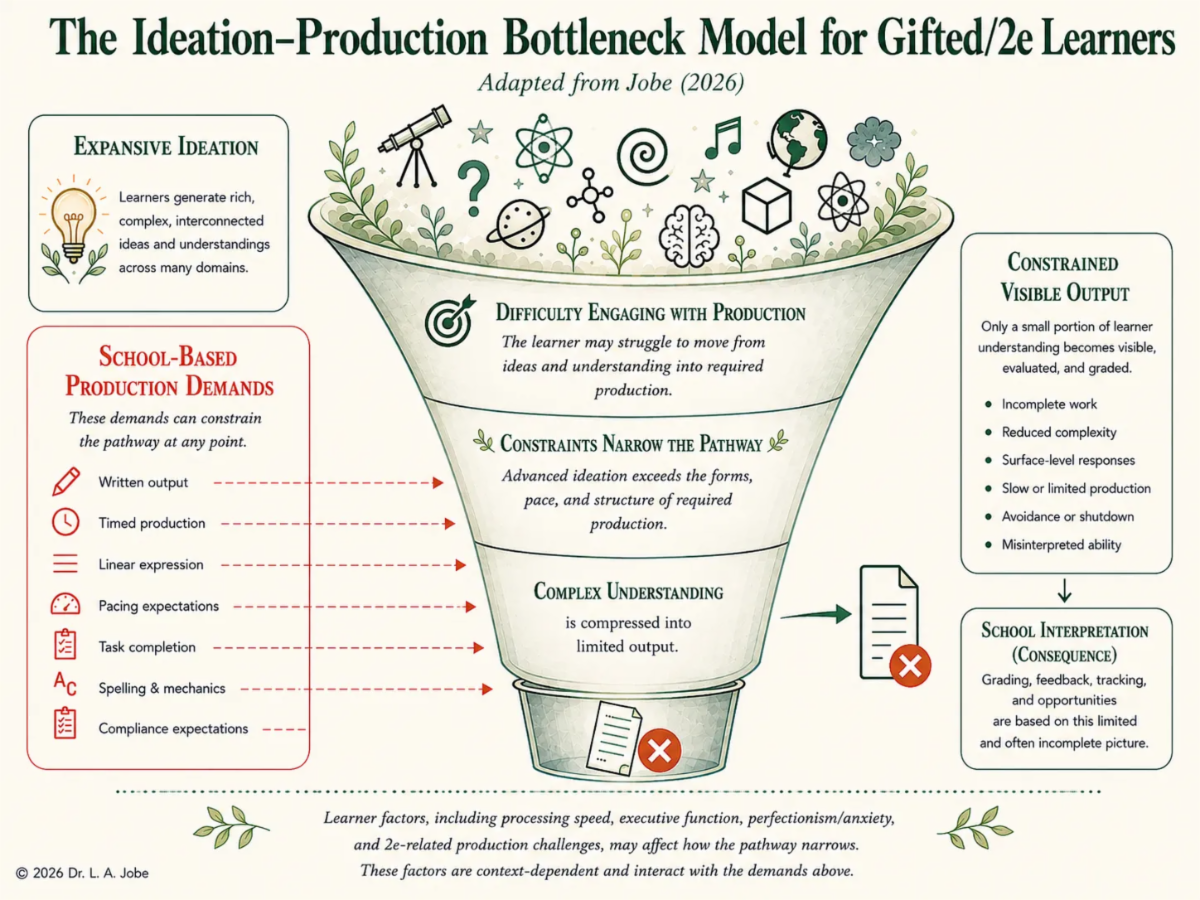
I have seen this pattern repeatedly in my own family, in my practice, and in my doctoral research on educational fit. I conceptualized the Ideation–Production Bottleneck Model (Jobe, 2026)1 to describe the volume of advanced, novel, and complex ideas these learners continually generate, and how much of that thinking can be lost when they are given a written assignment. The model can help us identify where production breaks down and what support may help when production is necessary.
Jake: A Reluctant Writer
Learners like Jake may be reluctant or refuse to even begin the production process. Jake readily thinks, talks, and problem-solves when the work is meaningful to him, but getting his thoughts down in writing takes much more effort. Jake has developed a pattern of shutting down when writing is required, sometimes before he ever begins organizing his ideas or drafting. For Jake, we need to begin with his interests as an entry point for motivation.
Solution: Use Jake’s Interests as an Entry Point
The ideation-production bottleneck can look very different depending on what learners are asked to produce and how they approach the work. Using a learner’s interests as an entry point can help them engage with production. Providing autonomy and multiple pathways for expression can widen the pathway between what they are thinking and what they are able to produce in writing (Jobe, 2026).
When I worked with Jake one-on-one, I discovered that he loves Minecraft, especially experimenting with ”mods.” I told him I had younger students just getting into Minecraft and asked if he'd be willing to use his expertise to draft a "quick infographic" to "help them out." Jake jumped into the project, composing several well-written instructional paragraphs into an attractive infographic in Canva.
Jake's interest in Minecraft provided the entry point. He had considerable knowledge to share, and helping younger learners gave him an authentic reason to put that knowledge into writing. Without a predetermined rubric or tightly defined expectations, Jake had considerable autonomy over how he developed the project. Canva also gave him room for creative expression, allowing him to combine substantial writing with visual organization and design rather than limiting him to a traditional written assignment.
Molly: Organization Demands, Perfectionism and Anxiety Narrow Writing Pathway
For Molly, motivation is not the problem. She wants to write, cares about doing a good job, and has plenty of ideas she wants to share. Her difficulty begins as she tries to fit those expansive ideas into the constraints of an assignment. She has spent months developing an enormous, interconnected meta-world, and now she has to decide which small part of that thinking belongs in a three-paragraph essay. This requires her to organize ideas that have developed in many directions, decide how to fit them into the expected structure, and put them in linear order with proper punctuation, while leaving out details that feel important to her.
Once Molly begins trying to write, the demands keep building. She has to hold onto all of her ideas while deciding how to begin, remember what she has already included, and keep the assignment requirements in mind. Molly keeps getting hung up on trying to find just the right word from her rich vocabulary bank. Perfectionism further delays each decision, especially when she feels she is not adequately reflecting the ideas swirling in her mind.
Anxiety adds another layer. Molly knows the essay will be graded and becomes increasingly overwhelmed as the evening goes on. By the time she finally gets a few sentences onto the page, she is mentally exhausted. When she hands in her homework, her teacher gets a very narrow view of Molly's expansive thinking.
Solution: Tools Help Widen Molly’s Pathway
Using the Ideation-Production Bottleneck Model to identify Molly’s particular constraints helps us choose supports for each point in the pathway. Several of Molly’s challenges remind me of my own profoundly gifted, dysgraphic son, whose ideas often moved much faster than he could write them down. As a parent, I found that simple tools such as a large whiteboard with different colored dry-erase markers or even Post-it notes were very helpful.
To support Molly, her parents can help her get all of her ideas out before asking her to organize and choose from them. She could talk while a parent takes notes on the whiteboard, allowing her ideas to keep flowing at top speed. For many of our learners, this can be a more successful first step than a mind map or graphic organizer, which would still require her to generate, organize, and record ideas simultaneously.
Once her ideas are visible, Molly could then decide what belongs in this assignment and what can be set aside. A whiteboard works especially well here because ideas that are not needed can quickly disappear from view. It is also important for Molly to understand that leaving an idea out of this particular assignment does not make it less important. She is simply choosing which ideas she needs for these three paragraphs. If erasing the other thoughts feels stressful, she can "park" them elsewhere for another day.
Now, Molly can organize her remaining ideas into the essay's structure. Different colored markers could represent each paragraph, or individual ideas could be written on Post-it notes and physically moved into groups. This would give Molly a visual structure to follow before she begins drafting and would reduce how much she has to hold and organize in her mind while she writes.
Finally, drafting and revision can be treated as separate tasks. When Molly gets hung up trying to find just the right word, she can highlight what she wants to come back to and keep writing rather than interrupting her ongoing train of thought. She can return to those words later, using a thesaurus if helpful. Revision should also happen in separate passes: one for topic sentences, another for punctuation, and another for word choice. These require different writing skills, and separating them gives Molly more room to focus on one demand at a time.
For a learner like Molly, turning these strategies into a task list can also help reduce the pressure. As she moves through each phase of her written production, she can check off each step and see exactly where she is in the process. This can reduce the mental effort required to keep track of what comes next and make it easier to pause for a break and then return to the assignment.
Conclusion: A More Accurate Understanding Aids Writing Woes
Ultimately, the purpose of the Ideation-Production Bottleneck model is to give us a more accurate understanding of each learner, pinpoint where and how they struggle, and help them continue building the skills they need. Jake and Molly have far more complex thinking than their written work initially reveals, and their pathways narrow in different places.
When we understand where the pathway is narrowing, we can make sure production difficulties do not limit access to appropriately advanced learning. That understanding can also help us create a better-aligned educational fit in which learners remain engaged with ideas that reflect their actual abilities and level of thinking.
Notes:
-
Jobe, L. A. (2026). From misalignment to realignment: Parent perspectives on educational fit for highly and profoundly gifted twice-exceptional learners [Doctoral dissertation, Elmbridge University].
|