|
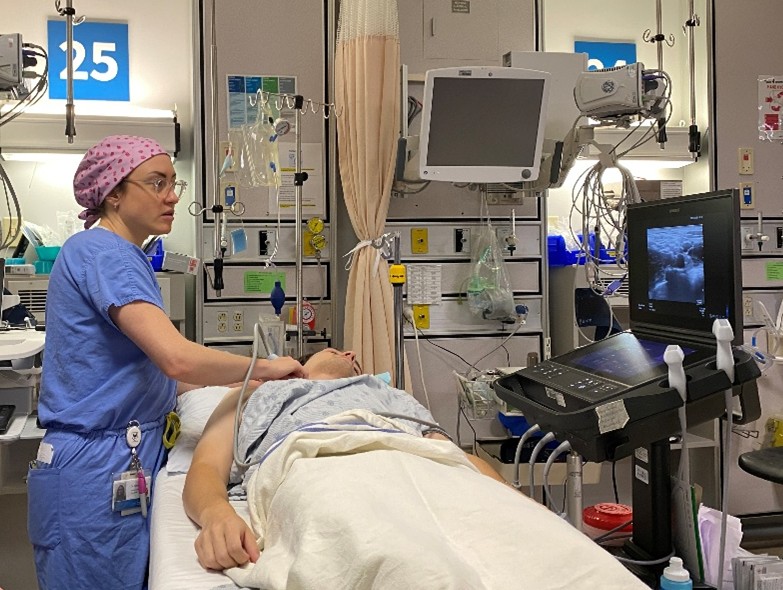
Dr. Alison Sampson, a year 4 resident, performs a PoCUS scan on a simulated patient.
Point‑of‑care ultrasound (PoCUS) has become an essential component of modern clinical practice. To remain at the forefront of perioperative care, the Department continues to strengthen its ultrasound education strategy, supporting both residency training and continuing professional development for clinical faculty.
Embedding PoCUS in Residency Training
Traditionally, PoCUS exposure for our residents has occurred during ICU rotations. To ensure that all trainees graduate with foundational PoCUS competencies, the Department is formalizing PoCUS as a required component within the final‑year anesthesia residency training blocks. This enhancement will equip residents with the tools, knowledge, and confidence to use ultrasound effectively in perioperative resuscitation and clinical decision‑making.
A pilot PoCUS curriculum is currently under development and is scheduled for full implementation in July 2026. The course is being created by second‑year resident Dr. Intek Hong as part of his scholarly project, under the supervision of Dr. Shannon Bradley, Residency Program Director, and Dr. Angela Builes, who will serve as the rotation lead.
The curriculum is designed to allow residents to learn and apply ultrasound principles in a structured but self‑directed manner. PoCUS‑trained staff anesthesiologists will provide ongoing feedback on learners’ image acquisition and interpretation skills. The course focuses mainly on cardiac and lung ultrasound; however, it also covers additional applications such as airway assessment, abdominal ultrasound in trauma, and gastric ultrasound for perioperative aspiration‑risk stratification. “While this new rotation is designed to be foundational, residents may still undertake the ICU PoCUS elective to further build on their skills in a more critical patient population,” says Dr. Bradley, emphasizing the value of both experiences.
Faculty Development in Ultrasound
Alongside ongoing improvements to residency education, the Department continues to expand ultrasound training opportunities for faculty members.
Since 2021, under the leadership of Drs. Genevieve McKinnon, Angela Builes, Dana Archibald, Kwesi Kwofie, Ana Sjaus, and Edmund Tan, the Department has delivered the Perioperative Ultrasound Anesthesia Training (PULSATe) program as a Continuing Professional Development offering.
The primary goal of PULSATe is to develop and implement a structured curriculum that enables anesthesiologists to learn essential echocardiography and PoCUS skills. The course focuses on assessing cardiac function, identifying lung pathology, evaluating fluid status, and visualizing airway anatomy and gastric volume. Anesthesiologists who complete the program are also able to contribute to resident education by supporting learners in achieving their PoCUS competencies.
Another example of faculty-focused ultrasound education is the gastric ultrasound workshop—affectionately known as GUS—developed in partnership with the IWK Department of Women’s and Obstetric Anesthesia. Since its launch last year, Drs. Angela Builes, Ana Sjaus, and Kwesi Kwofie have delivered three sessions.
“The GUS workshop is designed to be practical and interactive, offering ample hands‑on scanning time so participants can refine their technique and perform accurate measurements,” says Dr. Builes. The workshop reinforces the bridge between theory and practice through a review of indications for gastric ultrasound in perioperative and peripartum care, both qualitative and quantitative aspiration‑risk assessment, scanning techniques, and required adjustments for special patient populations.
Taken together, these initiatives highlight the Department’s coordinated and forward‑looking approach to ultrasound education across all stages of professional development. “By embedding PoCUS into structured residency training and supporting accredited, collaborative faculty development, we are fostering a sustainable culture of ultrasound excellence,” shares Dr. Robyn Doucet, Medical Director of Education.
|