| | Follow us on social media! | | New Resource - Canadian Medicine Carbon Footprint (MCF) Formulary | |
The Coalition is excited to launch the Canadian Medicine Carbon Footprint (MCF) Formulary, an information resource displaying the carbon footprint ratings of a selection of drugs frequently prescribed and used in Canada. It is designed to facilitate research, education, and quality improvement initiatives.
We are thrilled to work with YewMaker from the UK to develop the formulary using MCF Classifier data developed and provided by Haroon Taylor and Nazneen Rahman, creators of the original MCF Formulary.
If you have any questions, email coalition@greenhealthcare.ca.
| | |
New Resource -
Greening the Wards Mini Guidebook
Sustainability in general internal medicine starts with small, practical steps, and accessible tools that make change easier in everyday clinical practice.
Our new mini guidebook is a condensed version of Greening the Wards: A Guidebook for Promoting Environmental Stewardship in General Internal Medicine.
It provides a quick, at-a-glance overview of key principles in sustainable health care, designed with busy medical residents in mind. This resource can be used as both a quick reference and a poster-style overview, helping clinicians and learners integrate environmental stewardship into routine care.
| | |
Forget for a Moment Foundation: Growing Canada’s Health Care Forests
The Forget For A Moment Foundation is a proud collaborator with CCGHC as part of the national Canadian Health Care Forests Initiative—an inspiring movement recognizing health care and long-term care establishments that are integrating nature into the heart of care.
As part of this collaboration, establishments that have received a JASMA Healthcare Planter, a green wall installation, or participate in the Blooming Moments Program are being recognized for their commitment to enhancing quality of life through nature. These organisations are now featured on the Canadian Health Care Forests map, highlighting their leadership in creating more human-centred care environments.
| | |
Funding Renewal & Program Expansion - Decarbonization in Action
The Decarbonization in Action program has been renewed for the next three years, thanks to continued support from the Peter Gilgan Foundation.
Over the next three years, we’re expanding the program through a cohort model that brings hospitals together to accelerate adoption of practical, high‑impact climate solutions. We’ll provide:
- Technical and engineering support for emissions reduction initiatives with a focus on clinical sustainability
- Communications resources for impact amplification
- Peer‑learning networks for sharing knowledge and co-creating solutions.
This Summer, we’re looking to recruit 15 hospitals across Ontario to participate in our 2026 Decarbonization in Action Cohort.
| | |
Article Release - Optimizing Prescribed Inhaler Use: Nursing Support for People and the Planet
This article suggests that nurses can improve both patient outcomes and environmental sustainability by optimizing inhaler use. It highlights that metered-dose inhalers (MDIs) use potent greenhouse-gas propellants, while dry powder and soft mist inhalers have much lower carbon footprints.
Nurses can support accurate diagnosis, assess patient suitability for different devices, reinforce proper inhaler technique, promote environmentally preferable options when appropriate, and encourage recycling and safe disposal. A patient-centred approach remains essential, as MDIs are still necessary for some individuals.
This article was developed as part of the Preparing Canada’s Health Care Buildings for Net-Zero project, made possible with investment from the Government of Canada’s Low Carbon Economy Implementation Readiness Fund.
| | |
Foundational Course: Climate Change and Health in B.C.
This capacity-building course is an online, self-paced, climate change focused learning opportunity for everyone who works in the B.C. health system—all settings, at all levels, and across all teams.
These foundational modules help learners understand how climate change affects human health and health systems, and different ways the health system can take action to reduce its own environmental impact and build climate resilience.
How to Access the Course:
-
Complimentary Registration - Free access for individuals working for a public sector organisation within the B.C. health system through a recognized email domain.
-
Paid Registration - Available to all networks and interested individuals for a fee of $25.
| | |
Brain Climate Equity Collaborative: Advancing Equitable Climate-Resilient Brain Health
Climate change is increasingly recognized as a threat to neurological health through exposures such as extreme heat, wildfire smoke, and air pollution. Emerging evidence links these hazards to stroke, cognitive decline, neuroinflammation, and worsening neurological disability, with equity-denied populations bearing disproportionate burdens.
Despite this growing evidence base, no national Canadian framework addresses the intersection of climate change, neurological health, and equity. This paper describes the development of the Brain Climate Equity Collaborative (Brain-CE Collab), a graduate-initiated, interdisciplinary non-profit established in 2025.
| | |
Advancing Environmentally Sustainable Learning Health Systems: Perspectives from a Canadian Health Center
Learning Health Systems
This article argues that Learning Health Systems can help health care organisations accelerate environmental sustainability by continuously collecting data, evaluating interventions, and applying lessons learned.
Drawing on experiences from a Canadian health centre, the authors highlight the importance of leadership, cross-sector collaboration, measurement, and embedding sustainability into routine decision-making to drive ongoing improvement and reduce health care’s environmental impact.
| | |
Youth Unite with Advocacy Groups to take Federal Government to Court
Canadian Association of Physicians for the Environment
A federal court challenge has been launched by three young Canadians, the Canadian Association of Physicians for the Environment (CAPE), and Environmental Defence. They argue recent federal climate policy rollbacks have left Canada without a credible plan to meet its legally binding 2030 emissions target.
The lawsuit seeks to compel the government to comply with the Canadian Net-Zero Emissions Accountability Act by producing a transparent, science-based plan to achieve its climate commitments and protect future generations.
| | SUSTAINABLE PRESCRIBING/PHARMACY | | |
CPhA Seeks Pharmacist Input to Support Development of Climate-Sensitive Infectious Disease Resources
Canadian Pharmacists Association
| |
The Canadian Pharmacists Association (CPhA), in partnership with the Indigenous Pharmacy Professionals of Canada (IPPC), is developing new climate-sensitive infectious disease toolkits to support pharmacists and communities across Canada.
As part of the RxClimate Action project, these resources aim to help pharmacy teams better understand and respond to the growing impact of climate change on infectious diseases, including Lyme disease, West Nile virus and waterborne infections.
To help shape practical, culturally relevant resources, CPhA and IPPC are seeking input from pharmacists who provide care to First Nations, Inuit and Métis communities.
| | |
PAN International and Meatless Monday launch collaboration to support healthier, more sustainable food choices
Physicians Association for Nutrition
A new collaboration between PAN International and Meatless Monday will help bring practical, evidence-informed plant-forward action into health care and other institutional settings.
Working with the Johns Hopkins Center for a Livable Future, the partnership will provide resources and support to encourage healthier, more sustainable food choices, highlighting the benefits of plant-forward diets for human health, climate action, and environmental sustainability.
| | |
Thoughts on Canada’s New $3.2 Billion Food Security Strategy: It's Time for Canada to Become Its Own Best Customer
Nourish
Canada’s new National Food Security Strategy invests $3.2 billion in critical food infrastructure to strengthen affordability, resilience, and domestic food production. This commentary argues that achieving lasting food security will also require stronger connections between food systems, public health, sustainability, and institutional procurement. The article highlights the opportunity for health care, education, and other public institutions to leverage their purchasing power to support healthier, more equitable, and climate-resilient food systems.
| | Nourish Food for Health Symposium 2026 | | |
Date: October 7-8, 2026
Location: Vancouver, BC
Nourish’s 2026 Symposium, Who Health Care Feeds, unites the leaders, doers, and bridge-builders across health, philanthropy, government, and food systems who are ready for change.
They’ll focus on how planetary health mandates translate into menus, and how those menus can shape the future of health care. Nourish is proud to collaborate with Vancouver Coastal Health to co-host Symposium 2026.
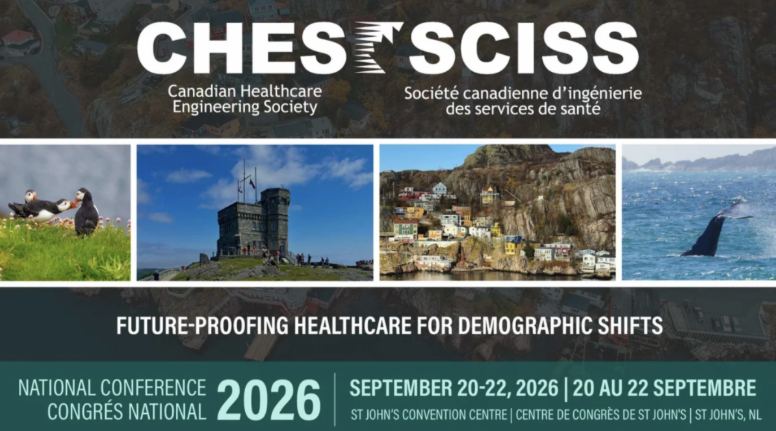
| | CHES 2026 National Conference | | |
Date: September 20-22, 2026
Location: St. John’s Convention Centre, St. John’s, NL
The CHES 2026 National Conference brings together health care engineers, facility managers, and industry experts for two days of learning, networking, and innovation.
Why Attend?
Expert Insights: Hear from leading voices in health care engineering and technology. This year they are adding a third concurrent session on both days!
Hands-On Learning: Participate in workshops and technical sessions designed to solve real-world challenges.
Networking Opportunities: Connect with peers, vendors, and thought leaders shaping the industry. Fantastic and fun events!
Two great keynotes: Great beginning and ending! Brad Gushue and Ross Bernstein.
| | |
Have you registered as an organ donor?
Contact your local organ donation agency and speak to your family about your wishes. You have the power to save and transform lives. Learn more and register to donate HERE.
| | The Canadian Coalition for Green Health Care is Canada’s premier green health care resource network, leading the evolution of green in Canada’s health sector as a national voice and catalyst for environmental change. www.greenhealthcare.ca | |
Some articles referred to in the Digest make reference to services and/or product offerings from specific suppliers. The CCGHC recommends that readers research the service and product offerings available through a wider range of suppliers for comparison purposes and in keeping with public sector purchasing guidelines. These articles should not be interpreted as an endorsement of any product or service. | | | | |