April 2026

Community, new treatment updates, new faces, relaunching Scratch and more

Welcome to the Spring edition of “The Hive," We CU's quarterly newsletter.


Springtime in the U.S. brings a sense of renewal and meaningful momentum for our We CU community. We’re excited to share new developments and opportunities in this edition that reflect the work we’re building together. None of this happens without you. We invite you to stay engaged and help us grow a stronger, more connected movement for everyone affected by chronic urticaria. 


Here are a few ways to get more involved with We CU. You can share your story on our website, participate in ongoing research opportunities, or submit a quote to be featured on our community voices page. Every contribution, whether big or small, helps us better serve people living with chronic hives.  


Interested or have something to share? I’d love to hear from you. Drop me a line at kristen@livingwithcu.org  


The We CU Team


Clay Banks via Unsplash

We CU joins GlobalSkin

What does this mean for our community?


We have exciting news to share! We CU is now a member of GlobalSkin, or the International Alliance of Dermatology Patient Organizations, a truly global coalition spanning 86 countries and 59 skin conditions.  

Credit: Clay Banks via Unsplash
 

As the only U.S. nonprofit dedicated to chronic urticaria, We CU couldn't be more thrilled about what this means for our community in 2026:  


  • a global network of peers  
  • deeper learning through conferences and forums  
  • expanded advocacy efforts, including training patients to take part in research and raise awareness  


With GlobalSkin, we join a coalition of patient organizations working to amplify patient voices and improve the lives of people affected by skin conditions worldwide. 


We CU is proud to be a member of GAAPP and GlobalSkin — global communities working to improve the lives of people with chronic and skin conditions worldwide. Explore their work here and here.  


Have a question about your hives? Ask Scratch


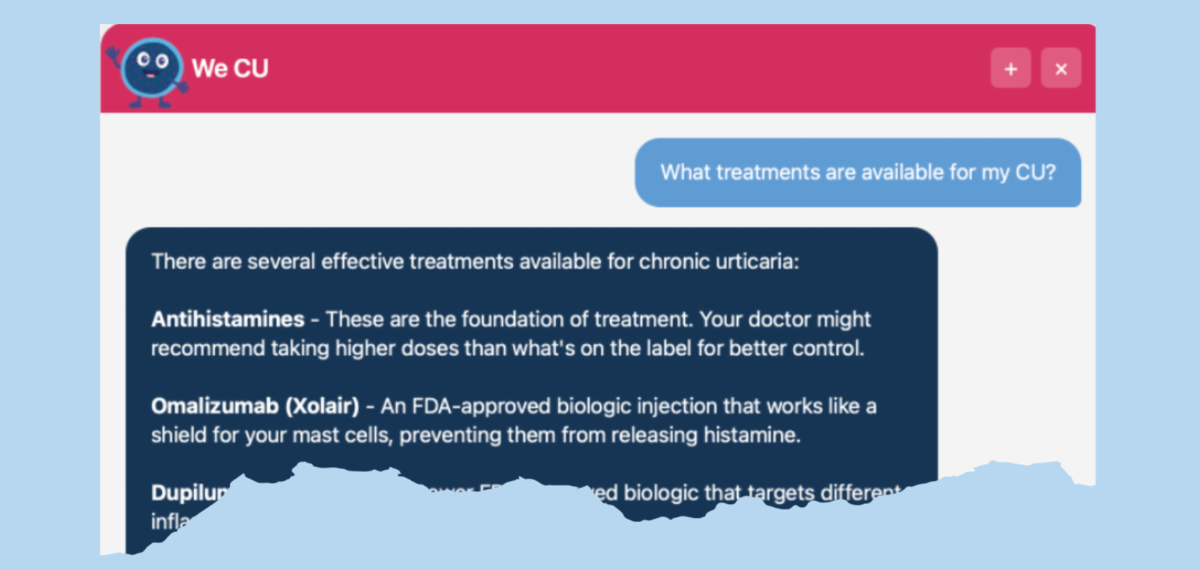
Earlier this year, we relaunched Scratch, an AI-powered tool designed to answer your most common questions about chronic hives anytime, day or night. Built using 175 peer-reviewed sources, Scratch delivers fast, reliable, and evidence-based information for patients, caregivers, and anyone seeking to better understand CU.


From explaining symptoms and treatment options to offering tips for self-advocacy, Scratch meets you wherever you are in your journey. While it doesn’t replace medical care, it helps bridge critical information gaps with empathy and accuracy. Try Scratch today (it’s the mast cell at the bottom of our homepage) and explore how it can support your path to better understanding and care. how it can support your path to better understanding and care.


Meet We CU's Director of Communications and Engagement

Ariam Alula


A public school kid from the Bronx and Manhattan, Ariam Alula (pn: ah-ree-ahm ah-loo-lah, slight roll of the "R") brings a global perspective along with a strong foundation in engagement journalism and family advocacy.


At We CU, her work is shaped by personal experience supporting her sibling on the autism spectrum and navigating health care systems as the child of Eritrean immigrants. She is especially passionate about how language impacts care and making sure patients feel seen, heard, and understood.


Ariam is committed to amplifying overlooked voices and building community with evidence-backed resources that empower people living with chronic hives. 


New developments in chronic urticaria treatment 


There's a lot of movement in the CU treatment landscape right now. In April, the European Commission approved dupilumab for children ages 2 to 11 with chronic spontaneous urticaria, making it the first targeted therapy for this age group in the EU. It's already approved for adults and adolescents in the U.S.  


New data on remibrutinib, an oral therapy currently approved in the U.S., suggests it may reduce symptoms quickly, in some cases within the first week of treatment. An investigational therapy, barzolvolimab, is now in phase 3 trials. The first and only FDA-approved biosimilar for omalizumab, called Omlyclo, is available in the U.S. and was approved for a new dosage strength in recent months. 


There are other medications and molecules to treat CU in development. We will keep you posted on milestones and major outcomes as they progress.

Myth or Reality?

Common misconceptions about chronic hives DEBUNKED


We often come across misconceptions about chronic hives online. To your left is a graphic with some of the more common myths about CU and the realities behind them.   


Did this graphic teach you something new?  


For more myths, check out this webinar we produced last year, led by our Executive Director, Kristen Willard and featuring We CU board members. 

What We CU stands for

Our Mission

To empower individuals impacted by chronic urticaria by encouraging awareness, education, advocacy, and supporting research to improve understanding, treatment, and patient outcomes.

Our Values

Compassion: We act with care and empathy.

Community: We encourage strong relationships and open dialogue.

Inclusivity: We welcome and respect individuals of all backgrounds.

Integrity: We do the right thing no matter what.


Our Vision

We see a world where you control chronic urticaria rather than it controlling you.