Diving into the IMPACT Framework: A Guide to the Key Components of High Quality Early Childhood Measures | |
|
Last month, we debuted The IMPACT Framework: A Guide to the Key Components of High Quality Early Childhood Measures. In the coming months, we'll dive into these four key components: Cost, Usability, Cultural Relevance, and Technical Merit. This month we'll focus on Cost, which includes both the price and the accessibility of a measurement or assessment tool.
Know someone who works with early childhood assessments? Share this guide with them to help empower their work!
| |
|
What is the IMPACT Framework?
Our team created the IMPACT Framework as a resource to help early childhood practitioners and measurement decision-makers navigate the often complex process of choosing an assessment that best fits the needs of the community being served.
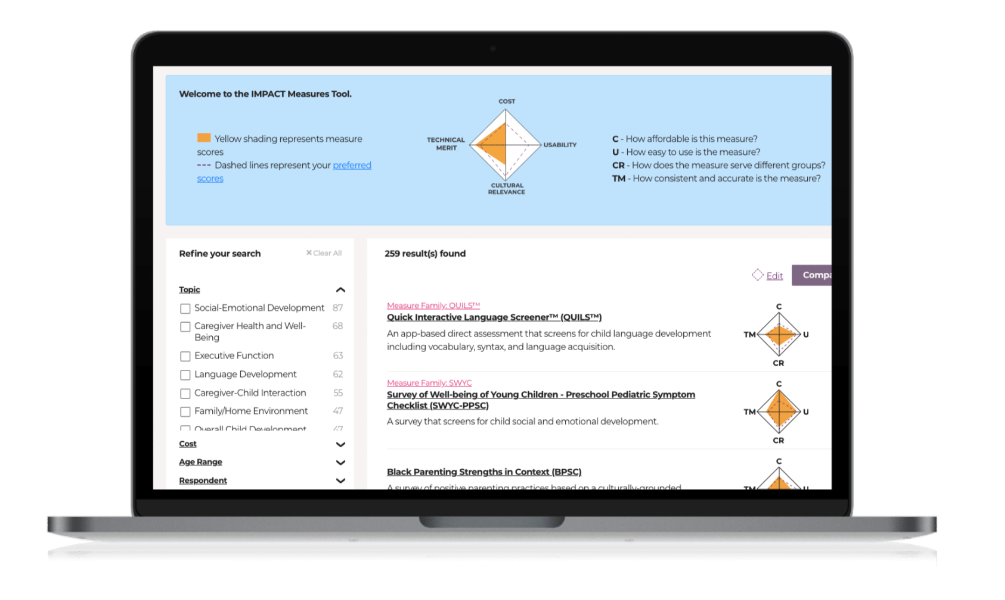
The IMPACT Framework was developed using the key concepts of the IMPACT Measures Tool®, our free measurement database of hundreds of early childhood and parenting assessments, which uses our science-backed scoring system to evaluate the strengths of each measure in different contexts. This website was created to empower the early childhood field to make informed decisions around measurement, to benefit the children and families they serve.
| |
|
The Four Scores of the IMPACT Measures Tool®
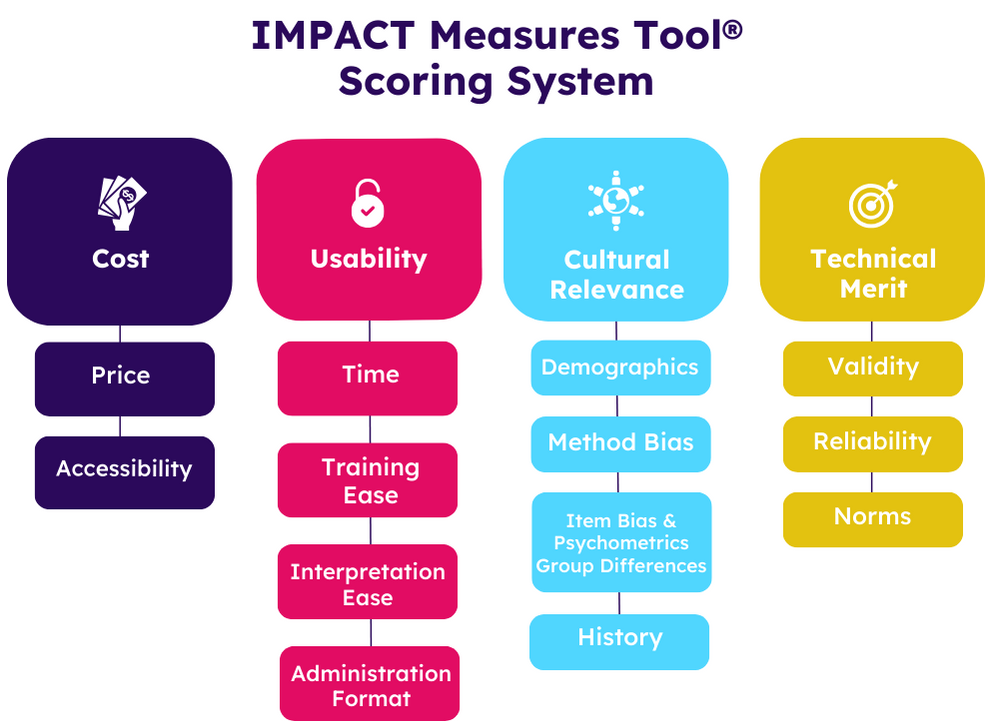
Four key components which determine the quality and fit of an assessment are: Cost, Usability, Cultural Relevance, and Technical Merit.
Cost: Determined by how affordable the measures is, and how easy it is to access.
Usability: How easy it is to administer a measure and to interpret the results.
Cultural Relevance: The extent to which measures are developed with different communities in mind, and the steps taken to prevent or address measurement bias.
Technical Merit: How consistent and accurate a measure is.
| |
|
Cost: The First Component of a High-Quality Measure
The Cost score of the IMPACT Measures Tool® refers to the affordability and accessibility of the measure. The cost of a measure can vary widely depending on the measure type, how it is administered, the materials and training required, and more. For many programs and organizations, cost is a primary factor when considering whether or not to use a measure. Despite this, it is not always easy to determine the entire cost of a measure given the many different components with various expenses. When determining cost, the areas of Price and Accessibility are important to consider. The overall Cost score of the IMPACT Measures Tool® incorporates these two concepts and helps to bring transparency and ease in understanding the comprehensive cost of a measure.
1. Price
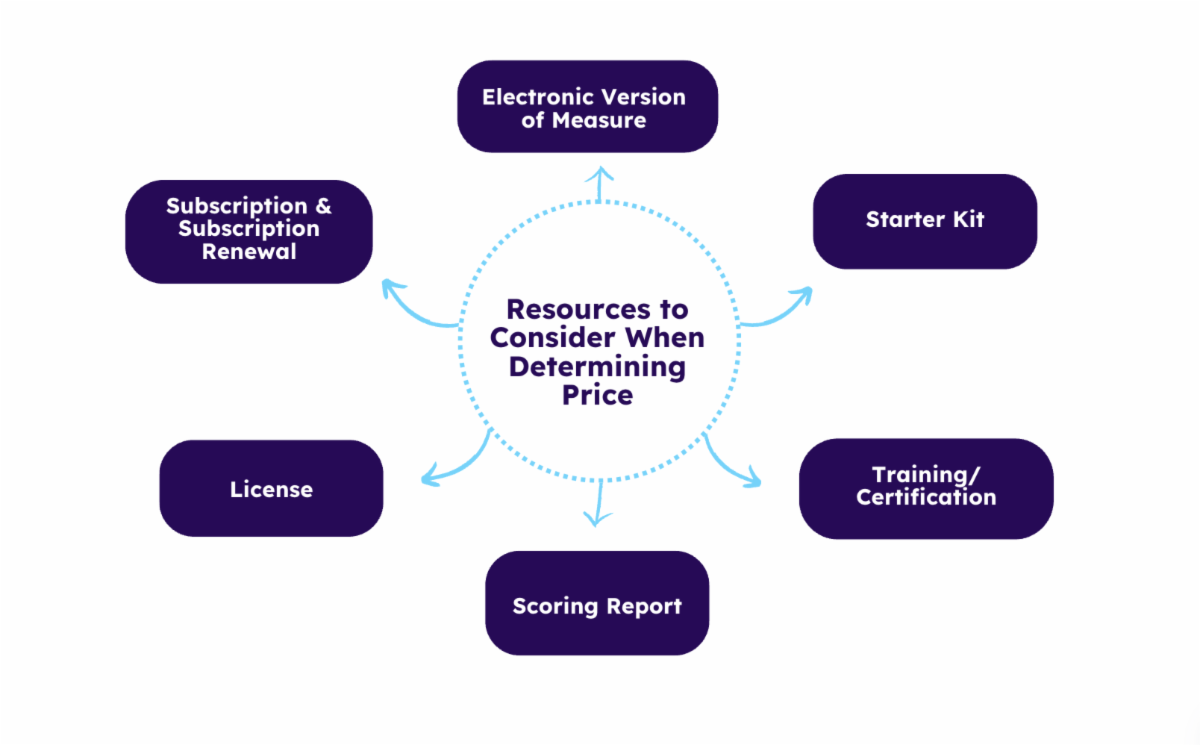
Price accounts for the actual monetary cost of the measure. There can be expenses associated with many different components of a measure including copies of the measure itself, a starter kit or manual, training expenses, and licensure or subscription fees. Some measures have a one-time fee while others may have fees that are ongoing. It is important to consider all sources to have a comprehensive understanding of the price associated with using a measure.
| |
|
2. Accessibility
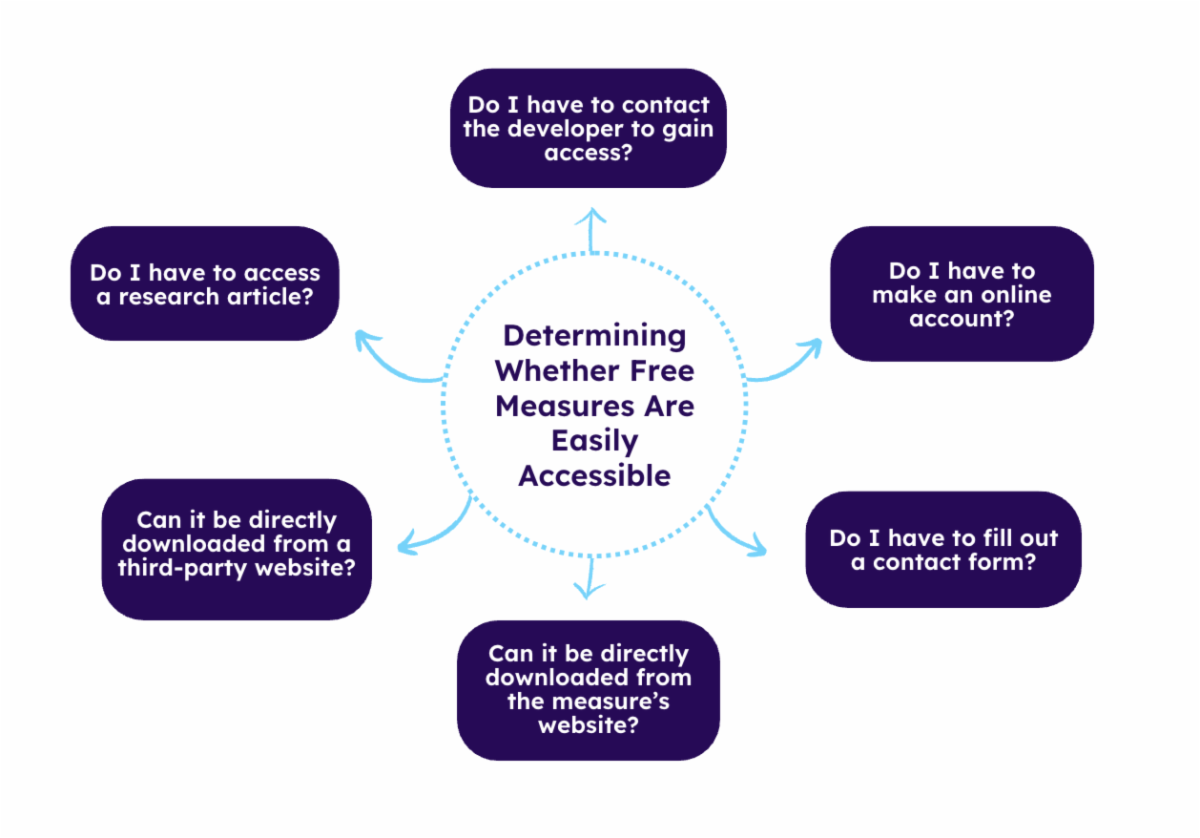
Some measures are free, but they still can be difficult to access. If a measure is free but difficult to access, there is a “cost” associated with the time and effort it takes to acquire the measure. For example, some measures can immediately be downloaded for use while others may require an account login or access to a published research article. To understand the full cost of a measure, accessibility is an important factor to consider.
| |
|
Guiding Questions to Consider
- What is my overall budget for purchasing measures?
- Will my budget remain similar over time?
- Do I have the ability to pay ongoing expenses if necessary (e.g., subscription fees, re-ordering paper copies of questionnaires)?
- Do I have the ability to pay/purchase initial start up costs if necessary (e.g. computers, tablets, internet subscriptions, etc.)?
- If training fees are associated with the measure, how many people need training? Are there ongoing re-certification costs I need to budget for?
- What is the current cost/budget for assessment? Has it been appropriate? What resources do I have to obtain assessments and/or assessment services?
- What are my organization’s administrative priorities and budget for assessment?
- What concerns does my team, supervisor, organization, or system have about cost?
- How are cost and budget for measures related to my understanding of equity-centered assessment?
| |
|
Takeaways
As an early childhood professional, you hold significant skills, knowledge, and responsibility in serving as connective fibers in your economy, systems, community, and with families. Your experience is critically valuable, and The Institute for Child Success seeks to center this experience in systems change to promote child-centered and equity-centered measurement, assessment and evaluation. Through lived experience, early childhood professionals and programs have amassed and cultivated the tools to meet the diverse needs of children and families in both stable and trying times.
The IMPACT Measures Tool was created to serve early childhood professionals such as yourself, so you can harness your own power in assessment, measurement, and evaluation. In developing an understanding and mastering the measurement concepts used to develop The IMPACT Measures Tool, you can tell your own data story to promote child-centered assessment and equity-centered systems change.
Download the free IMPACT Framework guide for more detailed information about each scoring category, as well as a full list of questions to guide your selection of high-quality measures to use with your community.
| |
Looking for measurement support? | Are you or a colleague looking for support in assessment and measurement? For those who are seeking additional support, we offer personalized consultation services in measurement and evaluation. | |
| |
|
|
Have you used the IMPACT Measures Tool or resources to support your work? Share your story with us!
Email khammond@instituteforchildsuccess.org
or connect with us on Facebook, Twitter, and LinkedIn.
| |
|
IMPACT is a suite of tools and resources to help support the measurement needs of the early childhood field, including the IMPACT Measures Tool, a repository of early childhood and parenting measures. In addition to our Measures Tool, our IMPACT offerings also include educational content such as videos, articles, and practical tools, which you can explore on our website.
For more information on using IMPACT, watch our tutorial video.
| |
|
Have questions about early childhood measurement? Know of an exciting innovation in this area? Let us know!
Email aduncan@instituteforchildsucces.org to connect on all things measurement.
| |
We would like to thank the Pritzker Children’s Initiative, Overdeck Family Foundation, Valhalla Foundation, the Heising-Simons Foundation, and the Brady Education Foundation for their generous support of the IMPACT project, which has made our work possible. | |
|
ICS works on behalf of children from prenatal to age 8.
You can support our work by helping to
fund our research and advocacy.
| | | | |