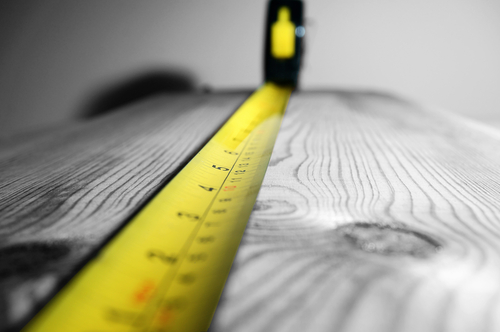
In the past 20 years I have done a fair amount of design and construction outside the US. Originally it was design and construction in the Middle East and Central Asia during the all-expense paid trips by the US Air Force, and then with container building construction in various locations around the world. All those designs were done in Metric, or SI system. Going back to our Imperial Units here in the US has been irritating, because compared to SI, they are a royal pain.
Metric is easy to work with. Distance measurements are reflected in meters. A centimeter is 1/100th of a meter, a millimeter is 1/1000th. Imperial measurements you get feet and inches. Inches are divided into fractions, not 10ths or 100ths. You have miles (5280 feet) instead of kilometers (1000 meters). There are more obscure and archaic measurements you run into for surveying, like chains or perches (66 feet) and rods (16 ½ feet). Oh, and we must not forget acres (43,560 feet). How did we get such a mess, and is the Imperial System really that bad?
I have some old engineering manuals, and they explain it well. For a start, there is a good reason we use the Imperial system. Until the Metric system was developed, measurements in Europe were a mess. Distance measurements not only differed from country to country, but they would often vary village to village. Not so in Britain.
The British Empire had established standards for its measurements and applied it in all its colonies. Looking back to the end of the 18th century, that was very extensive. It was not only us; it was the Caribbean (a vital area in our trade), parts of Africa, and India among other places. It was as close to an international system as you could get. So, when we achieved independence, it made good sense to keep the system, although Thomas Jefferson was in favor of the new metric system. We have tried to convert to that in fits and starts since. Today, we are close, with our automobiles and other machinery in SI, groceries in dual units, things like soft drinks sold by the liter, scientific and medical measurements in SI, NASA and the US military in SI.
The question comes up, why are Imperial units the way they are? Why aren’t they simpler, like Metric? It all has to do with how they were developed, and whole numbers. Measurements included in Imperial have roots back to Roman times, and further back. They have been developed for specific uses, rather than general. For example, the acre is how much land a horse could plow in a day. That was important if you owed your lord so many days labor a week. How much area should he expect you to plow?
The chain was developed for surveying. Until fairly recent times, surveyors measured land with a 66-foot chain, divided into 100 links. 80 chains gives you a mile. 25 links gives you 16 feet 6 inches, or a rod. 10 square chains gives you an acre. A mile divides neatly into 320 rods. While all these different units look confusing, they allow a surveyor to keep whole numbers and do hand calculations quickly. When I worked in Burlington Township, NJ, the customary width of a road was 2 rods. That is 32 feet, which allows two 12-foot lanes, and four feet on each side of the road for shoulders. A road in a subdivision was two rods, which allowed room for parking on the sides of the road with room for traffic to pass. The Imperial system made everything simple to work with.
In surveying, the foot is divided into tenths and hundredths to make measuring simple for that purpose. When we get into work where measurements are often less than a foot, inches get to be used, like in building construction. Having 12 inches in a foot allows you to divide the foot up into more segments with whole numbers than if you divided your foot up into tenths. In tenths, you only have 2 and 5 evenly divisible, in twelfths, you have 2,3, 4 and 6. If you are measuring a side of a property that is 130.24 feet, that’s not a big issue. If you are measuring a wall thickness, it is much easier to use 8 inches instead of 0.67 feet (or if inches were in tenths of a foot, 6.7 feet). Traditionally, inches are divided up into fractions that the denominator is in powers of 2. Like ½, ¼, 1/8, 1/16, and so on. Again, we can get into smaller and smaller measurements without getting into messy numbers and hand calculations are easy. A carpenter laying out framing can do all the calculations in his or her head and the numbers do not get messy.
It goes the same with all the other measurements in volume and weight. The system is worked out to allow division of measurements that allows you to avoid fractions and do easy calculations. So, when you look at it from that standpoint, the Imperial System is OK.
However, the strength with the SI system is it only uses a few different measurements, meaning we are not dealing with furlongs, rods, chains, feet, links, and inches for lengths. Moving everything to decimal measurements allows you to do that, which simplifies it. Since we are breaking down the measurements into very small decimals like millimeters, milligrams, milliliters, we are avoiding fractions. Also, since the system is used worldwide, it gives us the ability to work with the same units everywhere.
Will we go totally Metric in the US? It will be hard because of our legacy measurements. We have got highways with standard 12-foot lane widths. Walls built with 8” wide block. 2x4’s used in wood construction – translating those to Metric is messy. For example, those 8-inch block will be 203 millimeters. In Canada, they are still using Imperial units for building construction because of that. It is just not going to be easy to do a total conversion. Someday in the future our temperatures may be in Centigrade, distances will be in kilometers, and we will purchase liters of milk. We are still going to be using 2x6’s and 2x4’s for lumber, 8-inch block, 10-inch beams and so on. I feel confident that we will use Imperial measurements in construction of buildings, pipelines, and roads for a very long time.