December 17, 2020
Top stories
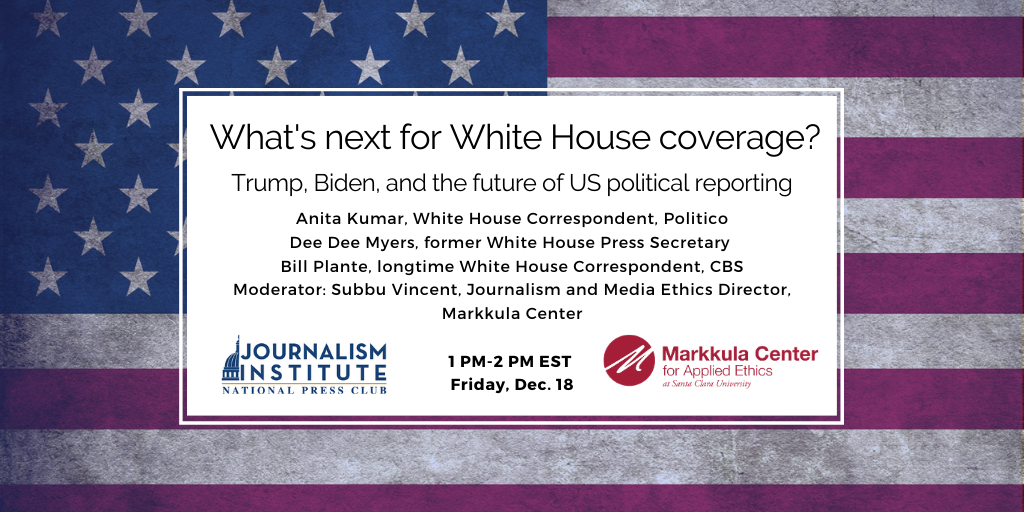
As president-elect Joe Biden prepares to lead a deeply divided country, what’s next for White House coverage? What can past coverage and recent experiences teach us about envisioning a better future for how journalists cover the president, and how Americans understand the United States?

Register now for this program, a partnership between the National Press Club Journalism Institute and the Markkula Center for Applied Ethics at Santa Clara University, which will address these topics.

Date: Friday, December 18, 2020
Time1–2 p.m. EST / 10–11 a.m. PST

Joining us with lessons from their firsthand experiences with the White House press corps are current Politico White House Correspondent Anita Kumar, former White House Press Secretary Dee Dee Myers, and longtime CBS White House Correspondent Bill Plante. The program will be moderated by Subbu Vincent, director of Journalism and Media Ethics at the Markkula Center for Applied Ethics.
Advice from Jill Geisler,
Bill Plante Chair in Leadership & Media Integrity, Loyola University Chicago
Freedom Forum Fellow in Women’s Leadership

If experience is a great teacher, then our annus horribilis was a graduate course in leading through change and challenge. 

Consider this column a commencement address for the Leadership Class of 2020, recognizing the good work accomplished, the stress endured, but most important: the lessons learned.

Here are ten of them, dear graduates:

  1. When it comes to moving entire news operations (especially broadcast) to remote production almost overnight, we put MacGyver to shame. Kudos to every behind-the-scenes engineering, digital and security specialist. 
  2. We now understand that the sheer need to survive professionally can lead people to learn technology and tools they had previously avoided. It doesn’t mean we should use fear as a training method from now on; urgency and support are the powerful combination.
  3. Our colleagues are resilient, but they aren’t unbreakable. It’s essential to lead with empathy, plan with understanding, and keep the physical and mental health of our staff a priority.
  4. As they work remotely, the home lives of our colleagues are in view as never before, opening up a window to them as people, not just producers. Family members, partners, and pets are in the picture. Even when people return to newsrooms, we need to keep that window open.
  5. Companies that refused to let people work from home in the past now realize they were short-sighted. They may have missed hiring or retaining great people, especially women, who asked for nothing more than to prove they could make it work. Now we know they can.
  6. Saying “Black lives matter” doesn’t compromise a journalist’s objectivity.
  7. Saying “Black lives matter” can’t be simply performative. It needs to represent the depth of work that organizations are willing to do to purge racism and inequity from their infrastructure. It takes more than pledging to recruit more vigorously and promote more underrepresented journalists to leadership. We set people up to fail if we drop them into the very cultures, systems, budgets, protocols and assumptions that have enabled the core problems.
  8. Our youngest employees have deep concerns about social justice. They’re not alone in that, but they often are seen as the least knowledgeable. Veteran colleagues need to respect their voices, rather than frame their objections to the status quo and their push against “both sides-ism” journalism as youthful idealism or naivete. We will lose them if we don’t listen to them.
  9. Working at a distance from each other demands extraordinary communication skills of leaders — and of each other. Our bonds are built over time by shared experiences in the field, often over hot coffee or frozen toes. During boring drives and thrilling chases for exclusives. In edit bay gossip sessions and lunchroom birthday parties. When we don’t have those in-person moments, our ties can weaken along with our teams. It’s on all of us to be intentional communicators, especially for our newest co-workers.
  10. Journalists were the early targets of attempted delegitimization by political partisans. This year, public health and election workers faced the same assault, only underscoring our continuing responsibility to present and support evidence-based information. 2021 presents boundless opportunities for just that.

Class of 2020, you have led journalism in a year like no other. You took care of good people. You nurtured great journalism. You’ve probably taken only a fraction of your vacation time, if that.

Please take good care of yourself. We need you even more in the year ahead.

Click here to read Jill’s previous posts.
Throughout 2020, journalists across the country have shared their best practices for working through the pandemic. As we approach 2021, we’re asking what they learned this year and what they hope to learn in the year to come. 

NameAnna Pogarcic 
Current job: Editor-in-chief, The Daily Tar Heel, University of North Carolina
Previous Institute Q&AsOne Vote NC, a student news collaborative made up of seven college newspapers in North Carolina; The Daily Tar Heel’s infamous “clusterf–k” headline

What are the main lessons you learned this year from your reporting that you’ll use next year?

Pogarcic: We’ve had two main takeaways: Communication is key, and you shouldn’t justify things by saying “this is the way we’ve always done it.” This was our first year of having remote production be the norm and many of our staffers weren’t even in Chapel Hill, so we learned to be intentional about communication to make sure everyone was included. And even beyond that, we really had to rethink the way our newsroom worked. Because we’re a college paper, a lot of our readers also weren’t in Chapel Hill, so we couldn’t mostly rely on our print paper anymore. Having to question what we were doing and think about how we could do it differently taught us how to be adaptable.

How did your work change during the pandemic?

Pogarcic: The biggest thing for us was the shift to remote production. As a college paper, our office on the main street in Chapel Hill is our heartbeat for our student staffers. But this year, staffers weren’t allowed in because we felt it was too big of a risk to everyone’s health. Our work is highly collaborative, and it felt different to have to work together virtually as opposed to sitting next to each other in the office.

While it felt strange and was a challenge, we had no choice but to adapt, and I think we’re better off for it. Being virtual means we’re more accessible, and it also helped us think about news in a digital-first lens.

What do you hope to learn or cover in the coming year?

Pogarcic: The big thing for us is going to be how the spring semester compares to the fall. Will UNC have to send students home again? Will we see cases rise in Chapel Hill and across the state? How else could college life change? Our university adjusted its testing and re-entry plan for the spring, but we’re still seeing a lot of pushback from the community, students, and staff. It will be interesting to see how it plays out and what we learn.

How are you taking care of yourself now that you weren’t at the beginning of the pandemic?

Pogarcic: Being a student journalist is hard, and I’m just glad next semester is my last semester of college and I only need to take two more classes. It can be hard to handle everything with so much going on with classes and work and life, but I try to find joy when I get a chance to pause.
The next generation of journalists graduated in 2020 into a challenging job market unlike any other. We spotlighted them this summer, shared advice from their role models, and are checking in with them this month to see where they are now and what they’re learning about journalism. 

School: University of Houston-Clear Lake
Current status: Working on teaching certification in Texas
Career goal: To teach journalism

Where are you working right now? Is the position full-time, part-time or an internship?

Ruiz-Peña: As of now, I am working on getting my teaching certification in Texas. I want to eventually teach journalism, but for now I feel called to teach upper elementary. Being a teacher has always been a dream of mine, but I gave up on it years ago. I initially began college with the intent to become a teacher, but life happened and I was led to transition into communication/journalism. That path built up my confidence and allowed me to learn more about who I am as a person and leader. Then the pandemic hit and life sort of stopped and changed. It left me with a lot to reflect on and ultimately led to the decision to resurrect my dream of teaching. 

What’s the biggest lesson you’ve learned on the job search?

Ruiz-Peña: I’ve learned that the amount of awards won and skills you list on your resume is not always enough. Especially now in this time of COVID, there are employers seeking skilled and seasoned journalists. This can make it harder for those of us fresh out of college. 

Have your journalism goals changed since graduation, and if so how?

Ruiz-Peña: They have changed only slightly. I knew eventually I wanted to teach journalism, but it seems to be coming into fruition closer than expected! 

How are you taking care of yourself and staying motivated right now?

Ruiz-Peña: Lots of prayer, time walking around, staying busy and remembering my goals. 

This newsletter is written & edited by the National Press Club Journalism Institute staff: Beth Francesco, Holly Butcher Grant, and Julie Moos. Send us your questions and suggestions for topics to cover.

Get this from a friend? Subscribe, and view the archives.