|
This is part of a series highlighting Heritage Consulting Group projects in celebration of America's semiquincentennial. Our work in commercial real estate unites our love of history and architecture with building reuse. Our best projects uncover fascinating facts about the buildings we are working on and the communities that they are part of. Let's celebrate #America250 together through the lens of historic preservation.
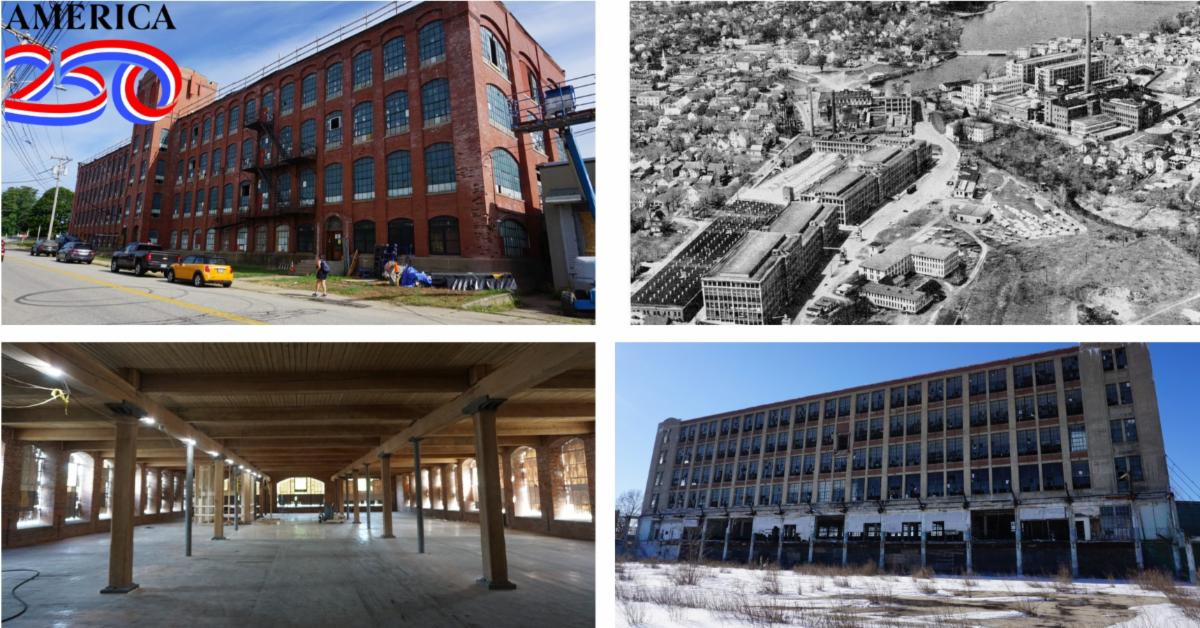
Today we have another look at industrialization with Jagger Mill and Goodall Worsted Mill in Sanford, Maine. Project Manager Caitlin Teare was struck by the economic legacy embodied by these buildings, representing nearly 200 years of industrial history along the banks of the Mousam River. The closure of mills since World War II has hurt Sanford economically, like many small manufacturing towns/cities. This rehab will not only save examples of an important local building type but will give the community an economic shot in the arm.
Starting in the early eighteenth century, sawmills and grist mills were built to serve local customers. In the nineteenth century the economy broadened with the opening of textile mills whose products were shipped to distant markets. George and Louis Goodall and Henry Hodgson founded the Goodall Worsted Company in the 1890s to help diversify the local economy.
Goodall Worsted produced alpaca worsted cloth for coat and dress linings and later a mohair-cotton blend that was popular for summer suits. The company grew rapidly. By 1900, it occupied twenty buildings, employed 850 individuals, and produced goods (wool fabric and worsted and mohair yarns) valued at $1.5 million annually. At its peak, the company had over 4,500 employees. Both the Jagger Mill and the Goodall Worsted Mill – Tower A were built during a company expansion c. 1920.
While the Maine textile industry slowed dramatically after World War II, the surviving buildings illustrate its storied history and importance to the community. Conversion to multi-family housing will create over 200 new dwelling units and ensure that the former mill buildings have a productive use as they continue to serve the community in a new way for generations to come.
|