Aug. 26, 2025

Top stories

■ Public broadcast cuts hit rural areas, revealing a political shift (New York Times) 


■ Judge orders Kari Lake to answer questions about Voice of America under oath (NPR) / ‘It appears a new reduction in force is imminent at the U.S. Agency for Global Media. In a court filing today, the government revealed that retention registers were sent to unions ahead of a new RIF. The previous RIF sent in June was rescinded due to administrative errors.’ (Scott Nover)


■ Mario Guevara: Judge to hear case of Atlanta journalist held by ICE (FOX 5 Atlanta) / As ICE arrests surge, a journalist in Southern California covers raids in her own backyard (KQED) / The student newspaper suing Marco Rubio over targeted deportations (The Intercept)


■ Reuters and AP issue joint letter to Israeli officials to demand clear explanation for airstrikes that killed journalists in Gaza (Reuters) / ‘We are painted as targets’: How a secret Israeli unit puts Gaza journalists in the crosshairs (FRANCE 24) 


■ Fox and Fox News at risk of being pulled from YouTube TV in carriage dispute (Hollywood Reporter) / YouTube hits six consecutive months as top TV distributor (Hollywood Reporter)


■ ‘NewsNation, America’s fastest-growing cable news network in total day viewership, today announced that it will launch a new weekend show hosted by author and journalist Batya Ungar-Sargon … will air Saturdays at 4 p.m. ET.’ (Justin Baragona)


■ Penske sells TVLine to Static Media (The Wrap)


■ ‘The Wall Street Journal’s internal shake-ups have opened the door for CNN, which is luring away some of its most formidable newsroom leaders.’ (Status)


■ The Chicago Reader finds new life with new buyer: ‘I’m grateful that it’s going to have a future’ (Chicago Tribune)


■ Mother Jones and Reveal announce several newsroom changes (Mother Jones and Reveal via Editor and Publisher) 


■ Signal Ohio joins wave of nonprofit newsroom unionization (Nieman Journalism Lab)


■ ABC News promotes Katie den Daas to SVP of global newsgathering (The Wrap) / Michael Atmore named editor-in-chief of Women's Wear Daily (Variety) / Michael Arnold to lead Indiana Public Media (Current) / Time taps Altman as executive editor (Talking Biz News) / Vaughn Sterling joins CNN as executive producer of The Source with Kaitlan Collins (CNN) / WSJ hires Mehta as news associate (Talking Biz News) / Massimo Calabresi joins Opinion (New York Times) / Tom Schad joins The Washington Post as the Washington Commanders beat reporter (Washington Post)


■ ‘Taylor Swift's Instagram post announcing her engagement to Travis Kelce has gotten over 1.1 million likes in less than 10 minutes. I assume this will become one of the most-liked and shared posts ever.’ (Sara Fischer) / ICYMI: I spent a year covering Taylor Swift's Eras Tour around the world. Here's what it was like. (USA TODAY)

The Global Business Journalism Program is hiring a co director for job seekers looking for an exciting educational experience at a top university in China Apply now

The International Center for Journalists is seeking a co-director for the the Global Business Journalism Program at Beijing’s Tsinghua University – China’s most prestigious university. Learn more and apply here.

CRAFT

How journalists can use arrest data to cover the federal takeover of D.C. law enforcement


By Holly Butcher Grant


The federal takeover of D.C. law enforcement has unleashed confusion and fear among its residents and visitors. 


So far, more than 2,300 National Guard members have been deployed to D.C., now carrying firearms. And arrests have surpassed 1,000 since the takeover began.  


While the Trump administration touts this move as a way to combat crime, questions about its impact and necessity remain. For journalists covering the federal military presence in D.C., there are several avenues to accessing the information needed to answer these questions.

The D.C. Open Government Coalition recently published a memo and a primer on government transparency, citing statutes like D.C. Code § 5113.06, which requires that D.C. arrest records be made available to the public. 


To learn more about how journalists can contextualize the federal takeover and arrest data, the Institute interviewed media attorney Robert Becker, who is a board member at DC OGC.


This interview has been lightly edited for length.


What are some of the barriers to information that journalists covering the federal takeover are facing right now?

Becker: The biggest one is getting the information because it's all over the place. The arrest books are public by statute under Metropolitan Police Department (MPD) orders in the districts. [Editor’s note: There are seven police districts in Washington, D.C.] 


This means that somebody has to go traveling around to each district to get all the arrests. The books are supposed to include 30 days worth of arrests. That's a lot of work. No single news organization probably has enough reporters here to go traveling all over the city to get the information. 


As for what happens after arrests, there are a lot of open questions. One place you can find out is if you go to Superior Court in Courtroom C-10 where the arraignments are held, there should be a lockup list for the day. That will have some of the information. 


As for the federal arrests, that information is supposed to be given to MPD to include in the arrest books. Is that happening? I don't know. Under the general orders, the rule says that when an arrest is made in the District, the law enforcement agency is supposed to tell MPD. The statute clearly says that. So if they're doing that, then MPD’s arrest books should show what's out there. 


MPD traditionally has been a black hole in terms of FOIA. They don't like to give out information to anybody about anything. But this isn't FOIA. You have a right to see this the day it happens without having to make a FOIA request.


Let’s quickly talk about FOIA since FOIA officers have been impacted by the sweeping federal layoffs earlier this year, causing even more delays in open-records requests. What are some ways that journalists can work around these roadblocks?


Becker: I would try and not look at this as a FOIA situation. If you file a FOIA request, they have 20 business days to respond. These arrests that are being made now are public record because they have historically been public. Arrest logs and incident logs have historically been public at the police station. The police blotter is a tool that reporters have used for at least the past 100 years. So you want to avoid the FOIA situation with these arrests, which means somebody's got to go down to the police districts and get the records. 


This may be one of those situations where a bunch of news organizations get together and divide up the labor just to get the data and collect records from all over the city and the court. It may be the most efficient thing for some news organizations to say, we'll go to the First District. You go to the Second District. Then get the information and cover what's going on in the courthouse.


The public's right of access is protected by the First Amendment. You can just go into the clerk's office and say, “We want to see that case.” If you can get the docket numbers, you can go into court view in the Superior Court and look at the cases there. You can go into Pacer and look at federal cases. So those things you can get that way. 


And as for the arrests, the best way to get that information is really to insist that they live by the statute and their rules.


What other advice do you have for journalists when they are being stonewalled in their records requests?


Becker: If they don't get the records, if they go to the district offices and they're told they can't see the records, then they need to very vocally say MPD is violating the law. 


Reporters are notoriously bad at advocating for themselves. They don't want to be part of the story. That's why when I was with the Reporters Committee for Freedom of the Press, I tried to do that for some of them. 


But if you're being denied access to stuff that you are entitled to, it's time to speak up and say, we tried and we have been refused. That's the most effective thing you can do.


Many organizations are either reluctant to sue or can't afford to sue to get information. But if a pattern starts to develop, talk to RCFP about whether they can do something to try and push this along.


If journalists witness an arrest or raid, what should they do if they are met with resistance when reporting? 


Becker: They can record what is happening with cameras, with cell phones — the general orders very clearly say that the public can record cops doing their jobs. 


As for asking questions, it's just the usual things: Who, what, when, where, why, and how? What was this person charged with? Which court are they going to be taken to? 


This is happening in such an irregular way, so first of all, who is doing the arrest? Do you know? Are they wearing enough insignia to even know who's making the arrest? That's a basic issue, and how many is it? Is it a immigration thing? Is it a criminal thing? That's all valid, perfectly valid questions to ask. 


Just ask the questions. You might not get the answers, but there's no harm in asking the questions.


As this story continues to evolve, how can journalists keep their audiences informed while also avoiding the spread of misinformation? 


Becker: One of the reasons I wrote that memo was that in the first week of this fiasco, what I was seeing was numbers coming out of the White House like, “X number of arrests happened today.” This was not saying anything about the fact that nearly half of the arrests were immigration cases.


If you look back at the previous 30 days, are these arrests any better or any worse than MPD does on a daily basis? That begins to tell you whether this is really doing anything. Is it? Where is the crime really happening? The crime isn't happening on the National Mall. So if the National Guard is on the Mall, then what's that doing for crime in Anacostia or Northeast? 


Keep the context there. Make sure that you indicate that the same day last year, MPD made the same number of arrests. Or more arrests. Or less arrests. And got X number of guns off the street. 


This context going back will be difficult, because, as I said, the arrest books only show 30 days. But the perspective of whether this is any better — or worse — than what happened before is crucial. What would have happened if none of these people had come to D.C. to do law enforcement?

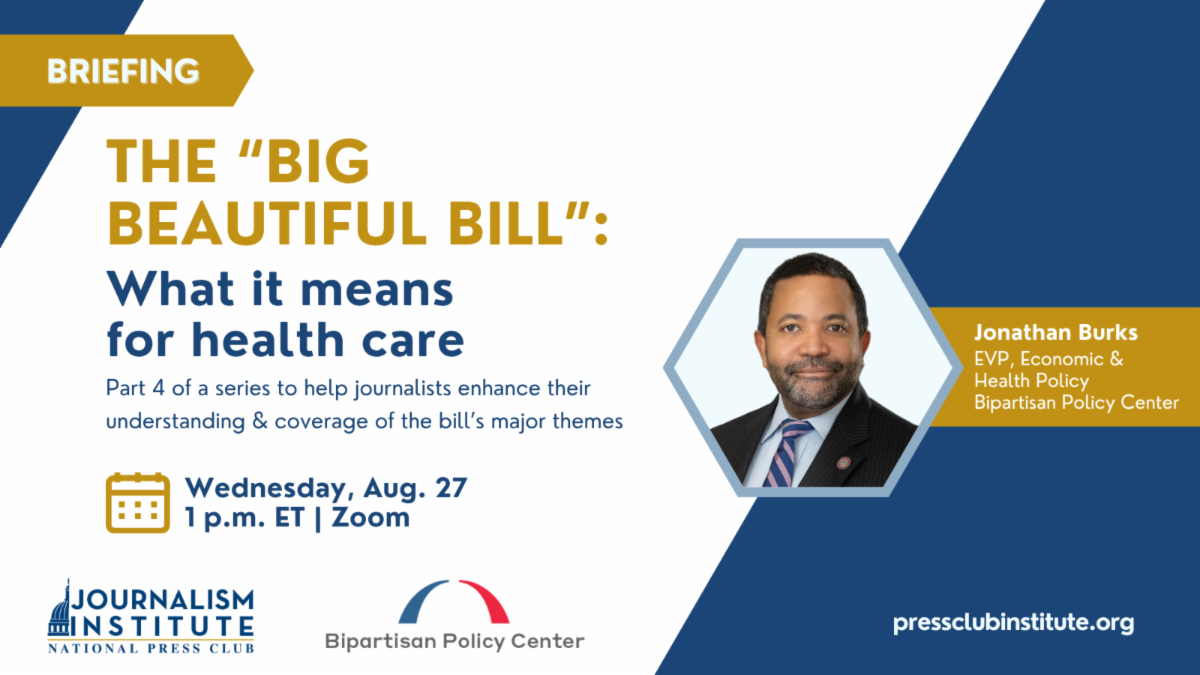
Join us tomorrow at 1 pm ET with the Bipartisan Policy Center to learn what changes the new law makes to both Medicaid and Medicare. This free webinar will also look at the funds allocated toward health care in rural communities and changes to qualification requirements for food stamps.  

CAREER
 

Career office hour, Sept. 2


The Institute is supporting job-seekers by offering free career office hours every other week to help journalists with all parts of the job search process. 


These virtual sessions are designed to offer practical skills and tips for journalists looking for work, as well as a sense of community and comfort during what we know can be a deeply difficult time in one’s life.


The next session is on Tuesday, Sept. 2, from 11 a.m. to noon ET. Sign up here:

Note: To ensure everyone attending has the best experience possible, we’re limiting registrations for each session to 30 people, so we encourage those who are interested to sign up early. Journalists are welcome to sign up for as many of these sessions as they want.


COMMUNITY


Resources

This newsletter is written and edited by the National Press Club Journalism Institute staff: Beth Francesco, Holly Butcher Grant, Elliot C. Williams, Allison Prang, and Mitch Harle. Send us your questions and suggestions for topics to cover.


Get this from a friend? Subscribe, and view the archives.

Facebook  X  Linkedin  Youtube  

DONATE TO THE INSTITUTE


The National Press Club Journalism Institute promotes an engaged global citizenry through an independent and free press, and equips journalists with skills and standards to inform the public in ways that inspire a more representative democracy. As the non-profit affiliate of the National Press Club, the Institute powers journalism in the public interest. The Institute's tax ID number is 52-1750908.