Nov. 4, 2026

Top stories

■ Candy and smiles on MS NOW, and some regrets on Fox News (New York Times) / Trump blamed Fox News for Republican losses even as network’s hosts went easy on him (The Guardian) / ‘Ahead of his election night marathon, NBC News’ data chief spoke to Status about navigating the polarized media landscape, the rise of prediction markets, the possibility of a polling miss, and more.’ (Status) 


■ ‘NBC News was #1 last night across television, per Nielsen fast nationals. And Kornacki was #1 livestream on YouTube.’ (Dylan Byers) / ‘Average prime time viewership for the 6 biggest networks on election night: NBC: 6.52 million; ABC: 4.91 million; CNN: 3.93 million; MS NOW’ 3.92 million; Fox News: 3.88 million; CBS: 2.63 million’ (Brian Stelter) 


■ Abdul El-Sayed has heated exchange with Sky News reporter (Variety) / SF journalist says they were banned from Wiener Election Night watch party (KRON4) 


■ Democrats just took the House and the Senate. Get ready for a whole lot of media investigations. (Hollywood Reporter)


■ ‘We are a threat to Putin’: The small Norwegian news outlet with half its staff on Russia’s wanted list (The Guardian)


■ The New York Times adds 420,000 digital subscribers (New York Times) / New York Times faces AI questions as digital subscriber growth shines (TheWrap) 


■ How a historic Harlem newspaper is reimagining its headquarters (New York Times) 


■ Paxton Media Group acquires Louisiana State Newspapers (Connersville News-Examiner)


■ ACBJ laying off staff photographers (Talking Biz News)


■ Renee Shaw appointed CEO of KET (Current) / Wait joins Engadget as editor (Talking Biz News) / Hearst TV station reveals a new morning anchor lineup (NewsBlues.com) / Meet our new FOX26 reporter, Finnley Pendergast (FOX26) / ESPN NFL reporter stepping away to deal with ‘medical stuff’ (PennLive)

 
CRAFT
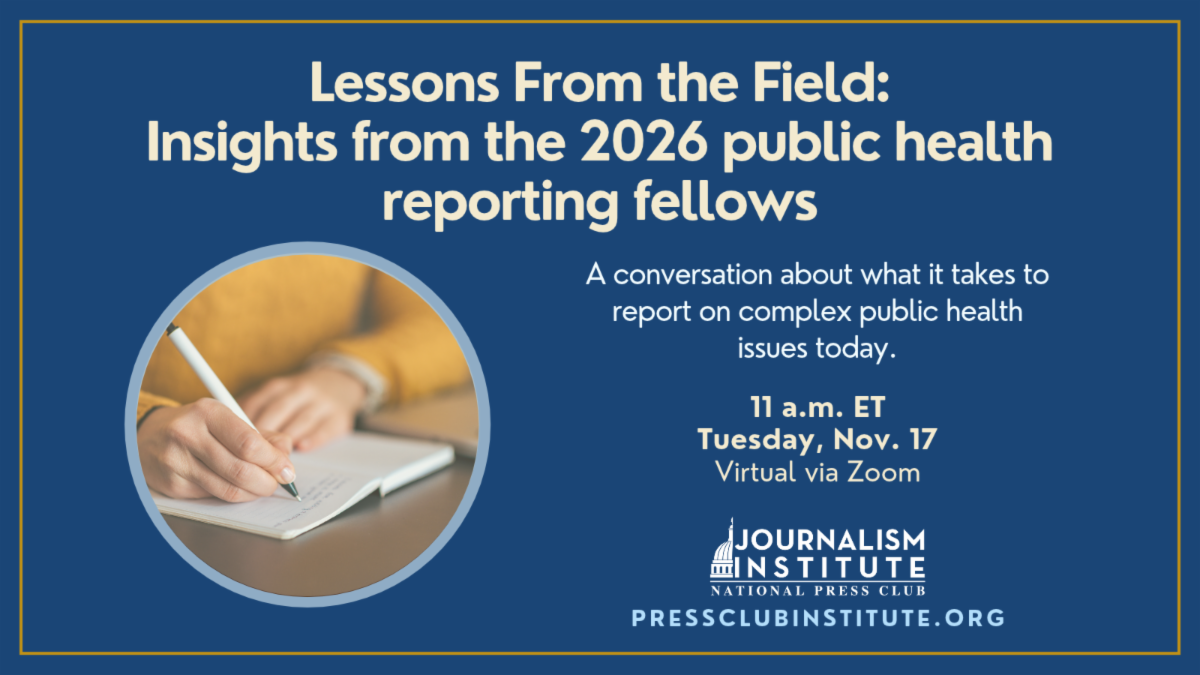
Lessons From the Field: Insights from the 2026 public health reporting fellows. A conversation about what it takes to report on complex public health issues today. 11 a.m. ET Tuesday, Nov. 17 Virtual via Zoom.

Lessons From the Field: Insights from the 2026 public health reporting fellows


Join us for a conversation about what it takes to report on complex public health issues today, from identifying trusted sources and navigating data challenges to engaging communities and translating science for broad audiences.


🗓️ Tuesday, Nov. 17 | ⏱️ 11 a.m. ET | 📍Virtual via Zoom | 🎟️ Free


This free panel discussion will spotlight the work and experiences of the 2026 Public Health Reporting Fellowship cohort, bringing together six journalists to share the reporting strategies, resources, and lessons learned from their fellowship journey.


Meet the fellows


  • Maea Lenei Buhre is a general assignment producer for PBS NewsHour. Buhre’s project explores the long-term environmental health and mental health impacts of the 2023 wildfires in Maui, with a focus on residents’ access to care. Watch here.
  • Cassie Chew is an independent journalist. Chew’s project focuses on the coming adult autism services surge, using Illinois as a case study to examine gaps in services, disparities in access, and the human consequences of a system that largely stops at 21.
  • Whitney Downard is a reporter for the Pennsylvania Capital-Star. Downard’s project covers Pennsylvania’s experimentation with a new type of medical provider — primary care medics — as the state’s response to known shortages in licensed medical providers.
  • Olga Loginova is an independent environmental journalist and documentary filmmaker. Loginova’s project explores maternal and child healthcare and access to care among residents of Arizona colonias. Read the article in English here and in Spanish here.
  • Mark Rabago is a correspondent for the Marianas Press. Rabago’s reporting dives into the rates of cancer cases and access to healthcare in the Northern Mariana Islands, a U.S. territory. Read the first article in the series here.
  • Jayati Ramakrishnan is a reporter for The Seattle Times. Ramakrishnan will report on mental health-related wraparound services with a solutions-focused approach that ties in to the overarching need for systems of care. Read the article here.


Each journalist will share practical tips, tools, and resources that you can apply to your own reporting, along with insights from their fellowship projects and the challenges they encountered along the way.


Participants will learn


  • Apply reporting strategies and lessons from journalists covering a range of public health issues;
  • Discover new tools, sources, and resources to strengthen public health reporting; and 
  • Gain practical insights for navigating complexity, building trust, and telling impactful health stories.


This program is part of the NPCJI’s monthly webinar series produced as part of the Public Health Reporting Fellowship. In partnership with the Common Health Coalition, the fellowship offers training and financial support for mid-career journalists to complete reporting projects focused on the intersection of public health policy and health care delivery.

CAREER
 

Creating systems without a newsroom


“Whether you have left a newsroom recently, or a newsroom left you, the shock to the system is like no other. I remember when I left The Wall Street Journal. ... What my first 90 days taught me was the importance of creating an infrastructure for myself. Not branding. Not a personal manifesto. A boring system: a shortlist of outlets that fit my skills, a weekly pitch habit that I kept as the backbone to my activity, and a rate floor I wouldn't fall below. It was important to recognize that while the persuasive urge to fire out a billion emails every day was all powerful, I knew that a strong and rigorous system would keep me going for the long haul.”


-- Daniel Levitt, founder of Inside The Newsroom, excerpt from “The first 90 days without a newsroom” (Inside The Newsroom)


COMMUNITY

Resources


This newsletter is written and edited by the National Press Club Journalism Institute staff. Send us your questions and suggestions for topics to cover.


Get this from a friend? Subscribe and view the archives.

Bluesky  Instagram  Facebook  Linkedin  X  Youtube

DONATE TO THE INSTITUTE


The National Press Club Journalism Institute promotes First Amendment values by equipping journalists in Washington, D.C., and nationwide with the skills, knowledge, standards, resources and networks to empower and inform the public. As the non-profit affiliate of the National Press Club, the Institute powers journalism in the public interest. The Institute's tax ID number is 52-1750908.