Oct. 21, 2026

Top stories

■ Trump pushes to evict White House press corps (New York Times) / White House won’t deny Trump is eyeing press briefing room for indoor pool (TheWrap) 


■ WSJ EIC Emma Tucker defends attending a WH dinner with News Corp. executives, saying ‘I'm a journalist. I wasn't going to say no to a dinner with the president’ (Axios)


■ FCC chairman warns broadcasters that airing ‘fake polls’ could run afoul of ‘regulatory obligations’ (Deadline)


■ The Wall Street Journal’s new AI tool, ‘Doppler,’ forecasts the issues that will shape the midterm elections (Nieman Journalism Lab) / Alaska’s journalists join forces to cover the midterms (New York Times) 


■ Sen. Tuberville has journalist who questioned him kicked out of Alabama campaign rally (AL.com) 


■ Oregon Journalism Project retracts story on video featuring Washington County candidate (Willamette Week)


■ Neighbors reel after Bronx behemoth shutters community newspaper (The City Reporter)


■ ‘As the CBS News president meets with anxious staffers abroad, Status has obtained an audio recording capturing its foreign editor berating a reporter in a previous role at The WSJ, raising fresh questions about her management style.’ (Status)


■ WDRB and WAVE build the region’s largest news team to deliver ‘Local First’ journalism (WDRB+WAVE Digital Staff) / Washington Post hires Politi as economics editor (Talking Biz News) / NY Times hires Kay to cover Musk’s companies (Talking Biz News) / Alex Worthey named GM of WMNF (Current) / WNET plans new show to replace ‘Amanpour & Company’ (Current) / WPVI names Adam Joseph chief meteorologist following Cecily Tynan's retirement (NewscastStudio) / Minnesota Star Tribune hires award-winning reporter Sarah Todd to cover Timberwolves (Minnesota Star Tribune)


■ Nobody wants to talk about why The Ringer is pivoting to Substack (Defector) / Substack brings dynamic ad insertion to podcasts (Adweek) 


■ Video is now literally at the heart of The Sun newsroom (Press Gazette)

 
CRAFT

Midterm Coverage: What journalists need to know about the election workforce


By Kris Seavers, NPCJI Training Program Coordinator


To help journalists report on the high-stakes 2026 midterm elections, the Institute partnered with the Bipartisan Policy Center for a midterm coverage briefing earlier this year. 


BPC Elections Project Director Wren Orey offered insights into challenges that elections officials are facing this election season. Orey oversees BPC’s election administration policy and researches reforms to improve the security, accessibility, and trustworthiness of elections. 


When it comes to covering elections, Orey emphasized the importance of understanding the scope of the election workforce. They encouraged journalists to make an effort to build relationships with local election officials early — and not reach out for the first time amid the chaos of Election Day.


Elections are “complex and decentralized,” and Orey noted that the office size and policy for elections varies greatly from state to state and county to county. 


By the numbers, here’s what that looks like:


  • There are 10,000 chief election officials, including county clerks and municipal clerks, working across the U.S. 
  • State chief election officials — typically secretaries of state — are supported by 25,000 full-time staff.
  • In federal election years, 900,000 temporary workers join this force of workers.
  • The most common local election official is a white woman in her mid-50s with a college degree who earns just over $50,000 a year.
  • Seventy-five percent of local election officials serve just 8% of voters, mostly in rural jurisdictions.
  • Eight percent of local election officials serve 75% of voters in large jurisdictions like Los Angeles County, California; Fulton County, Georgia; and Maricopa County, Arizona.
  • Local election official turnover reached its highest level on record in 2024, which Orey attributed to underfunding of the Election Administration and the effect of technology on local election offices.


For additional elections resources, click here or watch the briefing:

CAREER
 

How to tune up your journalism resume


“A strong resume tells a concise, specific story about your career journey. It doesn’t simply state your job responsibilities. It provides examples that demonstrate how you go above and beyond to deliver the news.


Imagine if every reporter who covered city government wrote on their resume: Covers weekly government meetings, analyzes legislation and explains policy to readers, writes headlines and shares stories on social media. Or if every sports photographer wrote: Covers home and away games of professional sports teams, submits photos throughout games with accurate captions, ensures images are not blurry. How would hiring editors distinguish between these applicants? …


Describe how you landed a tough story, worked on an investigation, persuaded difficult sources to talk, filled in as a weekend breaking news editor, received an exclusive fellowship, created a newsletter that quickly achieved a high open rate or got the photo everyone couldn’t stop talking about.”


-- Cristina Silva, managing editor for operations and standards at The Boston Globe, excerpt from "Your journalism resume is probably too vague. Here's how to fix it." (Poynter)


COMMUNITY
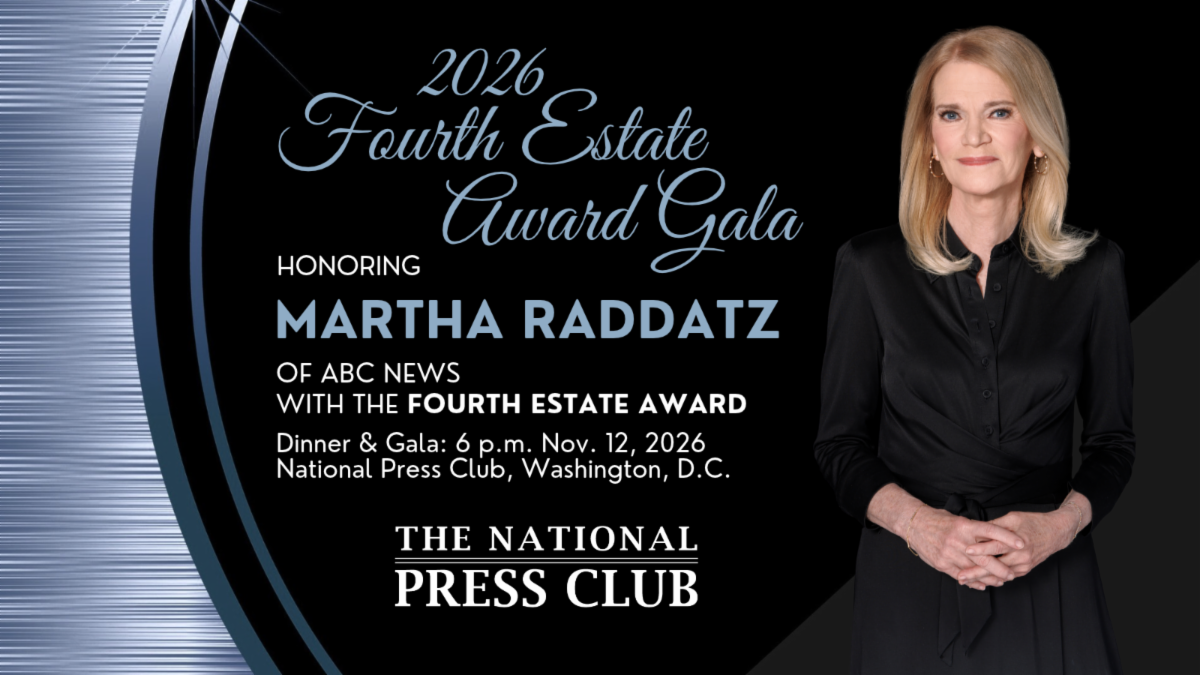
2026 Fourth Estate Award Gala honoring Martha Raddatz of ABC News. Nov. 12 at the National Press Club. Tickets on sale now.

Celebrate excellence in journalism at the 2026 Fourth Estate Award Gala


The National Press Club and the Institute will celebrate four honorees on Nov. 12 at the 2026 Fourth Estate Award Gala in Washington, D.C., recognizing work that ranges from war reporting to holding governments accountable.


🗓️ Thursday, Nov. 12 | ⏱️ 6 p.m. ET | 📍National Press Club | 🎟️ On sale now


✨ Martha Raddatz, ABC News – Fourth Estate Award

ABC’s chief global affairs correspondent and co-anchor of “This Week” will receive the Club’s highest honor. Raddatz has covered conflicts from Bosnia to Iraq and Afghanistan, where she embedded with U.S. forces on dozens of missions, and has reported on the bin Laden raid, operations against ISIS, and the wars in Ukraine and the Middle East. At home, she moderated the 2012 vice presidential debate, co-moderated multiple presidential debates, and reported from the Capitol during the Jan. 6, 2021, attack. She joins past recipients including Walter Cronkite, Gwen Ifill and Christiane Amanpour.


✨ The New York Times – John Aubuchon Press Freedom Award (Domestic)

The Times is being honored for the courage and institutional resolve essential to a free and independent press. The award is the Club’s highest press freedom honor and is named for a former National Press Club president who fervently advocated for press freedom. The Times follows last year’s domestic honoree, The Associated Press, which the Club recognized for defending press freedom and the right to speak freely without government retaliation. 


✨ José Rubén Zamora – John Aubuchon Press Freedom Award (International)

Zamora is the Guatemalan journalist who founded the daily elPeriódico. Jailed in 2022, he spent more than three years behind bars in proceedings marked by irregularities, constantly changing judges, and a brief release before he was sent back to prison in March 2025. He was released to house arrest in February 2026 after 1,295 days in detention, though press freedom groups warned he remained subject to restrictions and continued legal persecution. In September, he also received the Gabo Foundation’s Recognition of Excellence, with the foundation’s director calling him a paradigm of investigative journalism in Latin America. 


✨ Rebecca Ellis, Los Angeles Times – Neil and Susan Sheehan Award for Investigative Journalism

Ellis, a staff writer focused on government accountability, investigations and legal affairs, joined the Times in 2023 as a Los Angeles County government reporter. She previously covered city politics, housing, homelessness and policing for Oregon Public Broadcasting, worked the Miami Herald’s metro desk, and was a Kroc fellow at NPR. Her series “Decades of Abuse” was a 2024 finalist for local reporting in awards administered by the University of Michigan’s Wallace House. 

Can’t make it to D.C.? You can still support the mission. The gala raises money for the Institute, which promotes press freedom and First Amendment values by equipping journalists with the skills, knowledge, standards, resources, and networks to empower and inform the public. A donation today helps make sure journalists can keep doing their jobs freely and safely. 


Want your newsroom to stand behind this work? Sponsor the gala. Sponsorship is a way for news organizations, journalism nonprofits and media companies to put their name behind press freedom and the training that keeps reporters safe and effective. Sponsors support the Institute’s programs while being recognized alongside this year’s honorees. If your organization might be interested, email us at npcgala@press.org.

Resources


This newsletter is written and edited by the National Press Club Journalism Institute staff. Send us your questions and suggestions for topics to cover.


Get this from a friend? Subscribe and view the archives.

Bluesky  Instagram  Facebook  Linkedin  X  Youtube

DONATE TO THE INSTITUTE


The National Press Club Journalism Institute promotes First Amendment values by equipping journalists in Washington, D.C., and nationwide with the skills, knowledge, standards, resources and networks to empower and inform the public. As the non-profit affiliate of the National Press Club, the Institute powers journalism in the public interest. The Institute's tax ID number is 52-1750908.