Jan. 15, 2026

Top stories

■ Journalists confront new reality in reporting after FBI raid (Washington Post) / Reporters Committee seeks judicial records of warrant served to search Washington Post reporter’s home (Deadline) / ‘Tip of the iceberg’: The FBI search of a reporter’s home has newsrooms bracing for more (CNN) / ‘The FBI’s disturbing raid on a Washington Post reporter ignited widespread outrage across journalism, but Jeff Bezos stayed conspicuously silent — angering some inside the newsroom’ (Status) / Jeff Bezos criticized by countless Washington Post readers amid silence on FBI raid: 'You hastened the death of democracy' (The Wrap) 


■ ‘Katie Pavlich, a longtime Fox News commentator who begins a 10 p.m. show on NewsNation on Monday, has a major booking on her second night: Donald Trump.’ (Jeremy Barr) / NewsNation’s Katie Pavlich on leaving Fox News, breaking into primetime and booking 50 Cent (The Wrap) 


■ ‘New York Attorney General Letitia James filed an amicus brief supporting the New York Times in its lawsuit against the Defense Department, saying that military families in her state have been "deprived of critical information" since reporters have left the Pentagon.’ (Scott Nover) / Defense Department to overhaul military newspaper Stars and Stripes (POLITICO) 


■ ‘In clips from Minneapolis, the city looks like it's under military occupation. Almost every TV segment features viral video footage of ICE. Almost every article cites the footage too.’ (Brian Stelter) / Journalism theater project tells Chicago 'Sanctuary Stories' amid immigration crackdowns (Block Club Chicago) / 'Sloppy': Journalist who went through ICE's hiring process details experience to CNN (CNN)


■ Judge dismisses pending CPB lawsuits as corporation dissolves (Current) 


■ Warner Discovery doesn’t need to disclose Netflix deal details soon, judge rules (Wall Street Journal) / David Ellison's Paramount suffers a setback in its legal fight with Warner Bros. Discovery (Business Insider) 


■ McClatchy Media accuses Google in federal court of monopolizing online ad sales (Miami Herald)


■ Newsom plans no new journalism funding despite $175 million funding deal with Google (CalMatters) 


■ USA TODAY Network launches TODAY Californian (USA TODAY)


■ Trib Total Media announces expansion, new weekend publication (WTAE-TV) / Trib expands to fill Pittsburgh’s newspaper void (Trib Total Media)


■ WOUB cuts six positions, plans for less support from university (Current)  


■ POLITICO’s John Harris moves into chairman role, search begins for new editor in chief (The Wrap) / Ex-Washington Post opinion editor David Shipley joins The New York Times as editor at large (The Wrap) / FOX News Media announces executive promotions (FOX News) / Evan Smith joins The Atlantic as managing director for events (The Atlantic) / FOX Weather signs meteorologist Melanie Black (FOX News)


■ Fort Worth Report journalists, staff announce union organizing campaign (The NewsGuild)

CRAFT

How journalists can protect their sources amidst press freedom concerns


By Holly Butcher Grant


On Wednesday, FBI agents searched the home of a Washington Post reporter during an investigation into the disclosure of classified information, sparking significant press freedom concerns across the industry and country. 


As news outlets like the New York Times noted, it is “exceedingly rare” for federal agents to search a journalist’s home. Under the Privacy Protection Act of 1980, journalists are generally safe from search warrants for their work product or documentary materials — unless they are suspected of committing a crime related to them. 


In this instance, reporter Hannah Natanson was not a target of the investigation; FBI agents were seeking information related to a government contractor. As the Post's “federal government whisperer,” Natanson covers how the Trump administration is reshaping the federal government, interviewing more than a thousand sources comprising current or former federal employees. 


Press freedom advocates worry that this raid will have a chilling effect on accountability reporting and might silence whistleblowers. (Go deeper: See how government officials are using the Espionage Act to target leakers and whistleblowers, and what journalists can do.) 


To help navigate these press freedom concerns, the Institute reached out to two journalists with extensive experience covering the government. Here are their tips for protecting sources in this political climate. 


Miranda Spivack, investigative journalist and author: 


“Keep sensitive documents, interview information, transcripts, and contact information offline. Consider using a thumb drive to store this info and then keep that out of your home and office — but have a quick way to get access when needed.


Think hard about what you are saying on social media before posting. Draft a post and then wait for 30 minutes, if possible, so you have time to think through the risks. Also, remember to regularly delete your browsing history.  


For messaging, use Signal, whose metadata retention is relatively limited. And be sure that your sources understand you will do all you can to protect them, but that they still could be at risk. Ask them how they might handle a breach of confidentiality, due to an encounter like what happened to Natanson.”


Steve Herman, executive director of the Jordan Center for Journalism Advocacy and Innovation; assistant professor of practice in the School of Journalism & New Media at the University of Mississippi; and former chief national correspondent at Voice of America: 


“Having reported from dozens of countries with various levels of surveillance, I’ve found that the safest method for interacting with sources who would face the most jeopardy if exposed is to meet in person and cover your tracks. 


When it was time to arrange for it, I would sometimes use an intermediary for an extra layer of protection in exchanging messages. But no method is full-proof. I always assume the best spyware, such as Pegasus or whatever the NSA has concocted, can read and hear everything on a cell phone or laptop, no matter the encrypted messaging app.”


Additional resources:


CAREER
 
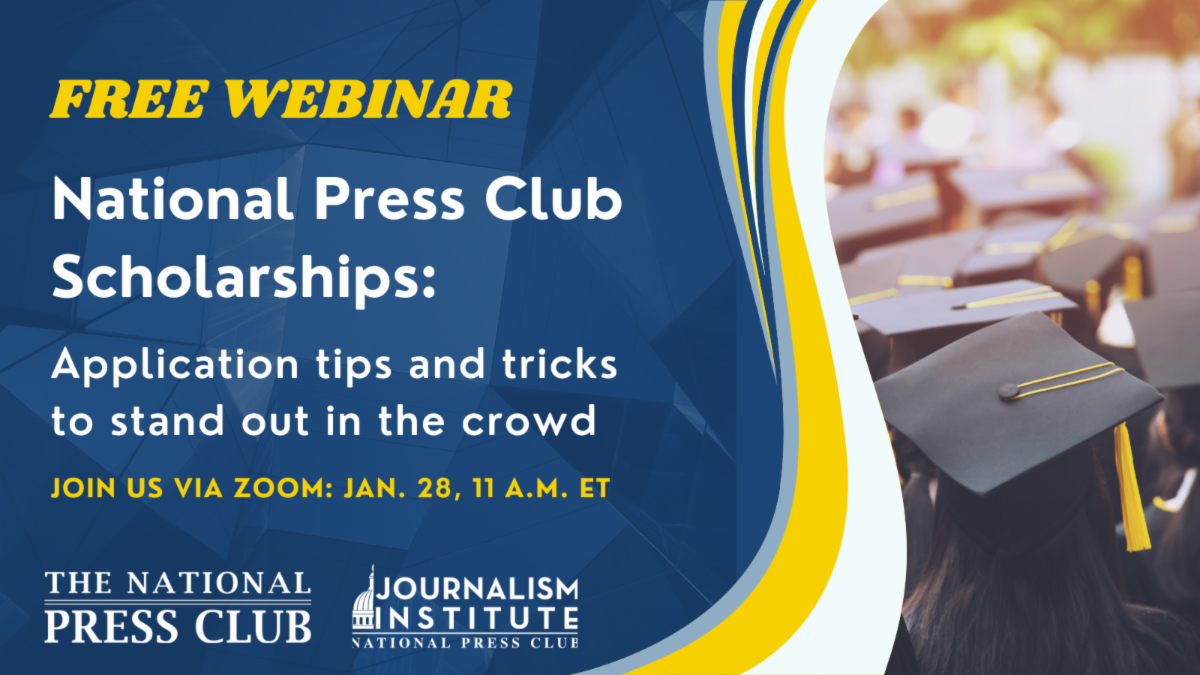
Free webinar on National Press Club scholarship application tips and tricks Join us over Zoom at 11 am ET on January 28

National Press Club Scholarships: Application tips and tricks to stand out in the crowd


Each year, the National Press Club awards more than $30,000 in funding to student journalists at the high school, college, and graduate levels. But with hundreds of applicants competing for six opportunities, how can students stand out in the crowd?


Join the Institute from 11 a.m. to noon ET on Wednesday, Jan. 28, for an inside look at what makes an application exceptional. The session will take place via Zoom; registration is open.

We’ll cover scholarship application dos and don’ts, including advice on developing strong essay responses, selecting stellar work samples, and choosing the right individuals for a letter of recommendation. You’ll also have plenty of opportunity to ask questions about the application process, eligibility requirements, and selection timeline. 


2026 National Press Club scholarship opportunities include:


  • The Scholarship for Journalism Diversity Honoring Julie Schoo is a $5,000 scholarship awarded to a high school senior. The award can be renewed for up to three years at $5,000 per year. 
  • The Richard G. Zimmerman Scholarship is a one-time scholarship of $5,000 to support a high school senior who wishes to pursue a career in journalism. 
  • The Wes Vernon Broadcast Scholarship supports diversity within broadcast journalism. The scholarship is $5,000 awarded to a student who demonstrates a commitment to a career in broadcast journalism. The award can be renewed for up to three years.  
  • The Lewis Scholarship provides housing and a monthly stipend to support student journalists of color with newsroom internships in Washington, D.C., during the summer semester.
  • The Dennis and Shirley Feldman Fellowship recognizes a journalism graduate student with a one-time scholarship of $5,000.
  • New this year: The Rich Passan Sports Writing Scholarship is a $5,000 award supporting undergraduate college juniors or seniors who demonstrate excellence and promise in sports journalism.


All applications are due on Sunday, March 1, at 11:59 p.m. ET. (You can apply using this link.)


We hope you’ll attend even if you’re unsure about applying for an NPC scholarship. The tips and tools shared will help with any application you have on your radar.


COMMUNITY

Resources

This newsletter is written and edited by the National Press Club Journalism Institute staff: Beth Francesco, Holly Butcher Grant, and Elliot C. Williams. Send us your questions and suggestions for topics to cover.


Get this from a friend? Subscribe and view the archives.

Facebook  X  Linkedin  Youtube  

DONATE TO THE INSTITUTE


The National Press Club Journalism Institute promotes an engaged global citizenry through an independent and free press, and equips journalists with skills and standards to inform the public in ways that inspire a more representative democracy. As the non-profit affiliate of the National Press Club, the Institute powers journalism in the public interest. The Institute's tax ID number is 52-1750908.