July 20, 2026

Top stories

■ Officials sought phone records of NYT journalists and their relatives in effort to unmask sources (Associated Press) / A US judge granted NYT temporary reprieve from Trump admin subpoenas targeting three reporters, ahead of a July 23 hearing over confidential sources (Status)


■ The Pentagon avoids questions as the US war with Iran escalates (CNN) / ICYMI: Appeals court keeps Pentagon’s escort policy for journalists in place (Washington Post) 


■ Paramount Skydance’s $110B merger with Warner Bros. Discovery paused by judge (Washington Post) / ‘The 14-day restraining order prohibits the companies from closing the deal as a dozen states challenge it.’ (Wall Street Journal) / California AG Rob Bonta says a CNN spin-off wouldn’t resolve Paramount–WBD lawsuit (CNN) / ICYMI: Paramount weighs leaving California over Warner Bros. rift (Semafor) 


■ ‘Judge grants The Guardian's motion to dismiss in defamation claim vs. United Healthcare’ (Ben Mullin)


■ China warns of reciprocal countermeasures after US shortens foreign journalist visas (Associated Press) / ICYMI: Statement on DHS rules restricting visas for foreign journalists (National Press Club)


■ How 2 exiled Russian journalists took refuge in the Bay Area (KQED) 


■ 2 of Georgia’s oldest newspapers acquired, will increase local coverage (Atlanta Journal-Constitution)


■ Taney County newspaper suddenly closes, employees say they’re waiting for pay (KY3)


■ Former CPB exec launches consultancy, NPR reporters leave after workforce reduction (Current) / POLITICO names Adam Wren, Dasha Burns and Will Steakin Playbook co-authors (POLITICO) / Jennifer Amur is joining the National desk (New York Times) / Wagner named Big Tech team leader at Bloomberg (Talking Biz News) / Two more Knoxville TV reporters are leaving, including another at WBIR (Knoxville News Sentinel) 


■ A car crash nearly killed ESPN’s Matt Miller. Then came the fraud allegations. (The Athletic) 


■ The little outlet that could: How BINJE got most requested media credential on globe (BINJE) / Newsletters, live coverage, a one-time magazine: The World Cup is becoming a testbed for journalism experiments (Nieman Journalism Lab) / Breakout Fox broadcaster quits after just one World Cup (Daily Beast) / 2030 World Cup media rights race already taking shape (Front Office Sports)

Pamela Tobey Award for Excellence in Visual Storytelling 1000 dollar prize Apply now

Applications are open until 11:59 p.m. ET today, July 20, for the 2026 Pamela Tobey Award for Excellence in Visual Storytelling. This annual design award recognizes visual journalism that pushes the boundaries of storytelling beyond text and rewards creative uses of data visualization, interactivity, photography, videography, audio, illustration, and emerging tools. It includes a $1,000 prize and national recognition from the National Press Club Journalism Institute.

CRAFT
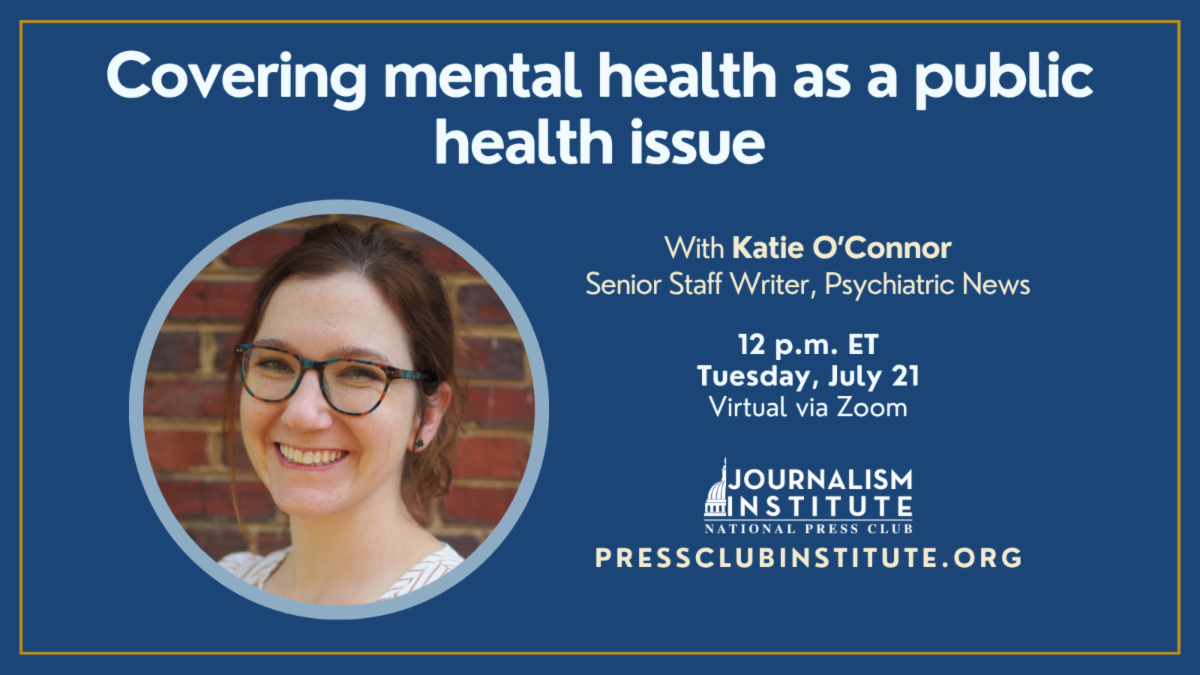
Public Health Journalism: Covering mental health as a public health issue. July 21, noon ET.

TOMORROW: Covering mental health as a public health issue


Mental health and substance use are important yet challenging topics on the health beat.


Where can journalists find reliable data? Which sources actually know the policy landscape? How do you translate dense clinical studies into stories readers understand?


Join the Institute tomorrow for a free webinar with Katie O'Connor, senior staff writer at Psychiatric News, who covers mental health advocacy and public policy.


🗓️ Tuesday, July 21 | ⏰ Noon ET | 📍Zoom


O'Connor will break down:


Whether mental health is your full-time beat or an occasional assignment, this session will leave you with concrete tools and contacts for your next story.

This program is part of the NPCJI’s monthly webinar series produced through its Public Health Reporting Fellowship. In partnership with the Common Health Coalition, the fellowship offers training and financial support for mid-career journalists to complete reporting projects focused on the intersection of public health policy and health care delivery.

CAREER


AI use policies for newsrooms


“All newsrooms should get on the record about how they are (or are not) using AI. One way to do that is in an AI use policy. At Trusting News, we believe your AI policy should be a living document that changes as your use of the technology evolves. If your newsroom is wary of publishing new policies, or if the approval process would be cumbersome, consider other ways to get this information to your audience. An editor’s column or an FAQ can be a less formal way to share your process. Picture a headline like ‘How our newsroom is exploring AI in our work.’ Use language like ‘we’re asking questions’ or ‘we’re exploring.’ Say ‘we typically’ or ‘we won’t usually’ rather than ‘we always’ or ‘we never.’ ”


-- Lynn Walsh, assistant director at Trusting News “Explain how you use (or don't use) AI” (Trusting News)


COMMUNITY

How Montgomery County student journalists are pushing back against a restrictive district policy


By Alyssa Rim, NPCJI Intern


When Ian Chen, a rising junior at Richard Montgomery High School in Rockville, Md., caught wind of a new policy proposed in his school county, it immediately struck him as absurd. 


“The memo contradicted everything I had been learning in journalism class,” Chen said. “There are laws, especially here in Maryland, that protect [student journalists].” 


The policy described in a memorandum circulated by Dr. Peter Moran, chief of Montgomery County Public Schools, instructs administrators to review every student publication and all school-related printed materials before publishing.


“While student editors and publication advisors engage in the initial rounds of editing, a school administrator must review the final draft of any printed items (publications, clothing, etc.) before printing or publication,” Moran writes in the memo, obtained by the Student Press Law Center, a non-profit organization dedicated to protecting press freedom rights for student journalists. 


Ironically, Maryland is among 18 states with New Voices legislation protecting student press freedom. Signed in April 2016 by former Governor Larry Hogan, the Maryland New Voices Act ensures student journalists have final authority over school-sponsored media content. Moran’s memo threatens this legal precedent, students and faculty advisers from all 25 MCPS schools argue in an open letter and online petition that’s collected nearly 800 signatures in support.


“There are a lot of important stories we published in the past that, under this new policy, could certainly be subject to prior restraint and not even published,” said Seva Gandhi, a rising senior and the online editor-in-chief of The Black and White, the student publication at Walt Whitman High School in Bethesda, Md.


Historically, The Black and White has reported on sensitive issues like drug abuse, racism, and sexual assault within the halls of Walt Whitman High School, including stories that hinged on the words of anonymous whistleblowers. Administrators are now also responsible for checking “language that implies wrongdoing without verification,” meaning stories that include information from anonymous sources are most likely to be flagged.


“We have a very intensive editing process, so we’re not in any circumstance going to publish something that could be potentially inappropriate,” Annabel Taylor, a rising senior and print editor-in-chief of The Black and White, said.


In response to the district’s memo, The Black and White wrote their own open letter to the Montgomery County Board of Education. Chen, an editor of his own school’s newspaper, The Tide, spearheaded a separate countywide open letter signed by more than 160 student journalists and faculty members. 


The letter, a collaborative effort between MCPS student journalists and their advisers, outlines what Maryland law states, what the students and staff are asking for, and why their cause matters. It also critiques Moran’s memo for its vague language, which creates “an inconsistent patchwork of enforcement, where student journalists’ rights depend on which principal happens to review their work.”


According to a statement from MCPS Superintendent Thomas Taylor, the district has had cases where “inappropriate content” was printed in school yearbooks and other publications, “resulting in substantial disruption to school operations and community hurt,” hence the new policy.


Taylor’s statement refers to the students’ concerns about censoring as “misperceptions about the role of school leadership in supervising student publications” and states that nothing in the memo impedes student journalism or imposes prior restraint.


“We believe it’s shamelessly false, and I think several national press rights organizations agree with us,” Chen said in response to Taylor’s claims. The students’ cause and their petition are also endorsed by multiple candidates for the Board of Education District 3. (Read on to learn more about the MCPS Board of Education meeting on June 25.)


The student journalists the Institute spoke to have not yet felt the effects of this policy in their schools, as the policy’s enforcement varies by administrator. Their concern is for the policy’s potential and how it could be interpreted and enforced. 


“Student journalism is kind of a microcosm of what’s going on at a national scale, and when we’re seeing students be censored, it sets a precedent for other publications,” said Gandhi, The Black and White’s online editor. “We’re uniquely situated to report on things other publications can’t, and this policy threatens the core of what student journalism is all about: holding people accountable.”

Resources

This newsletter is written and edited by the National Press Club Journalism Institute staff. Send us your questions and suggestions for topics to cover.


Get this from a friend? Subscribe and view the archives.

Bluesky  Facebook  Linkedin  X  Youtube

DONATE TO THE INSTITUTE


The National Press Club Journalism Institute promotes First Amendment values by equipping journalists in Washington, D.C., and nationwide with the skills, knowledge, standards, resources and networks to empower and inform the public. As the non-profit affiliate of the National Press Club, the Institute powers journalism in the public interest. The Institute's tax ID number is 52-1750908.